
Five parts make one connection path
A tool capture hood connects through a labelled port, two-ended adapter, hose and extractor inlet; separate gates below show mechanical fit, capture and material permission.
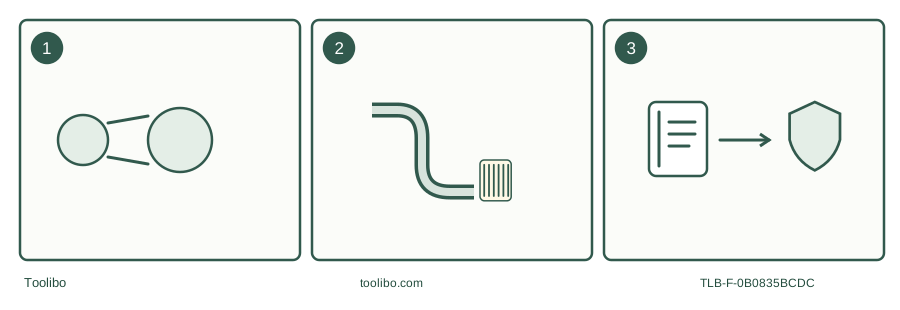
Identify
Record both endpoints and part codes
Fit
Check lock, seal and free movement
Verify
Check capture and task permission separately
A correct adapter solves a connection, not every extraction requirement.
Draw the connection before ordering
Make a simple line with five boxes: tool’s capture point, tool-side port, adapter, hose and extractor inlet. Write the exact model or part number below every component you already own. This separates a missing adapter from a missing capture hood or an unsuitable machine. Buying a connector cannot solve all three problems.
If a tool uses a removable dust box, check whether the manufacturer describes an external extraction connection and how it replaces that box. Do not assume every opening is a hose socket. Also identify which end of an existing hose is intended for the tool; the vacuum-end coupling may use a completely different attachment system.
Check geometry, not just one diameter
Record whether a fitting goes inside, outside or locks onto the next part. A nominal hose size may describe the hose bore rather than the dimensions of its rigid cuff. Tapers, shoulders, clips and bayonet lugs can make two apparently similar connectors incompatible.
Swipe or scroll horizontally to see all columns.
| Connection detail | What to record | Why a photograph alone is insufficient |
|---|---|---|
| Tool port | Exact tool and port/adapter reference | Similar shells can hide different fittings |
| Adapter ends | Which end faces tool and hose | Inside and outside dimensions are not interchangeable |
| Retention | Clip, bayonet, taper or specified friction fit | A loose push fit can separate during movement |
| Sealing | Intended mating surfaces and condition | A joint may hold while still leaking |
| Hose routing | Working reach without tight bends or drag | A fit at rest may fail while the tool moves |
Measurements help ask a precise question, but they do not replace an approved compatibility list. Before buying a stepped adapter, check whether the manufacturer permits trimming it and which step applies. Do not cut a reusable part just because an online picture looks similar.
Keep capture and containment separate
HSE describes on-tool extraction as a coordinated system, not simply a vacuum at the end of a tube. Its guidance also favours a proper adapter rather than tape for the tool connection. Treat the mechanical check as one gate. A second gate is whether the tool captures dust effectively at the working surface. A third is whether the extractor and its collection configuration suit the actual substance.
For example, an adapter supplied with a household vacuum demonstrates a possible connection, not permission for all sanding or drilling dust. Bosch’s UniversalVac 15 / AdvancedVac 20 manual limits intended pickup to non-hazardous material. A physically successful connection must not erase that boundary.
Dry-fit with both machines isolated
Follow each manufacturer’s isolation instructions before assembly. Check that the cuff is fully seated, the intended lock engages and the joint is not cracked or distorted. Move the unpowered tool through its expected working range while supporting the hose. The hose should not pull the tool off line, block a control or drag across an edge that could damage it.
Position the extractor so the route is short and orderly without obstructing access. Avoid solving a reach problem by adding an unverified chain of reducers and extensions. If the specified connection does not fit as documented, stop and confirm the part number rather than forcing it or filing away a locking feature.
Verify function only on an already permitted task
Once the material and equipment have been cleared for use, follow the prescribed startup sequence and check the machine’s indicators. An attached hose, motor noise and a clean-looking surface are not measurements of exposure. Visible dust escape, a loose connection or an airflow warning means stop and investigate according to the manuals.
Record the successful combination as a small compatibility card: tool, adapter, hose, extractor, collection configuration and task. Include photographs of the assembled external joints if useful. That record saves repeat purchases and prevents a later user from assuming the same adapter proves compatibility with a different tool, material or regional machine version.