
Check the working state
Dry layers: Paper bag plus textile prefilter around main cartridge.; Wet layers: Paper bag and textile prefilter out; clean cartridge stays.; Capacity: 15 L gross is distinct from 8.5 L net liquid; stop at float response.
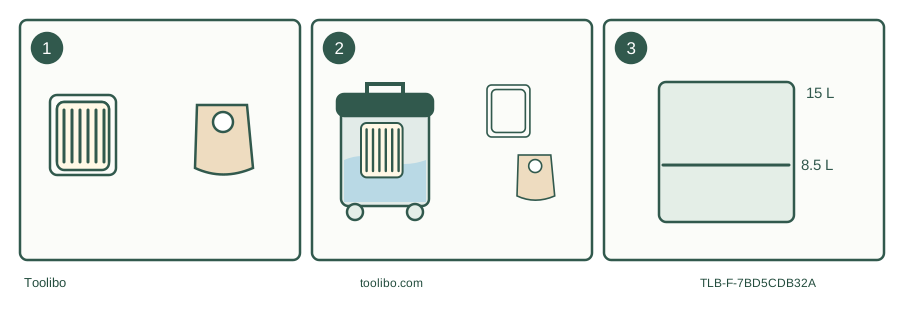
Dry layers
Paper bag plus textile prefilter around main cartridge.
Wet layers
Paper bag and textile prefilter out; clean cartridge stays.
Capacity
15 L gross is distinct from 8.5 L net liquid; stop at float response.
An original decision aid. Isolate power before opening, changing filters or emptying.
Identify the UK package and its limits
UniversalVac 15, order 06033D1170, is the UK corded Home & Garden wet/dry vacuum covered here. The common manual calls its tool family 3 603 CD1 1..; that is a type-family identifier, not an alternative retail order number. Match both the model and the actual rating plate when choosing service parts. The related AdvancedVac 20 has different controls and a drain; do not look for those features on this machine.
The container is 15 litres gross, while the manual lists 8.5 litres net liquid volume and an 11.8-litre dust-bag volume. Those numbers answer different questions. They are not interchangeable fill targets. Plan a route to empty the tank before starting a water job, rather than discovering that a full container is too awkward to carry through a doorway.
Understand the three filtering pieces
The paper dust bag sits at the container inlet. The textile prefilter fits around the main cartridge, and the cartridge protects the air path above the collected material. Recognising all three prevents the common mistake of taking out only the paper bag and assuming wet setup is complete.
For dry work, use the correct intact, dry filter arrangement and fit an appropriate bag for cleaner collection of permitted dirt. Check that the bag collar is seated, the head catches are closed and the hose is in the suction connection. The supplied 2.2 m hose and 35 mm tubes are for reach; they are not handles for pulling the machine around obstacles. Unwind the hose fully rather than operating with it wound around the head.
Make the wet changeover with power disconnected
Switch off and pull the plug before opening the catches. Remove the dust bag and the textile prefilter, empty the container and clean the main cartridge. Keep the cartridge installed, then refit the head and close the catches. Bosch’s “no filter change” description concerns the wet/dry cartridge; it does not cancel removal of the dry collection layers.
Use the appropriate floor-nozzle insert for the job, keep the bucket upright and keep electrical connections outside the liquid. This vacuum is for air-and-water mixtures, not continuous pumping. Do not immerse the cleaner, leave it unattended or use a wet-pickup capability as permission to enter an electrically unsafe flooded area. A larger hose or a second bag cannot increase the specified liquid capacity.
Respond to the float, foam and sudden loss of pickup
The float reduces suction when the maximum fill level is reached. Stop the machine immediately, disconnect electricity and empty the container. Do not wait for an automatic motor shutdown; the useful signal is the loss of pickup, not proof that the plug has become safe to handle in water.
If foam or water escapes, stop immediately as well. A partly full tank can still foam, so the amount of visible water is not a reliable reason to continue. Inspect the float routinely for contamination and damage. If it is sticking or damaged, do not tape it open or remove it to regain suction. A normal restart is appropriate only after the cause has been resolved and the equipment is sound.
Dry it before returning to dust
After wet use, remove the head and let it dry thoroughly in a safe place. Remove the main filter as directed and allow it to dry too. Do not trap residual moisture inside a closed bucket with a new paper bag. Drying prevents the next load from turning into paste and avoids leaving a damp enclosed container between jobs.
For ordinary dry filter cleaning, the manual specifies removing and tapping the textile filter and cleaning cartridge pleats with a soft brush. Replace damaged filtration immediately. Do not generalise washing instructions from another brand. Keep the head’s ventilation openings clear without opening the electrical housing or spraying water into it.
Use the numbers and tool adapter carefully
Bosch lists 1,000 W electrical input, 65 l/s maximum turbine airflow and 240 mbar maximum turbine vacuum. The last two are turbine figures, not guaranteed airflow and pressure simultaneously at the floor nozzle. A blocked hose or loaded filter changes actual pickup; it does not mean the motor suddenly lost its nameplate wattage.
The tool adapter gives a physical connection, not hazardous-dust certification or automatic start/stop. This household model must not collect harmful dust, hot or burning material, explosive dust, petrol, oil, alcohol or solvents. This guide does not authorize flour, cement, asbestos or lead-dust cleanup. If the material is uncertain, stop and identify the required collection method first.
For weak suction, unplug and check hose, tubes, nozzle, head seating, bag and filter. Damaged cables, repeated thermal trips, leakage or persistent faults require qualified service. A blockage check is an owner task; opening the motor or modifying protection is not.
Models referenced