
Three ratings must remain separate
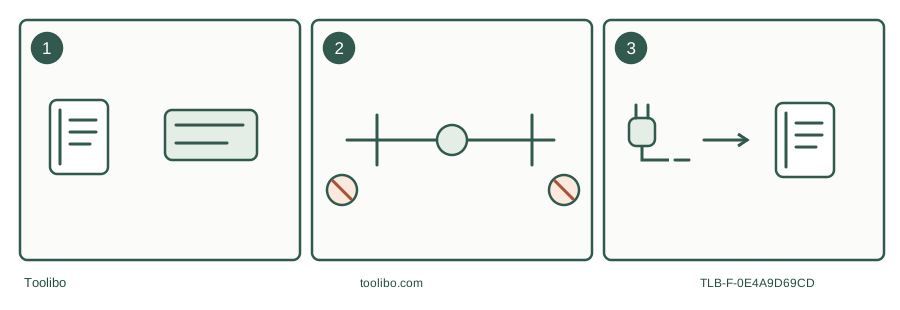
Three labelled blocks show vacuum input, connected-tool socket range and supply arrangement; a regional example branches a hypothetical 1900-watt tool into UK rejected and EU/AUS further checks required.
Identify
Read exact regional machine documentation
Compare
Check connected-tool minimum and maximum
Confirm
Verify supply and safe operating sequence
Passing a socket-load comparison is only one check; it does not approve the complete electrical arrangement.
One socket, three different numbers
An auto-start outlet lets a compatible connected tool trigger the extractor. It is convenient, but its presence does not mean every tool that physically plugs in is permitted. Start by separating three pieces of information that listings often place close together: the vacuum’s own rated input, the permitted connected-tool load, and the capacity and conditions of the electrical supply.
The first describes the vacuum. The second constrains the appliance you may connect to its outlet. The third concerns the complete powered arrangement. Do not take the largest number on the product page as a universal allowance, and do not assume the outlet limit already proves your wall circuit is suitable.
Swipe or scroll horizontally to see all columns.
| Number or condition | Where to verify it | What it answers |
|---|---|---|
| Vacuum rated input | Exact machine label and manual | What the vacuum itself is rated to draw |
| Outlet minimum and maximum tool load | Regional outlet table or marking | Which connected tool loads the function permits |
| Supply and cord requirements | Both manuals and local installation information | Whether the complete arrangement is suitable |
If one of these is missing, get the correct documentation rather than borrowing a figure from another country or another model in the same range.
A regional example that changes the answer
For the AdvancedVac 20 in Bosch manual revision 1 609 92A 7UL, the 220–240 V automatic-start table gives a connected-tool range of 100–2000 W for EU/AUS and 100–1800 W for the UK. These are connected-tool limits, not interchangeable worldwide specifications.
Consider a hypothetical tool labelled 1900 W. Its stated load is within the EU/AUS table’s upper figure but above the UK figure. That comparison alone therefore rejects the UK pairing; it does not fully approve the EU/AUS installation. The supply arrangement and all other manufacturer conditions still need checking. A tool below the listed minimum likewise should not be assumed to trigger the function reliably merely because its plug fits.
Keep the table revision and regional machine identification together when saving your setup. A marketplace description copied from another version can look plausible while giving the wrong answer for the unit in front of you.
Do not turn the example into a circuit-sizing recipe
Read the actual rated input information for both machines. A tool’s battery voltage, advertised output power or peak marketing claim is not a substitute for the relevant electrical input specification. If the required information is unclear, ask the manufacturer or a qualified electrical professional about the proposed arrangement.
Do not use a guessed subtraction from a household fuse rating as permission to operate. Other loads, installation conditions, protective devices and manufacturer restrictions can matter. Avoid improvised chains of adapters and extension accessories. Where an extension is permitted, use the specified suitable equipment and conditions; this article does not supply a universal cable size or extension length.
Assemble with the equipment isolated
Follow both manuals for isolation and connection. Check cords, plugs and the outlet for damage, keep the controls accessible and verify that the work environment is permitted. The cited Bosch outlet is for dry conditions. A wet/dry vacuum designation does not override the socket’s separate restriction.
Confirm the switch positions and intended start/stop sequence before energizing the arrangement. Never use the extractor switch as the only guarantee that the connected tool cannot start. Before changing an abrasive, blade, adapter or hose, isolate each device as its own instructions require.
Understand the trigger and the stopping delay
In this Bosch example the extractor can continue for up to six seconds after the connected tool stops. Treat the documented delay as expected operation, not as proof of a stuck switch. Conversely, an unexpectedly running tool, a burning smell, damaged connection or protective-device trip is not something to investigate through repeated start attempts.
If automatic operation fails, stop and check the documented mode, permitted load range and connections while safely isolated. Do not bypass a protective device or replace a fuse with a higher rating to make the combination work. Seek service when the prescribed checks do not resolve the problem.
A cordless tool does not become an equivalent trigger by plugging its battery charger into the outlet. Where automatic extraction is wanted for cordless work, look for a manufacturer-supported remote or compatible control system. Otherwise, use the permitted manual operating sequence. Convenience is worthwhile only when the complete arrangement remains documented, predictable and easy to stop.