
Storage and transport
Three panels show draining before lifting, designated handle with secured hose and cable, and indoor dry storage with a separate drying filter notice.
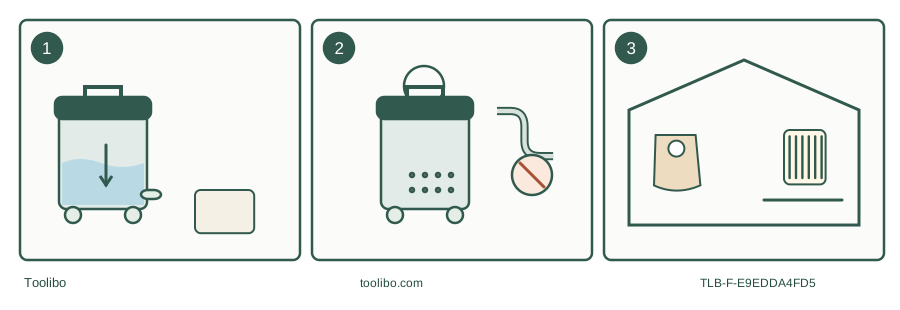
Empty
Remove liquid weight and dry the collection path.
Secure
Use the carry handle, not hose or cord.
Store
Choose indoor storage and identify the next mode.
Model-specific decision path; isolate power before opening or changing the collection system.
Separate a short pause from storage
Parking the nozzle for a few minutes is not the same as finishing the job. Before leaving the vacuum, switch it off and follow its unplugging requirements. For storage or transport, complete emptying and care first. Do not leave an ordinary vacuum running unattended, even if the nozzle is parked neatly in a holder.
This guide concerns known permitted household debris and clean water. A machine containing unknown or hazardous material must not be opened, transported through a home or treated as routine clean equipment without an appropriate handling decision. Label the unresolved contents and get suitable advice rather than hiding the problem under the lid.
Remove the weight and the moisture
Switch off and unplug in a dry safe location. Empty the tank or bag using the appropriate route for its contents. RIDGID HD12000 manual SP7160 (04/24) warns against lifting a vacuum heavy with liquid or debris; reduce the load before trying to carry it. The tank’s nominal volume says nothing about whether you can safely lift its current contents.
After clean-water pickup, drain the hose and clean permitted components. Fully dry the filter before storage or dry work as its manual requires. Kärcher WD 4 manual 59510240 also directs users to rinse the container and accessories as necessary and dry them before reuse. Closing wet parts together and forgetting them is a poor preparation for the next task.
Use the intended storage points
The documented HD12000 stores its cord around the designated carry handle/cord wrap, its hose around the head using the hose clips, and accessories at the caster-foot posts. The WD 4 has its own hose collar and storage locations. Match the actual diagram rather than copying a photograph of another version.
Keep bends gentle and avoid pinching the cable under the head or a wheel. Do not wrap the cord tightly around a hot motor housing or drag the plug on the ground. Secure detachable nozzles so they will not fall when the machine is lifted. A storage post, hose clip or nozzle parking notch is not automatically designed to carry the machine’s weight.
Swipe or scroll horizontally to see all columns.
| Before the move | Ready condition | Do not proceed with |
|---|---|---|
| Contents | Empty or safely reduced load | Heavy sloshing tank or unknown residue |
| Components | Correctly seated head, sound latches and handle | Broken retention or loose head |
| Cable and hose | Secured without pinch or tension | Trailing lead caught around an object |
| Route | Dry, clear and manageable | Steps or obstacles requiring an unsafe lift |
Carry by the proper handle and plan the route
Check the manual’s lifting arrangement and the actual handle condition. Do not use the power cord or suction hose as a carry handle. On a level clear floor, move the machine without allowing the wheels to run over its cable. At a threshold or stair, stop and choose a controlled method instead of jerking the hose until the tank follows.
Consider the empty machine’s weight and your ability to handle it. Remove only accessories that the manual permits you to remove, and secure them separately if that makes the move easier. Do not improvise a lift from the motor head when the latches or handle attachment are damaged. A second person can help with a suitable load, but cannot make a defective lifting point sound.
Choose a dry place that suits the manual
The documented WD 4 must be stored in a dry frost-proof room and protected from rain; its instructions reject outdoor storage. The HD12000 also requires indoor storage. These are named examples, not a temperature specification for every vacuum. Check the actual machine and any battery or charger instructions where applicable.
Place the unit where it cannot roll into a walkway, be struck by a vehicle or be climbed on by a child. Keep replacement filters and dry bags protected from moisture and crushing. If transporting in a vehicle, empty and dry the collection parts, keep the machine upright and restrained against movement using a suitable vehicle-loading method, and do not assume the accessory clips are tie-down anchors.
Leave the next operating state clear
Keep the manual reference and consumable part numbers with the machine. A simple note saying “dry filter fitted” or “filter drying; do not use” prevents a rushed next user from guessing. Before the next start, recheck the cable, latches and filter rather than assuming storage guaranteed their condition.
Do not store a wet electrical head as if drying alone certifies it safe. Water ingress, a damaged lead, cracked tank or loose handle needs service advice. Good storage leaves an empty, dry, mechanically sound machine with its next mode identifiable.