
Prevent tank odours
Three panels trace odour-prone retained water in hose and tank recess, separated approved parts drying, and clean dry storage with burning-smell route excluded.
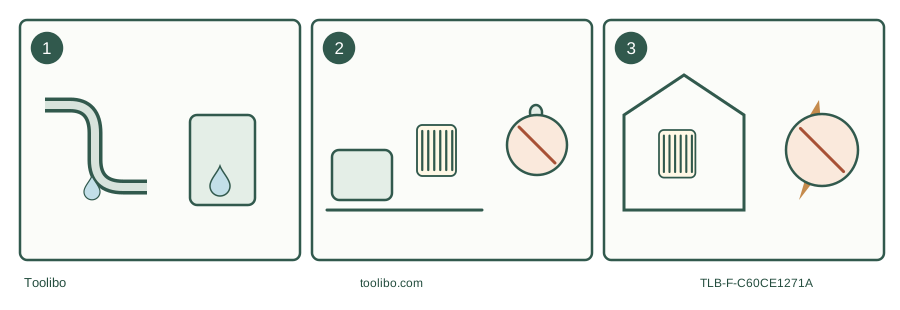
Remove
Empty known routine residues promptly.
Dry
Drain hose low points and dry permitted components.
Prevent
Store clean and dry; persistent or burning smells need help.
Model-specific decision path; isolate power before opening or changing the collection system.
Decide whether the smell belongs to routine care
A stale smell noticed when opening a tank after a known clean-water or ordinary household-debris task can point to retained residue or moisture. It does not establish a microbiological diagnosis. A burning, electrical, solvent or fuel smell is different: stop using the machine and follow the appropriate fault or hazardous-material route rather than attempting to deodorize it.
This article does not cover sewage, animal waste, rodent contamination, mould remediation or an unknown previous load. Do not open a suspect contaminated filter for household washing. Nor should you deliberately inhale close to the exhaust or tank to identify a substance. Use the known task history and visible condition, not a smell test, to decide whether routine care is appropriate.
Remove the contents before they become a storage problem
Switch off and unplug safely before opening the collection system. Empty known ordinary debris or clean water through the correct route. A collection bag is not a long-term rubbish bin, and the bottom of a wet tank is not an appropriate place to leave residue until the next weekend. Dispose of the actual contents according to local arrangements rather than pouring an unidentified mixture down a drain.
Check the bag’s condition as well as its apparent fullness. A disposable dry bag that became wet or damaged should not be dried and reused as a fresh consumable. Replace it with a compatible approved bag when returning to dry work. Keep the required main filter in the system; removing filtration is not a solution to odour or slow airflow.
Follow the residue around the entire path
Water and routine debris can remain in the hose low point, nozzle channel, tank recess or filter folds after the central bucket looks empty. With power isolated, separate the owner-removable parts as the manual allows and inspect these accessible areas. Do not dismantle the motor housing or probe internal electrical passages to hunt for the smell.
Swipe or scroll horizontally to see all columns.
| Location | Routine-care question | Appropriate action |
|---|---|---|
| Tank bottom and rim | Any known residue or standing water? | Empty and clean by the approved method |
| Hose and nozzle | Does trapped water drain from a low point? | Drain, clean permitted parts and dry |
| Filter | Correct part, clean enough and fully dry? | Follow its specific care or replacement instructions |
| Electrical head | Burning smell or possible water ingress? | Stop routine care and seek service |
Clean permitted parts without inventing a disinfectant recipe
Kärcher WD 4 manual 59510240 permits rinsing the container and accessories with water as needed and drying them before reuse. It separately specifies how to clean the flat pleated filter. That is not permission to wash the assembled electrical head, pressure-wash the machine or soak every replacement filter in cleaner.
Use only products and methods approved for the actual component. Do not add perfume, essential oils, bleach, drain cleaner or mixed chemicals to the tank or filter as an improvised remedy. An attractive smell does not establish cleanliness, and a routine rinse is not a disinfection claim. If the history requires disinfection or hazardous decontamination, obtain an appropriate product-specific plan rather than adapting this guide.
Give moisture a way out before closing the machine
Dry the washable collection parts completely in a safe place. RIDGID HD12000 manual SP7160 (04/24) requires complete filter drying after wet use to avoid mildew and filter damage, and before storage or dry pickup. The endpoint is full drying, not simply a dry-feeling outer fold or an arbitrary short wait.
Keep removed parts protected from fresh dirt and children or pets while drying. Do not run the motor unattended as a dryer, use a heat gun, or place media in an oven. If regular use prevents adequate drying, keep an approved dry spare filter and a clear label distinguishing parts ready for use from those still drying.
Make the next cleanup less likely to repeat the problem
Before each job, identify what the machine is about to collect and choose the correct mode. After a wet job, include hose draining and filter care in the finish, not just pouring out the tank. Store indoors as the exact manual requires, with the collection system dry and the cord disconnected.
If an odour persists after allowed parts have been cleaned and fully dried, or returns immediately despite a known clean task, stop improvising and ask the manufacturer about affected hoses, filters, seals or service. Do not promise that replacing one part will solve an unverified cause. The practical result is a known-clean, dry collection path and a clear escalation when ordinary care is not enough.