
Three labels that must not be merged
Three separate boxes show peak motor claim, electrical input and air performance, with a stop mark between peak HP and outlet selection.
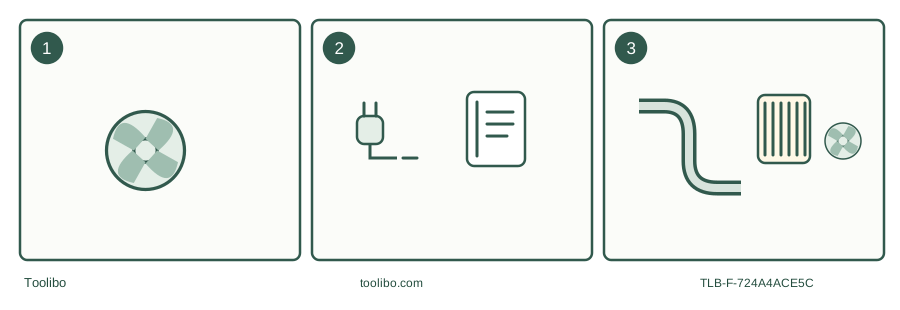
Motor
Keep peak and test conditions.
Supply
Read the regional nameplate and manual.
Air system
Compare matched performance conditions.
A motor headline, supply rating and air-system measurement are different comparison columns.
Keep three different measurements apart
Product pages often place peak horsepower, electrical watts or amperes, and airflow close together. They describe different things. Peak HP is a motor-performance claim under a stated method. Electrical input concerns what the appliance takes from its supply. Airflow and pressure describe aspects of its air-moving performance. None can simply stand in for the other two.
RIDGID’s Canadian HD1900 page explains that peak horsepower comes from laboratory motor testing using a dynamometer. Preserve the word peak when recording that figure. Do not rewrite it as continuous output, nozzle power or the electrical power the machine draws throughout a cleaning session. A brochure headline is not the supply label.
Use a three-column comparison instead of a single power ranking
Copy data without filling gaps by guesswork. Write the model and region above the table, because the same family name may be sold with different supply requirements.
Swipe or scroll horizontally to see all columns.
| Column | Copy from the matched documentation | Use it for |
|---|---|---|
| Motor claim | Exact wording, including peak and test qualifier | Understanding what the advertisement actually claims |
| Electrical input | Rated voltage, frequency, input current or watts as provided | Checking the stated supply and operating instructions |
| Working package | Air specifications with test conditions, hose and filter | Assessing the documented configuration for the permitted task |
If one machine lists peak HP and another lists watts, that is not yet a head-to-head comparison. Ask for equivalent data or leave the cell blank. A tidy-looking table with invented conversions is less useful than an honest table with a few unknowns.
Do not calculate an extension-cord choice from peak HP
The familiar horsepower-to-watt conversion does not transform a laboratory peak claim into the vacuum’s continuous electrical demand. Even an arithmetic conversion performed correctly answers the wrong question. Likewise, voltage multiplied by current is not automatically the appliance’s measured real power in every operating condition.
For supply arrangements, follow the exact regional nameplate and manual, including any extension-lead conditions and restrictions on using a tool outlet. If the vacuum has an automatic-start socket, that socket has its own permitted load and operating conditions. Do not subtract a guessed motor demand from a household outlet rating to invent a safe tool allowance. Unclear or unsuitable electrical arrangements need qualified advice, not a larger adapter.
A worked reading example, not a performance test
Imagine two shortlisted machines. One advertises a peak motor rating but gives no comparable nozzle airflow. The other lists electrical input and a hose airflow figure with a stated test method. You cannot conclude that the first is more powerful just because its headline number looks larger, or that the second is more efficient because its input number looks smaller.
Instead, check that both are suitable for the same material, then compare hose reach, usable capacity, included filtration, consumables and any performance measurements made under genuinely comparable conditions. If both meet the task, the practical difference might be emptying or storage rather than a motor headline. This example is a decision method, not evidence that a particular low-input model outperforms another.
Estimate running cost only from an appropriate energy assumption
For a rough cost illustration, a hypothetical appliance drawing a constant 1.0 kW for 30 minutes would consume 0.5 kWh. Multiply that by your applicable electricity price to estimate that interval’s cost. This is arithmetic using an explicitly assumed real-power input, not a calculation from peak HP and not a measured result for a named vacuum.
Actual use can vary with operating mode and duration. An authorised, appropriately rated measurement method may provide better information, but buying or installing test equipment is not necessary to choose a household vacuum. Keep filters, bags, batteries where relevant, and replacement parts in the ownership budget as well. The most useful power label is the one whose purpose you understand, not automatically the largest number on the box.