
Two quantities, one working system
Separate airflow and pressure lanes lead into a hose, nozzle and filter system; an incompatible-maxima multiplication is crossed out.
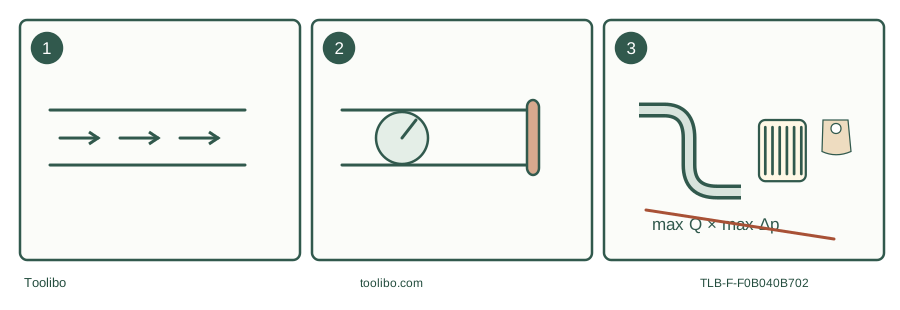
Flow
Volume moved per unit time.
Pressure
Pressure difference under stated conditions.
System
The working hose, filter and nozzle still matter.
A unit conversion preserves the test label; it does not create a comparable working measurement.
Give each number a name before ranking it
A vacuum needs moving air to carry material, and a pressure difference to drive that air through the working path. Airflow describes volume per unit time, often CFM, litres per second or cubic metres per hour. Suction pressure describes a pressure difference, sometimes expressed as water lift. They answer different questions, even when both sit in the same advertising panel.
Sealed suction is measured with a closed test condition. It is not the amount of air moving through an open working nozzle. The largest airflow figure also needs its test conditions: at the motor, at an inlet, or through a specified hose and filter. If the listing does not identify those conditions, retain that uncertainty rather than silently treating it as nozzle performance.
Put comparable units in one column
Unit conversion can make a table easier to read; it cannot make unlike tests comparable. One CFM is approximately 0.472 litres per second, while one litre per second is 3.6 cubic metres per hour. Keep the original label beside any conversion.
Swipe or scroll horizontally to see all columns.
| Published quantity | Useful question | What it does not establish |
|---|---|---|
| Maximum airflow | How much air was moved in the stated test? | Airflow at your loaded filter and nozzle |
| Sealed suction / water lift | What pressure difference was achieved under the test condition? | Ability to lift water continuously to that height |
| Air watts | What air-power result did the stated method produce? | A number obtained by multiplying unrelated maxima |
| Electrical input | What electrical demand is specified? | The useful air power at the cleaning surface |
For example, Shop-Vac item 5430097 lists 110 CFM as maximum airflow. Converting gives approximately 52 L/s. It remains a maximum listing figure, not a result measured with your nozzle. Do not compare that converted figure against another machine’s measured working-hose airflow without saying the conditions differ.
Do not manufacture a performance score
A tempting shortcut is to multiply the largest airflow by the largest pressure in a product listing. Those maxima may describe different points on the machine’s performance curve. A closed inlet can develop pressure while allowing no useful flow through that inlet. Treating both maxima as simultaneous creates an impressive but unsupported result.
Likewise, dividing airflow by price is only a ratio of a published number and a price. It omits filtration, collection suitability, consumables, usable capacity and test differences. It may help organise a personal shortlist after matching conditions, but it should not be presented as a tested cleaning-efficiency ranking.
Follow the actual working path
Consider the whole route from material to collection: nozzle, bends, hose, connections, container and filter. A narrow opening can collect small debris conveniently but can also be the first place larger material obstructs the path. An extra hose section adds reach and another connection; a loaded filter may change performance. None of these effects is quantified by a bare maximum-airflow label.
Start comparisons with the manufacturer-supplied or approved setup. Record any proposed extension or adapter separately. If you cannot establish compatibility and the task’s extraction requirements, do not assume a stronger motor will compensate. A hose conversion is not a substitute for a suitable dust-control system.
Make the spec sheet useful without pretending to test
Keep the original units, the test qualifier, the included hose size and length, and the filter configuration in your shortlist. Ask the manufacturer for missing measurement conditions if they would decide a purchase. Otherwise compare practical requirements that are actually known, such as storage dimensions or availability of the correct consumables.
After purchase, a careful permitted cleaning trial can reveal awkward reach or an obstructed nozzle, but it is not a certified airflow measurement. Never block the inlet to demonstrate strength, lift objects with suction, or improvise a water-lift rig. Diagnose poor pickup through the approved maintenance checks rather than trying to recreate a laboratory maximum at home.