
Check the working state
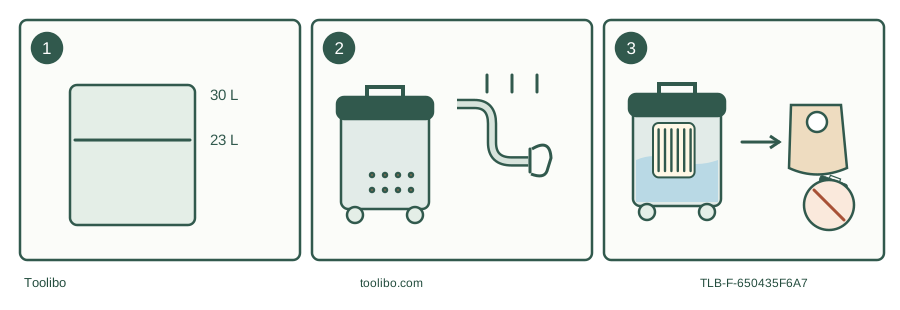
Identify: UK /2 version;30 L gross,23 L liquid; verify actual tool-socket rating.; Filter cleaning: Closed machine; palm-sealed hose and specified Push&Clean pulses.; Wet finish: Bag out, filter in, float checked; no transport while holding liquid.
Identify
UK /2 version;30 L gross,23 L liquid; verify actual tool-socket rating.
Filter cleaning
Closed machine; palm-sealed hose and specified Push&Clean pulses.
Wet finish
Bag out, filter in, float checked; no transport while holding liquid.
An original decision aid. Isolate power before opening, changing filters or emptying.
The suffix determines the electrical configuration
This guide concerns VC3011L/2, the UK 230/240 V version, EAN 0088381691147. The UK product page also lists VC3011L/1; do not apply the /2 tool-control arrangement to that other electrical version. Makita explicitly identifies automatic tool start/stop on the 240 V model. Confirm the rating plate and supplied manual before connecting either the vacuum or a tool.
The current product data distinguishes 30 litres gross tank volume,26 litres dust capacity and 23 litres liquid capacity. A steel tank may feel robust, but it does not eliminate the weight of the contents or make the electrical head waterproof. Plan an emptying point that can be reached with a manageable load, and empty early rather than aiming to hit a capacity limit.
Put Class L in context before a dusty job
The VC3011L is documented as Dust Class L. It is therefore different from an unclassified domestic bucket vacuum, but that difference must not be stretched into universal hazardous-dust permission. Class L is not Class M or H. Before a dust-producing task, determine the material and the complete extraction and protection requirements; a convenient power socket is not that assessment.
This owner guide does not authorize asbestos, lead, silica-bearing construction dust, cement or flour collection. The manual prohibits hot material and flammable, explosive or aggressive liquids and dust. Do not use the steel container for hot ash or solvent spills, and do not imagine that a different bag upgrades the machine’s certified dust class.
Establish dry filtration and a safe tool connection
Switch off and unplug before opening the tank or changing a collection bag. Keep the correct intact main filter installed, ensure the appropriate bag is seated properly and close the head locks. Inspect the nozzle, hose and seals for blockage or leakage. A filter with a tear or an incomplete seal must be corrected before operation, not compensated for with a tighter hose connection.
For a permitted tool task, switch both tool and vacuum off before connecting them. Confirm the socket limit on the exact UK unit and in its matching manual. No general socket wattage is supplied here because regional versions and family tables must not be mixed. Do not connect a multiway strip, heater or unrelated workshop load to the appliance socket.
Select the appropriate automatic mode only when the tool is ready for safe operation and the extraction connection is secure. Keep clear of moving tool parts when energising. Before changing tools, filters or hoses, stop and isolate electricity; automatic operation makes an apparently idle machine capable of starting again.
Use filter-cleaning pulses without opening the head
Push&Clean is a specific closed-machine function. With the correct filter installed and the cleaner running for an allowed dry task, close the hose or nozzle opening with the palm and actuate filter cleaning at least three times for two seconds each, as the shared manual directs. Keep the head closed throughout.
If pickup remains poor, stop and unplug before inspecting the hose, bag, filter and seals. A pulse button cannot remove every blockage or repair a damaged filter. Replace unsuitable filtration rather than running without it. Avoid using the blower to spread dust into an occupied room; the manual requires a clean hose and warns against uncontrolled dust dispersal.
Change to wet operation before the hose reaches water
Switch off, unplug, remove the bag and empty dry debris. Keep the suitable main filter fitted and check the float’s normal operation. Refit the head securely and keep the machine upright. Wet use is not permission to immerse the motor head or leave electrical connections on the wet floor.
Remain present and stop at a full-tank response, foam, escaping liquid or an abnormal loss of pickup. Turn off and unplug before opening or emptying; do not assume the float has electrically isolated the motor. Never hold the float open or keep restarting to collect more water. Do not tilt or transport the unit with liquid in the tank.
Empty, dry and respect the service boundary
Select disposal according to the collected material. Once empty, clean appropriate non-electrical parts, protect filter seals and allow wet components to dry before dry collection. Do not wash the electrical head. The product’s 1,000 W input,3.6 m³/min air volume and 210 mbar maximum sealed suction are separate ratings, not proof that a dirty or wet filter can be ignored.
The shared manual requires at least an annual dust-related inspection by Makita service or a trained person. This includes filter condition, airtightness and control function; it is not replaced by owner bag changes. Contaminated maintenance must be appropriately contained rather than performed casually in the home.
Damaged power leads, recurring protective trips, liquid in the head or unresolved faults require qualified service. Do not open the motor, change safety devices or fit unverified internal parts. Store the emptied machine dry and frost-protected with all locks closed for transport and the hose secured independently of the lifting handle.
Models referenced