
Check the working state
Tank: 25 L plastic versus 30 L steel; liquid18L versus 23 L.; Shared ratings: Both 1000 W input,3.6 m³/min air volume,210 mbar sealed suction; not simultaneous nozzle values.; Shared routine: Closed-machine Push&Clean; bag removed for wet, filter retained; same Class L boundary.
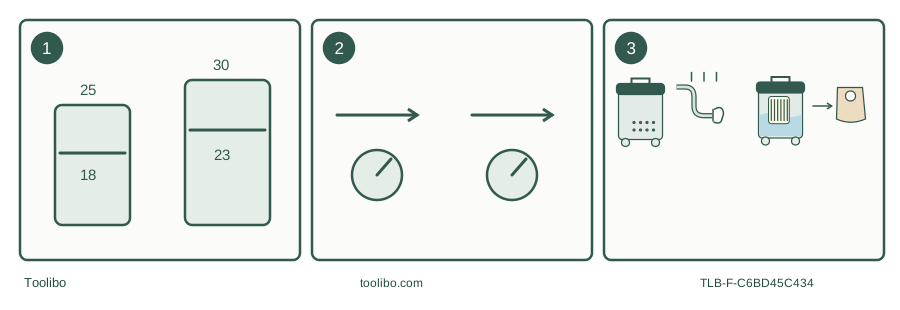
VC2512L/2
- 25 L gross container; 18 L liquid capacity.
- Dust Class L and Push&Clean; keep the main filter and remove the bag for wet pickup.
VC3011L/2
- 30 L gross steel container; 23 L liquid capacity.
- Dust Class L; automatic tool start/stop is specified for the 240 V version.
Tank
25 L plastic versus 30 L steel; liquid18L versus 23 L.
Shared ratings
Both 1000 W input,3.6 m³/min air volume,210 mbar sealed suction; not simultaneous nozzle values.
Shared routine
Closed-machine Push&Clean; bag removed for wet, filter retained; same Class L boundary.
An original decision aid. Isolate power before opening, changing filters or emptying.
Keep both machines in the same electrical region
This comparison covers UK VC2512L/2 and VC3011L/2, not a 110 V VC3011L/1 or continental package. The suffix, rating plate and supplied manual matter particularly when using a tool socket. A shared-family specification is not permission to transfer a socket wattage between markets. Confirm the actual UK unit’s marking and matching instructions before connecting a tool.
Both machines are documented as Dust Class L and provide Push&Clean filter cleaning. Their classification distinguishes them from ordinary unclassified home shop vacuums, but it does not make either a universal hazardous-dust collector. Material and task suitability must be assessed separately from container size, socket convenience or brand.
The capacity comparison has three rows
Swipe or scroll horizontally to see all columns.
| Listed capacity | VC2512L/2 | VC3011L/2 |
|---|---|---|
| Gross container | 25 L | 30 L |
| Dust capacity | 21 L | 26 L |
| Liquid capacity | 18 L | 23 L |
The VC2512L uses a plastic tank; the VC3011L uses steel. More collection space can mean fewer emptying interruptions for suitable material, but it can also create a heavier load. These figures are not targets that must be reached before stopping. A float needs to remain functional, and neither tank should be tilted or transported while holding liquid.
Think about the trip to the disposal point, thresholds and storage height. If the extra five litres encourage you to carry more water than you can control, a larger container has not improved that task. Empty earlier or organise a safer workflow. Steel is not permission to collect hot ash, solvents or aggressive chemicals.
The listed suction figures do not pick a winner
Both current UK product tables list 1,000 W input,3.6 m³/min air volume and 210 mbar maximum sealed suction. Equal published values do not establish identical performance with every nozzle or tool, and a larger tank is not evidence of greater suction. Input watts measure electrical consumption; airflow and sealed pressure describe different conditions rather than two maxima available together during cleaning.
No hands-on comparison, durability test or noise ranking is supplied here. A well-maintained air path can matter more to an owner than an assumed model hierarchy. Check the bag, cartridge, hose and seals before attributing weak pickup to the machine’s size. Use actual kit contents, not photographs of optional accessories, to decide whether the desired nozzle and adapter are included.
The everyday filter routine is closely related
Before dry use, unplug, inspect the correct main filter and fit the appropriate collection bag for the allowed task. Make sure the bag connection and head seals are correct, then close all locks. Never operate with a missing or damaged filter. The bag is a collection aid, not a replacement for the filter or a way to upgrade dust class.
Both use the specified Push&Clean routine with the machine closed. For the permitted dry task, run the cleaner, close the hose/nozzle opening with the palm and operate the button at least three times for two seconds each. If pickup remains inadequate, stop and unplug before checking the air path or replacing filtration. Powered pulse cleaning is a specific control function, not permission for live internal maintenance.
Wet changeover remains necessary on both
Turn off and unplug before removing the collection bag and emptying dry debris. Keep the correct main filter installed and check the float’s normal action. Refit the head, work upright and keep the electrical connection outside the spill. Neither the larger tank nor tool automatic-start capability turns the machine into an unattended water pump.
Stop at the full-tank response or an abnormal change in wet pickup. Foam or escaped liquid is an immediate stop condition even below the expected volume. Switch off yourself and disconnect before emptying; do not assume float action provides electrical isolation. Do not hold the float open or repeatedly restart to exceed a practical collection limit.
Clean appropriate non-electrical parts, protect the motor head from water and dry the relevant components before dry collection. Emptying and drying remain part of ownership whichever tank material you choose.
Choose handling, while retaining the same safety boundary
Consider the VC2512L/2 when the smaller plastic tank suits storage and lifting; consider the VC3011L/2 when its larger steel container solves an actual collection-space need. Those are configuration-based choices, not predictions of reliability or abuse resistance.
Neither is Class M or H, and this guide does not authorize asbestos, lead, silica-bearing construction dust, cement, flour or explosive-material cleanup. The manual excludes hot, flammable, explosive and aggressive material. Both also require the documented periodic dust-related inspection by Makita service or a trained person. Damaged leads, recurring protective trips, liquid in the head and unresolved faults need qualified service, not a bypassed float or an improvised repair.
Models referenced