
Check the working state
Dry and class: Correct filter and collection bag; Class L only, task suitability separate.; Push&Clean: Head stays closed; palm closes hose opening; three two-second pulses minimum.; Wet: Unplug for changeover; bag out, filter in, float checked.
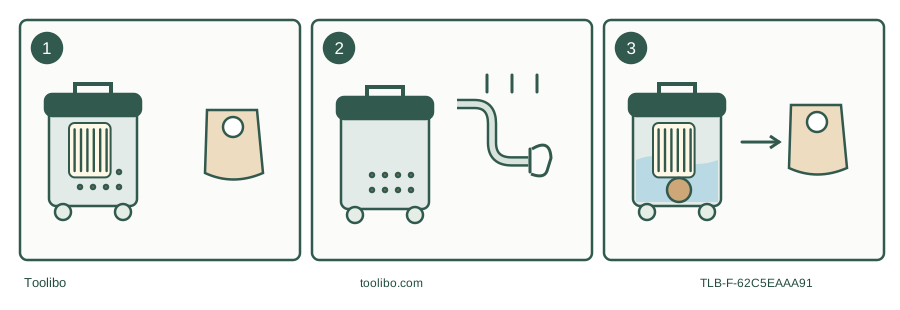
Dry and class
Correct filter and collection bag; Class L only, task suitability separate.
Push&Clean
Head stays closed; palm closes hose opening; three two-second pulses minimum.
Wet
Unplug for changeover; bag out, filter in, float checked.
An original decision aid. Isolate power before opening, changing filters or emptying.
Identify the UK variant before connecting anything
This guide covers Makita VC2512L/2, the UK 230/240 V version listed with EAN 0088381691161. The shared manual names VC2012L, VC2512L and VC3011L and includes regional electrical versions. Match the exact suffix and physical rating plate rather than borrowing a socket limit from a continental or 110 V machine.
The UK product data lists 25 litres gross tank volume,21 litres dust capacity and 18 litres liquid capacity. These are separate capacities, not interchangeable fill targets. It also lists 1,000 W input,3.6 m³/min air volume and 210 mbar maximum sealed suction. Airflow and sealed suction describe different conditions; input watts describe consumption. None establishes the simultaneous working airflow and pressure at a tool port.
Understand what Class L does and does not establish
Unlike ordinary unclassified household shop vacuums, this model is documented as Dust Class L. That is a real distinction, but it is not Class M or H and not a universal hazardous-material approval. The suitability of a particular dust-generating job still depends on the material, required controls, complete extraction arrangement and applicable workplace requirements.
This guide is limited to routine owner operation with permitted material. It does not authorize asbestos, lead, silica-bearing construction dust, cement or flour cleanup. The manual also excludes hot material and flammable, explosive or aggressive liquids and dusts. A fleece bag or replacement cartridge cannot make the machine explosion-proof or raise its certified dust class.
Establish a sound dry air path
Unplug before opening the tank, changing a bag or inspecting the filter. Keep the specified intact filter fitted; never operate with no filter or a damaged one. Install the suitable collection bag according to the exact material and manual requirements, ensuring its inlet connection and the head seal are sound. Close all locks before moving the machine.
Connect the hose and appropriate nozzle without obstructing the inlet or creating a sharp kink. Keep the unit stable and use it indoors as the manual requires. If connecting a power tool, switch both devices off first and confirm the actual UK socket load marking and matching manual. No numeric socket permission is supplied here because a family product table is not sufficient to resolve every regional version.
Use Push&Clean as a closed-machine control
Push&Clean is the specified powered filter-cleaning function, not a reason to open a running machine. With the head closed, correct filter installed and a permitted dry task, run the vacuum, close the nozzle or hose opening with the palm as directed and operate the cleaning button at least three times for two seconds each. This produces cleaning air pulses through the filter.
Release the opening and assess pickup. If suction remains low, stop and unplug before checking hose obstruction, bag fullness, seals or filter condition. Replace a filter that remains unsuitable after the authorized cleaning routine. Do not repeat pulses indefinitely, use sharp tools through the air path or infer that the pulse process makes contaminated dust safe to handle.
Prepare liquids with the bag removed
Switch off and unplug, remove the collection bag and empty dry debris. Keep the correct main filter installed, and check that the float works properly before refitting the head. Wet use is not bare-cage operation. Keep electrical connections dry, work upright and do not tilt or transport a tank containing liquid.
Stay beside the machine and stop at a full-tank response or abnormal loss of pickup. The float’s function is not proof of electrical isolation, so switch off yourself and unplug before emptying. Foam or liquid emerging from the machine requires an immediate stop and an emptied tank. Never immobilise the float to reach a capacity number or continue through a foaming mixture.
Finish with drying and controlled disposal
Dispose of the collected material according to what it contains, not simply by whether it is wet or dry. Empty and clean appropriate non-electrical components, preserve the filter seals and let wet parts dry before dry collection. Do not hose down the motor head. Use only the manufacturer-approved filter arrangement and replacement parts matched to the machine.
The manual calls for at least an annual dust-related inspection by Makita service or a trained person, including filter damage, airtightness and controls. That requirement is distinct from a quick owner wipe-down. If the machine has collected material requiring special containment, do not casually open it in a living area; arrange the appropriate controlled maintenance and disposal procedure.
A damaged lead, electrical fault, liquid inside the head or unresolved malfunction needs qualified service. Do not alter safety devices or undertake internal motor repair. Store the cleaned, emptied machine dry and frost-protected, with the cable and hose secured so neither becomes a lifting strap.
Models referenced