
Check the working state
Dry: Dry cartridge plus fleece bag for fine permitted dirt.; Wet: Same cartridge remains; bag is out and tank starts empty.; Stop: Float blocks suction: switch off, unplug, empty.
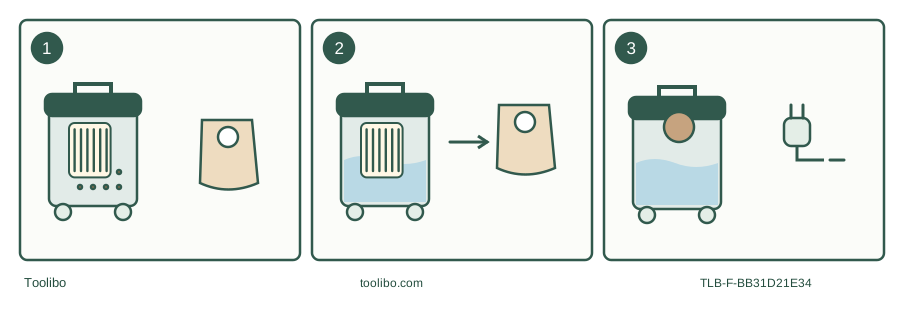
Dry
Dry cartridge plus fleece bag for fine permitted dirt.
Wet
Same cartridge remains; bag is out and tank starts empty.
Stop
Float blocks suction: switch off, unplug, empty.
An original decision aid. Isolate power before opening, changing filters or emptying.
Start with the whole model number
This guide covers the UK WD 3 V-17/4/20, part 1.628-103.0. It has a 17-litre plastic container, a cartridge filter, a fleece filter bag, a 2 m hose and a 4 m cable. A WD 3 P, a battery WD 3 and a metal-container S package are not this exact configuration. In particular, shared-manual instructions for an automatic power-tool socket do not give this non-P machine that feature.
The current specification table lists 1,000 W electrical input, 45 l/s airflow and 230 mbar vacuum. These are different quantities. Input watts describe electricity consumed; airflow describes moving air; pressure describes suction against resistance. They do not say how fast a particular nozzle will collect your debris. A clogged bag can make a correctly rated machine feel weak.
Decide whether the material belongs here
Use the WD 3 for suitable ordinary household or hobby-area debris, not as a certified hazardous-dust extractor. Do not collect petrol, solvents, combustible dust, reactive metal powders, undiluted acids or brine, or anything burning or smouldering. An unknown white powder is not an invitation to test suction. This guide does not authorize cement, flour, asbestos, lead or other hazardous-dust cleanup.
The stock configuration is not an ash vacuum. Kärcher makes a separate accessory condition for cold ash; without verifying that complete arrangement, leave ash out of this routine. A cool-looking surface does not establish that hidden embers are absent. Keep the cleaner out of rain and never place the motor head in water.
Assemble the dry configuration
Switch off and unplug before opening the container. Remove transport contents, fit the castors and check that the cartridge is seated securely and undamaged. The supplied cartridge must be dry for dry pickup. For fine, non-hazardous dry dirt, the manual requires a filter bag as well as the cartridge; the bag is not a replacement for the cartridge.
Unfold the fleece bag and fit its collar firmly over the inlet connection without tearing it. Keep the bag clear of the head seal, close the head correctly and connect the hose to the suction inlet. Use the floor nozzle for open areas and the crevice tool for narrow access, without forcing either against a fragile surface. Fully unwind the power cable and use the prescribed protective electrical supply with dry connections.
Change to liquid pickup deliberately
After dry work, stop and unplug. Remove the bag, empty dry debris from the container and inspect the cartridge and float area. Leave the correct cartridge installed. The phrase “no filter change” applies to that main filter, not to leaving a dust bag in place.
Set the machine upright on a stable surface. Keep the electrical connection away from the spill and use a suitable wet-pickup nozzle arrangement. Work in manageable passes while watching the machine. Do not use suction to investigate a chemical spill or an electrically unsafe flooded area. The 17-litre figure is container size, not a promise that 17 litres of water can be collected before stopping.
Recognise a full-tank or topple stop
At the wet fill limit, the float closes the suction opening and the motor runs at a higher pitch. Electricity has not necessarily switched off. Stop immediately, unplug and empty the container; do not hold the nozzle harder against the water or bypass the float.
A tip-over can close the float too. Stand the machine upright, switch off and wait at least five seconds before attempting a restart. First check for escaped liquid, damaged parts or a full container. If foam forms or liquid escapes, switch off and unplug immediately. A reset is not permission to continue with an unexplained fault.
Restore dry readiness and useful suction
After water pickup, empty and clean the container and accessories, then let them dry. Check the cartridge before the next dry task; if it is damp, wait until it is fully dry. Do not fit a new bag into a wet tank and expect it to stay sound.
For declining suction, isolate power and inspect the nozzle, tubes and hose, then the bag and filter. Replace a full bag or damaged filter rather than running without filtration. Keep service to accessible owner-cleaning tasks. A damaged lead, persistent electrical trip, liquid in the motor head or repeated unexplained suction loss needs authorized service. Store the emptied machine indoors, dry and frost-protected, with the hose and cable secured rather than used as carrying handles.
Models referenced