
Check the working state
Access: WD 3: cartridge under head. WD 4: separate top filter cassette.; Reach: WD 3: 4 m cable / 2 m hose. WD 4: 5 m / 2.2 m.; Shared limit: Both: bag out for liquids, main filter stays, dry before dry use.
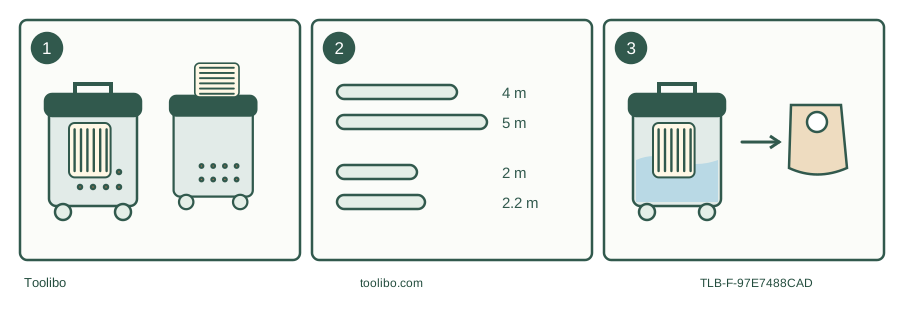
WD 3 V-17/4/20
- 17 L gross plastic container.
- Cartridge filter stays fitted for wet pickup; no built-in tool socket.
WD 4 V-20/5/22
- 20 L gross plastic container.
- Flat pleated cassette filter stays fitted for wet pickup; non-P version without a tool socket.
Access
WD 3: cartridge under head. WD 4: separate top filter cassette.
Reach
WD 3: 4 m cable / 2 m hose. WD 4: 5 m / 2.2 m.
Shared limit
Both: bag out for liquids, main filter stays, dry before dry use.
An original decision aid. Isolate power before opening, changing filters or emptying.
Match these two exact packages
This comparison concerns WD 3 V-17/4/20, UK part 1.628-103.0, and WD 4 V-20/5/22, UK part 1.628-211.0. It does not compare every product carrying WD 3 or WD 4 on the casing. P variants can add tool-socket functions, S variants change container material, and imported kits can change plugs and accessories. Both configurations here use plastic containers and ordinary on/off operation.
The practical starting question is where you will clean and how you will empty and maintain the machine. A bigger model number is not evidence that a vacuum is safer for a particular dust. Neither package should be selected as a certified hazardous-dust extractor merely because it is described as suitable for a workshop.
The most useful difference is filter access
The WD 3 uses a one-piece cartridge beneath the head. The WD 4 uses a flat pleated element in a removable filter cassette. Both can retain their specified main filter for wet and dry work, but the WD 4 offers filter access without reaching into the dirty bucket. That distinction matters if routine filter inspection is the task you most often postpone.
It does not eliminate maintenance. A WD 4 cassette must be seated correctly, its filter must be intact, and a washed element must dry completely before dry pickup. Its manual permits rinsing but specifically prohibits rubbing or brushing the pleated filter. The WD 3 owner must follow its cartridge-care instructions rather than copying a method used on a different filter shape or material.
Compare reach and handling in your actual room
The exact WD 3 package lists a 17-litre container, 4 m cable and 2 m hose. The WD 4 lists 20 litres, 5 m cable and 2.2 m hose. Extra reach may let the larger machine remain in one stable position while you work around a car, but adding cable and hose lengths is not a guarantee that every corner is reachable. Furniture, doors, nozzle position and slack consume that distance.
Mark a safe dry outlet position and imagine the hose route to the farthest spot. If the hose would pull the bucket sideways, plan to stop and move it. Both machines use unbraked castors. A larger wet load also changes lifting and emptying effort: nominal container size is not a target water fill, and it is sensible to empty before the load becomes awkward.
Read the performance figures as separate measures
Current UK tables list WD 3 at 1,000 W input, 45 l/s airflow and 230 mbar vacuum, and WD 4 at 1,100 W, 55 l/s and 240 mbar. Those manufacturer figures describe different quantities and are not a same-surface cleaning race. Input watts are not suction watts. Maximum airflow is not the airflow available while a nozzle is tightly sealed against a mat.
The meaningful owner questions remain whether the nozzle suits the surface, the hose is clear, the bag is filling and the filter is clean. Neither table supports a claim that one machine removes a fixed percentage more dirt, finishes a job a stated amount faster or lasts longer. No hands-on performance ranking is supplied here.
Both require an actual wet changeover
For liquids, stop and unplug, remove the dust bag, empty the container and keep the correct main filter installed. “No filter change” never means “leave the bag in.” Check the float area and keep power connections away from the spill. At the full-tank limit, the float blocks suction and the motor note rises; the operator still has to switch off, unplug and empty.
Afterward, clean and dry the container and accessories. Check the main filter is fully dry before fitting a dry bag and returning to dry dirt. If a mixed job repeatedly switches between water and dust, allow time for that recovery instead of assuming either machine bypasses the drying requirement.
Make the decision within the material limits
Choose the WD 3 when its smaller container and listed reach fit your storage and ordinary cleanup route. Consider the WD 4 when cassette access, a somewhat larger container or extra cable reach solves a specific inconvenience. Those are configuration-based reasons, not reliability predictions.
For either one, exclude flammable liquids and dust, reactive metal powders, acids or brine, hot debris and unknown harmful material. Do not infer safe cement, flour or ash collection from broad marketing language. Persistent faults, damaged cables and liquid entering the electrical head require service, not a larger replacement filter or a bypassed float.
Models referenced