
Reach, bottleneck and handling
A hose route around a car is compared with a straight-line measurement, a reducer is shown as the narrowest opening, and a stable machine retains slack.
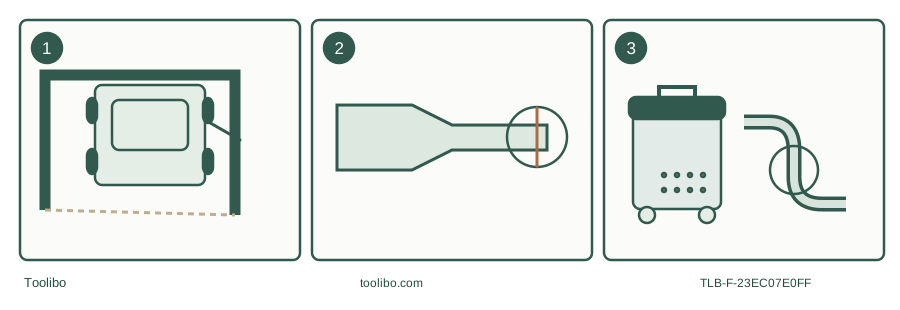
Route
Measure the working route with safe slack.
Bottleneck
Check the smallest opening, not just hose size.
Verify
Use approved parts and a normal permitted trial.
Longer reach is a practical benefit, but connector fit and the complete airflow path still need checking.
Describe the reach problem precisely
Before buying an extension, identify where the current arrangement fails. Is the machine unable to fit beside a car, the hose too short to reach its far footwell, or the nozzle simply the wrong shape? Those are different problems. A suitable longer nozzle or a different safe machine position may solve one without adding several metres of hose.
Measure the usable route, not the straight line. Include the door opening and the place the hose must turn, while keeping enough slack to avoid pulling the machine. Do not route through a closing door or across a path where people can trip. Avoid solving a reach problem by putting the machine somewhere unstable or outside its permitted environment.
Separate hose bore from connector size
A nominal hose diameter is not a complete fitting description. The cuff may be tapered, threaded or latched; the machine inlet and accessory end may differ. Measurements taken at the outside of a connector do not necessarily describe the internal working passage.
Record both ends, the hose’s nominal size, approved part number and any required adapter. A reducer can create a smaller passage even when most of the hose is large. An extension with a compatible-looking cuff can still lack the required lock or seal. Check the matched accessory information rather than forcing parts together.
Think in terms of the narrowest practical path
Air and debris travel through the whole assembly. A large hose does not make a narrow crevice tool pass larger objects, and a small adapter can remain the limiting opening. Additional length and bends introduce resistance; the actual effect depends on the machine and setup. There is no reliable universal statement that every extra metre costs a particular percentage of suction.
Swipe or scroll horizontally to see all columns.
| Proposed change | Potential benefit | What to verify |
|---|---|---|
| Longer approved hose | Reach around a larger work area | Handling, locks, supported length and working performance |
| Smaller nozzle or adapter | Access to a confined location | Obstruction risk and suitability for the material |
| Larger approved passage | Room for appropriate larger debris | All connections and the remaining nozzle bottleneck |
| Shorter supported route | Less excess hose to manage | Enough slack and a safe stable machine position |
Shop-Vac item 5430097, for example, lists a 7ft hose of 1-7/8in nominal diameter. That is a specific supplied arrangement, not a declaration that every1-7/8in accessory will fit every vacuum. Preserve the part identity when shopping for an extension.
Test handling first, not extreme suction
With the machine safely isolated, assemble only the approved parts and check that locks engage, seals sit correctly and the hose reaches without strain. Move the nozzle through the intended route while the machine remains stable. Check that the hose does not kink, drag across vulnerable surfaces or block the operator’s movement.
Then perform a normal, permitted cleanup with the correct filter arrangement. If pickup becomes unreliable, stop and inspect for blockage, leaks, a loaded filter or a poor adapter before blaming the motor. Do not block the hose with a hand or object to create a strength test, and do not keep operating a visibly obstructed setup.
Keep convenience separate from dust-control performance
A hose that makes a floor-cleaning job easier may not be suitable for a tool’s extraction port or required airflow. Likewise, an antistatic-looking material or a printed diameter does not establish that a complete conductive system exists. Follow the tool and extractor manufacturers’ supported combinations where those properties matter.
Keep a simple configuration note after a successful permitted trial: machine, hose part number, adapter, nozzle and the reason for the change. If another task needs a different arrangement, reassess it rather than assuming the longest hose is now the permanent best setup. The useful upgrade is the one that solves a real access problem without hiding a new bottleneck.