
Check the working state
Dry: Textile additional filter plus paper bag; hose at suction inlet.; Wet: Only supplied foam over cage; dry bag and filter removed.; Float response: Closed suction path plus louder motor: off, unplug, empty.
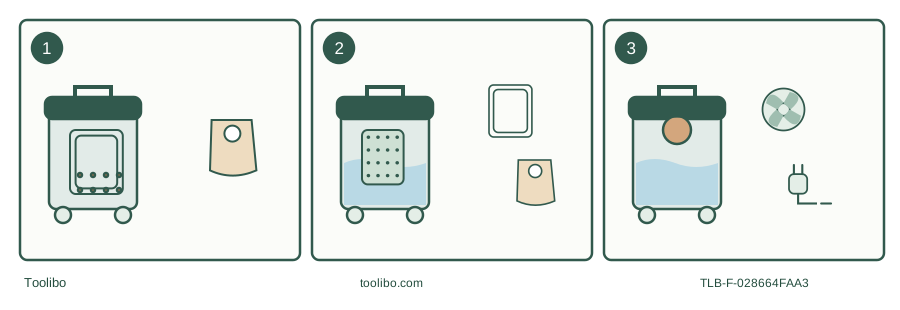
Dry
Textile additional filter plus paper bag; hose at suction inlet.
Wet
Only supplied foam over cage; dry bag and filter removed.
Float response
Closed suction path plus louder motor: off, unplug, empty.
An original decision aid. Isolate power before opening, changing filters or emptying.
Match the 20-litre revision
The TC-VC 1820 S covered here is UK article 2342167. The linked operating manual identifies 23.421.67 and I.-Nr.11039. Verify the identification number on your machine before buying parts; similar names and tank sizes do not prove a replacement filter or seal will fit. This configuration has a 20-litre stainless-steel tank, a 36 mm hose system and a 1.5 m suction hose.
The UK technical table lists 1,250 W input and 180 mbar suction pressure, with the dust protection class explicitly not classified. A pressure value in mbar is not an airflow value. The product page contains differing cable-length statements, so check the actual lead before planning outlet reach rather than stretching it to a claimed radius.
Prepare for dry debris without bypassing filtration
Switch off and unplug before opening the retaining hooks. For dry work, fit the supplied additional textile filter over the filter cage and fit the correct dirt bag onto the inlet. Check that the textile filter leaves no unfiltered route through the cage. The paper bag helps collect and dispose of permitted dry debris, but it does not replace the additional filter.
Keep the bag clear of the container rim and close the head securely. Connect the hose to the suction inlet. The blower connector is a separate outlet and will send air in the opposite direction. A quick visual check of the hose position is useful before starting beside loose debris, where an unexpected blast can spread rather than collect the mess.
Plan the weight before you plan the fill
A 20-litre container is a size description, not a target for filling with water or heavy debris. Keep the machine upright and close enough that the hose does not tug it across a threshold. Plan where you will empty it and how to reach that point without carrying an awkward liquid load through occupied space.
Use the handle and correctly closed retaining hooks, not the hose or power cord, when moving the machine. Empty earlier if the load becomes uncomfortable. The steel tank does not make the electrical head waterproof, chemical-resistant or suitable for hot material. Dry plug connections and a sound supply remain essential throughout a wet task.
Fit the wet configuration before collecting water
Stop, unplug, remove the head and take out the dry dirt bag and additional dry filter. Empty remaining dry material. For wet vacuuming, the matched manual specifies only the supplied foam filter over the basket. Fit it securely and inspect it for damage before replacing the head. Never run with an uncovered basket to “save the filter.”
Keep the nozzle and hose arranged for controlled pickup of a suitable non-flammable liquid. Do not use the machine to investigate an unidentified spill. A partly filled bucket can foam, and gross volume does not establish the remaining safe liquid capacity. Stay with the machine and be ready to stop rather than leaving it operating until something changes by itself.
Listen for the float closing the suction path
The manual gives a useful specific clue: at maximum liquid level, the floating safety device closes, and the suction noise changes and becomes louder. You must then switch off and empty the tank. The motor may still be running while the hose no longer collects effectively; this is not permission to open the head while plugged in.
Switch off and unplug before emptying or inspecting. Do not keep cycling the switch, press the nozzle harder into the spill or immobilise the float. If foam or liquid escapes, stop immediately even before the expected fill limit. After emptying, check the accessible float area and filter condition. Repeated early cutoff or continued leakage needs investigation, not a bypass.
Clean and return to the correct dry state
The foam can be washed under running water with a little mild soap and allowed to air-dry. Clean the container as appropriate, but wipe rather than immerse the motor head. Let wet parts dry before reinstalling dry filtration and a fresh bag. Check the filter attachment before every use and replace split or badly deteriorated consumables.
For weak dry suction, isolate electricity and check the nozzle, tubes, hose, bag fullness, filter loading and head seal. Do not diagnose by running without a filter. The manual excludes harmful, combustible, explosive and corrosive material, as well as burning matches, smouldering ash and cigarette ends. This guide does not authorize cement, flour, asbestos, lead or unknown powder collection.
Store the emptied machine dry and protected from freezing. A damaged lead, persistent electrical fault, burning smell or liquid entering the head belongs with authorized service. Owner cleaning of the tank and filters does not extend to motor disassembly, modified thermal protection or improvised electrical repairs.
Models referenced