
Check the working state
Container: 15 L versus 20 L gross steel tanks; not liquid fill targets.; Same changeover: Dry textile plus bag changes to wet foam only.; No class upgrade: Both not classified; more volume does not permit harmful dust.
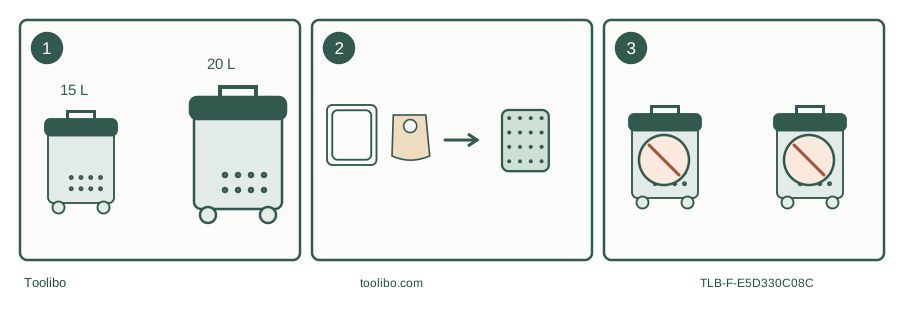
TC-VC 1815 S
- 15 L gross stainless-steel container.
- Dry use: textile filter and bag. Wet use: supplied foam filter. Dust class: not classified.
TC-VC 1820 S
- 20 L gross stainless-steel container.
- Dry use: textile filter and bag. Wet use: supplied foam filter. Dust class: not classified.
Container
15 L versus 20 L gross steel tanks; not liquid fill targets.
Same changeover
Dry textile plus bag changes to wet foam only.
No class upgrade
Both not classified; more volume does not permit harmful dust.
An original decision aid. Isolate power before opening, changing filters or emptying.
Compare the article numbers as well as the names
This comparison covers TC-VC 1815 S article 2342390 and TC-VC 1820 S article 2342167 on Einhell’s UK site. Their linked manuals identify I.-Nr.11016 and I.-Nr.11039 respectively. Keep your own identification number when ordering consumables or service parts. Product names can outlive revisions, so a shared “S” or similar photograph does not settle compatibility.
Both have stainless-steel collection tanks, four castors, ordinary on/off controls, a blower connection and a 36 mm hose system. Neither exact package here is a power-tool automatic-start model. The practical difference to start with is a 15-litre versus a 20-litre container, not a different hazardous-dust certification: both are explicitly listed as not classified.
Decide how much container you can handle
The TC-VC 1815 S may be sufficient when jobs are brief and the path to an emptying point is short. The TC-VC 1820 S offers more gross collection space, which can reduce interruptions for permitted bulky debris. These are conditional workflow benefits, not measured test results or claims about how many rooms either machine can clean.
Liquid makes the choice more physical. A larger bucket can tempt you to carry a heavier load. Neither gross tank figure is a guaranteed usable water capacity. Decide where the bucket will stand, where it will be emptied and whether the route includes steps or tight turns. Emptying early is preferable to trying to lift or tilt a load you cannot control comfortably.
Both use a 1.5 m suction hose in the verified UK listings. The 1815 S lists a 2.5 m lead. The 1820 S technical table lists a longer lead, but another paragraph disagrees, so inspect the actual machine before planning reach. Do not make a purchase or extension-lead plan based solely on an ambiguous combined working-radius claim.
The wet filter routine is the same kind of work
For dry pickup, both matched manuals specify the additional textile filter and the dirt bag. The textile filter covers the filter cage, while the paper bag attaches to the inlet. A bag is not a substitute for filtration over the cage. Seat both correctly, keep the bag out of the head seal and inspect for tears before starting.
For wet pickup, switch off, unplug and remove the dry bag and additional dry filter. Empty the container, then fit the supplied foam filter securely over the basket. The manuals specify foam for wet operation; this is not the cartridge-retained changeover used on some other brands. Buying the larger Einhell does not remove that setup step.
Afterward, clean the foam with the permitted mild-soap-and-water method and air-dry it. Let the container and relevant parts dry before restoring dry filtration and a fresh bag. If your normal job repeatedly alternates between water and fine dry debris, budget time and clean storage space for the changeover on either model.
Treat the float response as a stop instruction
The 1820 S manual explicitly describes the float closing at the liquid limit, with suction noise changing and becoming louder. The 1815 S manual uses automatic-stop wording. Do not turn either description into a promise that the machine is electrically isolated. When the fill protection acts or pickup changes at a high liquid level, switch off yourself, unplug and empty.
Foam or escaping liquid requires an immediate stop even before the expected fill point. A float is not a foam sensor for every situation. Do not tape it down, remove it or keep restarting to gain extra capacity. If it does not move normally, or the foam filter is damaged, correct the problem before another wet task.
Equal watts and pressure do not prove equal cleaning
Both product tables state 1,250 W input and 180 mbar suction pressure. Watts consumed are not airflow, and mbar is not a volume-per-second measure. These specifications cannot establish that two different nozzles clear a surface equally quickly, or that the larger tank produces stronger pickup. Bag fullness, filter condition and hose blockage remain important on both.
Use the blower only for a controlled, appropriate job, not to scatter unknown dust around a room. The same material exclusions apply: no harmful dust, combustible, explosive or corrosive substances, flammable liquids, hot ash or burning debris. Neither guide authorizes cement, flour, asbestos or lead cleanup.
Choose a manageable maintenance commitment
Choose the smaller or larger container according to storage, emptying access and permitted debris volume. Do not treat steel as a guarantee against chemical attack or assume a dust bag creates a hazardous-material system. For either model, clear accessible obstructions with power disconnected, replace worn filters and leave electrical work to authorized service. Persistent faults, damaged cables or liquid entering the motor head are reasons to stop, not reasons to bypass protection.
Models referenced