
Check the working state
Controls: UniversalVac: manual switch. AdvancedVac: tool auto start/stop and drain.; Liquid space: 8.5 L net versus 13.5 L net, distinct from gross 15 L /20 L.; Filter routine: Both remove bag and textile sleeve for wet; main cartridge stays.
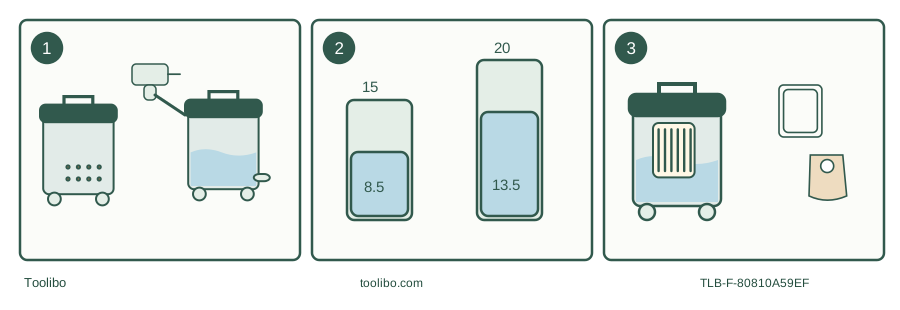
UniversalVac 15
- 15 L gross container; 8.5 L net liquid volume.
- For wet pickup, retain the main cartridge and remove the textile prefilter and dust bag.
AdvancedVac 20
- 20 L gross container; 13.5 L net liquid volume.
- Liquid drain and automatic tool start/stop; main cartridge remains fitted for wet pickup.
Controls
UniversalVac: manual switch. AdvancedVac: tool auto start/stop and drain.
Liquid space
8.5 L net versus 13.5 L net, distinct from gross 15 L /20 L.
Filter routine
Both remove bag and textile sleeve for wet; main cartridge stays.
An original decision aid. Isolate power before opening, changing filters or emptying.
Begin with the task rather than the badge
UniversalVac 15 UK order 06033D1170 and AdvancedVac 20 UK order 06033D1270 belong to Bosch’s household Home & Garden range. Both collect permitted wet and dry material and accept a tool adapter. Only the AdvancedVac 20 in this comparison provides the automatic power-tool start/stop function and a liquid drainage opening. Those features are more decision-relevant than treating “Advanced” as a measured performance verdict.
For a car interior followed by an occasional ordinary spill, the UniversalVac’s simpler on/off control may cover the task. For a permitted DIY tool job where reaching for a separate vacuum switch is inconvenient, the AdvancedVac’s socket and automatic control can be useful. First establish that the material is permitted; neither a conical adapter nor a tool socket establishes hazardous-dust suitability.
Compare usable space, not just tank names
Swipe or scroll horizontally to see all columns.
| Capacity in the shared manual | UniversalVac 15 | AdvancedVac 20 |
|---|---|---|
| Gross container | 15 L | 20 L |
| Net liquid volume | 8.5 L | 13.5 L |
| Dust-bag volume | 11.8 L | 16.8 L |
Gross container size includes space that is not a usable liquid load. The float and air path still need room. A person who repeatedly handles small water spills should think about the distance to an appropriate emptying point and whether lifting is comfortable, rather than buying solely by the biggest tank figure.
The AdvancedVac’s drain can avoid lifting a water-filled bucket to pour it out, provided the receiving point is suitable and the machine stays stable. It cannot determine where contaminated liquid may be disposed of. The UniversalVac requires a sensible controlled-emptying route. In both cases, stop and unplug before opening or emptying, and empty earlier if handling the load would be difficult.
The filter changeover is essentially shared
Both use a main wet/dry cartridge with a textile prefilter and a separate dust bag for dry work. Before wet pickup, remove the bag and textile prefilter, empty the container and clean the main cartridge. The cartridge stays installed. “No filter change” does not mean all dry-use components remain in the tank.
After wet work, let the head and cartridge dry thoroughly before returning to dry dirt. The AdvancedVac’s drain does not shorten this requirement. For routine cleaning, the shared manual describes tapping the textile prefilter and using a soft brush on cartridge pleats; a damaged filter is replaced. Neither model should be selected on the assumption that wet-to-dry switching is instant after a water job.
Automatic tool control brings an electrical check
The AdvancedVac UK manual table specifies a connected-tool range of 100–1,800 W, distinct from other regional versions. Confirm the supplied manual and the actual socket marking before connecting a tool. Keep tool and vacuum switched off during connection, and do not use a multiway strip to turn the vacuum into a general distribution board.
The automatic mode starts extraction with the tool and includes a run-on after the tool stops. For tools that admit little air, the manual directs opening the adapter’s false-air inlet. The UniversalVac does not gain this automatic function simply because the hose adapter fits. With either machine, a correctly connected hose still needs suitable dust collection at the tool and a task within the permitted material limits.
Do not turn turbine figures into cleaning promises
Bosch lists the UniversalVac at 1,000 W input, 65 l/s maximum turbine airflow and 240 mbar maximum turbine vacuum. AdvancedVac figures are 1,200 W, 70 l/s and 260 mbar. Input power, airflow and pressure are separate measurements; the turbine maxima are not simultaneous working values at the nozzle. The figures alone do not establish a particular time saving or debris-removal percentage.
The AdvancedVac includes an antistatic hose; the UniversalVac’s listed hose is not described the same way. Antistatic handling reduces discharge but is not explosion protection. Neither machine should collect flammable liquids, combustible or explosive dust, hot material or harmful dust. This comparison does not authorize cement, flour, asbestos or lead cleanup.
Choose the maintenance routine you can sustain
Pick between the two by the controls and emptying method you will actually use. Check storage space, nozzle access and how the hose will reach without tugging the machine. At the float’s fill response, stop manually and empty; do not count on automatic electrical shutdown. Foam or escaped water also means stop immediately.
For either model, clear accessible blockages only with power isolated, replace damaged filters and use qualified service for cables, repeated protective trips or unresolved faults. This is a documentation comparison, not a hands-on reliability ranking or a claim that the larger machine is the right answer for every workshop.
Models referenced