
RE 90.0: purge, attach, observe
RE 90.0: purge, attach, observe — numbered controls and physical routes explained by the legend.
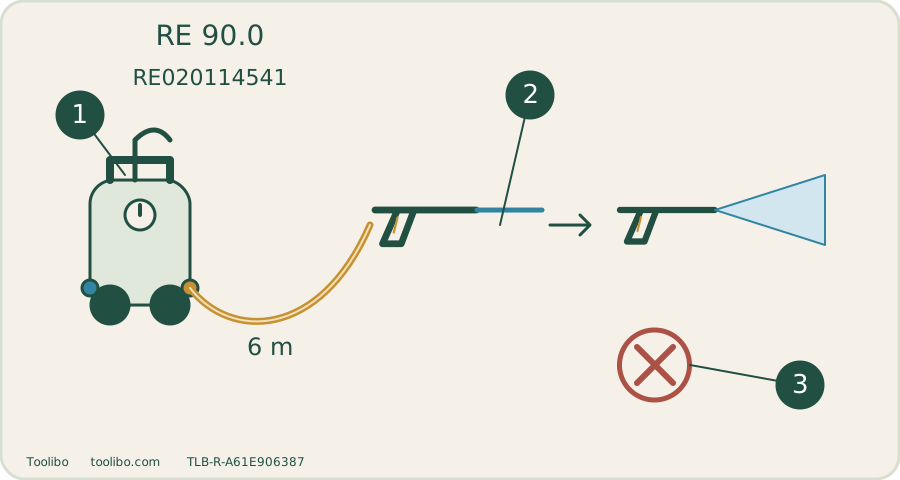
Identity
UK RE020114541 / RE 90.0
Water
Even stream before attaching lance
Fault
Cycling with released trigger: dealer inspection
Original explanatory diagram; not a dimensioned service drawing.
Use the current RE 90.0 identity
The UK product identifier is RE020114541. Its matched instructions are for RE 90.0, document 0458-002-0121-C, not the older 4951-series RE 90 or a US specification sheet. The current UK configuration has a 6 m hose, hose hook, separate fan and rotary nozzles, and a detergent spraying set. A hook is not a hose reel.
For the 220–240 V manual section, input is 2.1 kW, working pressure 100 bar and maximum permissible pressure 130 bar. Maximum water throughput is 440 L/h and minimum throughput 350 L/h. Both are output labels: 350 L/h is not a verified minimum inlet-supply requirement. Check the actual plate instead of selecting the adjacent 100 V or 127 V table.
A straightforward tap-fed start
- With the washer switched off and unplugged, position it securely and connect the pressure hose and gun. Inspect accessible joints, hose and inlet screen before use.
- Connect the water supply with the required backflow protection. Keep the inlet within 10 bar and pressure-fed water within 40 °C. Open the tap fully.
- Before attaching the lance, operate the gun until it delivers an even stream. Release and lock the trigger, then attach the lance and the selected nozzle securely.
- Match the electrical plate, arrange an appropriate dry, protected connection, plug in with the switch off and then start. Hold the spray equipment with both hands and test an inconspicuous suitable patch.
If the supply does not produce an even stream, investigate the tap, hose route and inlet screen before continuing. Do not treat repeated motor starts as a way to discover whether a dry or obstructed supply will eventually work.
Keep fan, rotary and detergent roles separate
The fan nozzle lets you adjust the spray for a broad area. The rotary nozzle is for stubborn dirt on insensitive surfaces; it is not a universal replacement for the fan. Make a small test and watch both the surface and its edges. If a coating lifts or a joint loses material, stop rather than bringing the nozzle closer.
The detergent spraying set replaces the nozzle at the end of the lance. Isolate power, stop supply, release pressure and lock the trigger before changing the attachment. Fill its bottle only to the 500 ml maximum, using the detergent’s own dosing instructions. Apply without allowing the detergent to dry, then change back to the appropriate rinse nozzle using the same safe isolation sequence.
For a pair of outdoor planters, inspect the coating and secure each object before washing. The existence of a rotary nozzle does not prove a thin painted surface can tolerate it. This manual also excludes food-contact surfaces, asbestos-containing material and lead-painted surfaces; do not extend a garden-cleaning example to those jobs.
Recognize a check you can do—and a fault you should stop
A changed spray shape can mean a blocked or worn nozzle. After isolation and pressure release, rinse the removed nozzle; use its cleaning pin for a blockage without enlarging the opening. A falling working jet also warrants checking available water and the inlet screen.
Repeated on/off cycling while the trigger is not pressed is different: the manual directs dealer inspection for a leak in the high-pressure system. Do not keep using the machine because it still sprays when the trigger is squeezed. Damaged wiring, persistent leaks or an unreliable gun also require service rather than opening the pump.
Store the hose on its holder
Switch off and unplug, stop water, press the trigger to reduce pressure, and lock it before disconnecting. Drain the detached hose and gun, clean the nozzle/lance and coil the hose on its hook. Keep the electrical cable separate and avoid sharp bends.
Choose frost-free storage. If transport or storage cannot avoid freezing, the matched manual has a specific antifreeze procedure; an arbitrary automotive mixture is not a substitute for checking that procedure and product directions. The RE 90.0 suits a user who wants simpler controls and can work comfortably within 6 m. If integrated detergent handling or on-gun pressure selection is the missing convenience, compare the RE 100 PLUS CONTROL rather than expecting a higher maximum number alone to solve it.
Models referenced