
Match the block to the edge and capture dust at the work
A firm flat block and a shaped flexible block preserve different edge profiles; a nearby extraction inlet collects dust into a hose.
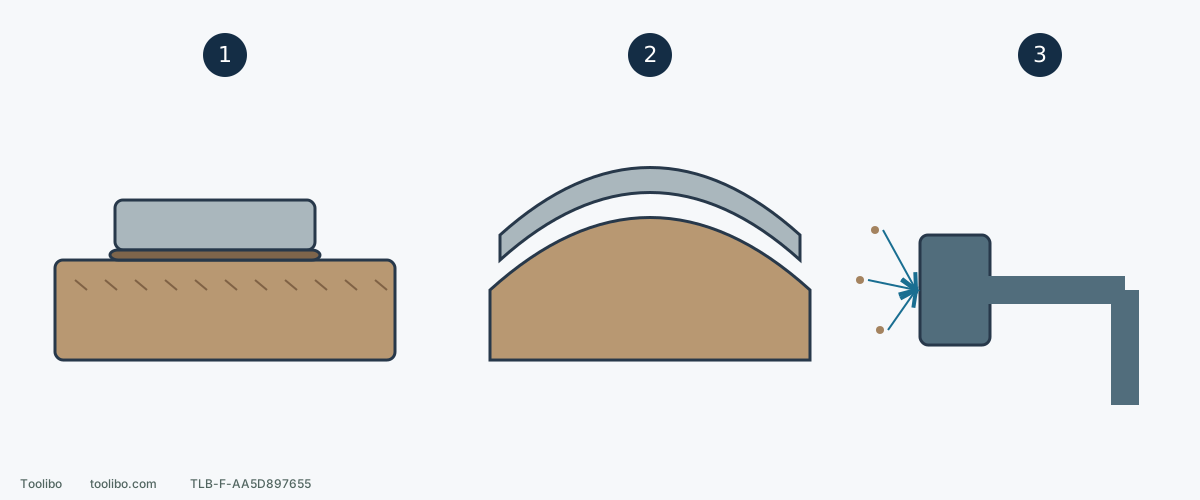
1. Flat edge, shape-preserving block
Support the sample and preserve width and fit. The MEDITE EXTERIOR cut-edge 180 example is conditional on that product, not a requirement to resand its factory face.
2. Curved profile, matching flexible block
EPF guidance favors a preformed block for the profile, with softer foam conforming to curves. Avoid flattening a crown or rounding an intended corner.
3. Effective local capture and suitable cleanup
Keep the inlet effective and unobstructed through the real path. Use assessed controls and suitable MDF cleanup equipment; do not blow or brush fine dust into the air.
Conceptual edge sections; the curved block is lifted to show matching shape. No nozzle distance, airflow or universal grit is specified. Captured dots do not prove safe exposure.
Identify the MDF product
MDF combines wood fibers and resin, with product-dependent composition, surface, use and coating requirements. Record brand, product, thickness, existing covering and the next operation: painting, laminating or bonding. Do not explore unknown coatings, suspect contamination or moisture damage by sanding first.
The example is confirmed MEDITE EXTERIOR, document QCUSG0675 20REV0. Depending on thickness its factory face has a 120 or 150 grit finish; cut edges may need 180 paper. Factory numbers describe delivery, not an instruction to start again at 120. Nor is 180 universal for MDF.
Check the dust-control plan before work
UK HSE guidance calls for effective local extraction during MDF machining or sanding, with respiratory protection supplementing rather than replacing controls. This checklist puts preparation into practice; absence of visible dust does not establish acceptable exposure.
- Material: identify the board and any existing coating and verify the proposed method; assess unknown material first.
- Capture: place effective collection at the actual hand-sanding location, without the work, clamps or block obstructing it. A vacuum elsewhere in the room is not local capture.
- Equipment: fit hoses, connections, bags and filters as specified, without obvious damage or blockage. Shut down and isolate that equipment before opening or cleaning it.
- Area: keep dust from bystanders and living areas, provide stable support and avoid cord/hose trip hazards. Hand work still needs these controls.
- Cleanup and protection: HSE recommends at least class M vacuum equipment or an LEV-connected hose for MDF dust cleanup, not compressed air or brushing that raises fine dust. Choose suitable, properly fitting respiratory protection from the assessment, including appropriate face-fit verification for tight-fitting equipment; an arbitrary mask is not a substitute.
Do not begin with unsuitable controls. Visible leakage is a stop signal; no visible cloud is not proof of safety. Vacuum wattage, advertising airflow and bag size do not replace assessment.
Decide on face and edge separately
MEDITE EXTERIOR faces are factory sanded; extra preparation depends on the intended finish. Do not resand simply for a finer feel, reduce thickness by sanding or heavily sand one side. Faced, primed or different-grade boards need their own preparation.
For an edge, consider cut quality, profile and finish. EPF’s 150–240 recommendation concerns hand preparation of MDF edges, not universal faces, machines or products. A firmer foam block preserves flat profiles; a compliant, profile-matched block suits curves without flattening peaks or rounding intended corners.
A practical sample: a cut straight MEDITE EXTERIOR edge
- Confirm product, applicable instructions and finish. Condition it as required; this document requires moisture below 10% before processing/coating, not a guess by touch. With dust controls in place, choose matching batch and cut-condition scrap.
- Secure/support it and record edge shape, width and fit. Softness, swelling, damage or major missing areas require a material decision, not sanding smaller to restore it.
- If the cut edge needs work, use the specified 180 paper on a suitable hand block for light controlled work along the edge. Improve roughness rather than reduce dimensions or remove the factory face.
- Stop and clean with suitable MDF dust extraction. Inspect saw marks, loose fibers, chips and altered straightness/profile. Do not speed inspection by brushing or blowing dust.
- Apply the intended edge-sealing/finish system to the sample, then inspect under its drying conditions before proceeding. Roughness or uneven absorption is not a reason for unlimited sanding; reconsider cut quality, abrasive and finishing method.
For outdoor or damp-interior use this EXTERIOR product additionally requires effective sealing of all edges/machined surfaces and edge/corner treatment including a minimum 3 mm radius. The straight-edge sample is preparation comparison, not a complete exterior installation. Design and finish must satisfy those product-specific requirements; 3 mm does not apply to all MDF.
Accept shape, finish and control, not just a smooth feel
Record product identity, edge paper, block shape, before/after fit and finish result. Preserve the required face condition and designed edge geometry, with a suitable coating sample, before extending the work.
Stop for extraction failure, visible dust escape, unknown exposed layers or other abnormalities and resolve the cause. Shut down nearby power tools, wait for all motion and isolate before turning, clamping or inspection. A tidy bench or smooth edge is not a material/dust safety assessment.