
Start with a removed shelf
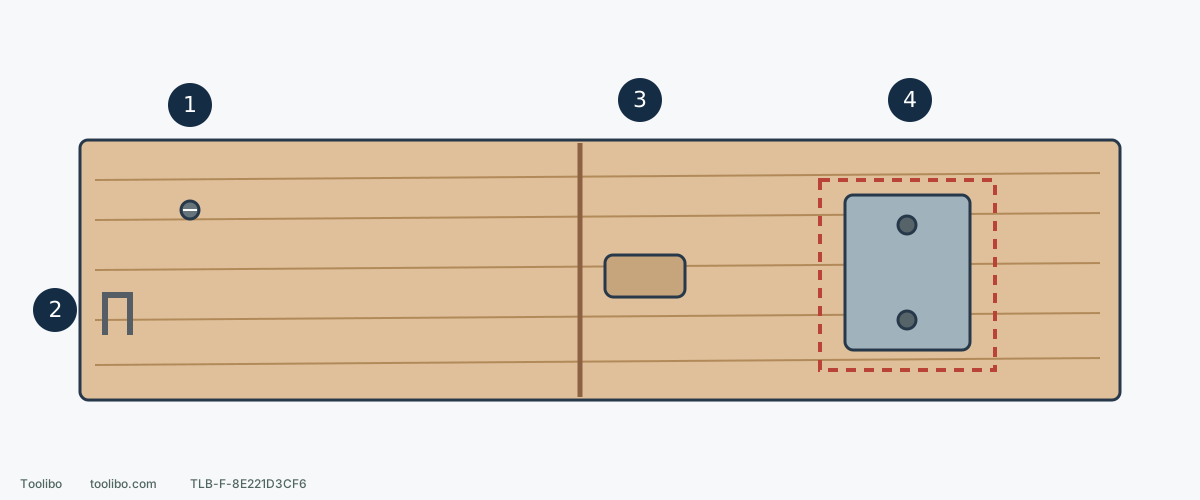
Imagine an old shelf with two former underside brackets and a repaired edge. Do not start with a coarse abrasive to see what appears. A fastener may be on the underside, and a removed bracket may leave a broken screw. Contact can tear paper, damage the pad or cause loss of control.
This check concerns a separate wooden piece you can safely move, inspect and secure. Do not dismantle a wall-mounted or load-bearing assembly, or one that may conceal services, merely to inspect it. Unknown old coatings are not exposed by scraping or trial sanding: establish the material and suitable treatment first.
Follow one complete inspection route
Switch off the sander, wait until all motion stops, unplug or remove its battery and put it outside the inspection area. Support the board. Use overhead light for the overall view and angled light for raised features. Support it before turning it over so neither wood nor loose hardware falls.
- Both faces. Work from one corner in adjacent strips. Look for screw heads, nail heads, both ends of staples, metallic spots, rust marks and suspicious holes. Rust is a clue, not identification of an internal object.
- All edges and ends. Check removed edging, end cracks, joined edges and old mounting holes. A small angled nail may reveal its entry on an edge even when no head is visible on the face.
- Joints and repairs. Examine filler patches, differently colored plugs, glue lines and repaired cracks, including the accessible opposite face. Do not pry open an unknown repair or probe holes with a sharp tool.
- Behind fittings. Inspect visible areas around brackets, hangers, hinges and trim. Remove a fitting only when its purpose and safe removal are established and it has no structural or other consequential role. Then inspect the concealed wood. An unexplained bracket is not simply an obstacle to remove.
If underside bracket holes align with a face patch, mark that area as unresolved on a sketch. Do not treat the patch as ordinary grain or confuse “looked at” with “cleared of concealed objects.”
Give each finding a specific outcome
A confirmed safely removable decorative fitting can be dealt with by the appropriate method, followed by reinspection of the hidden face and remaining fasteners. Raised nails and screws cannot remain in the sanding route. The Milwaukee 2649 warning specifically requires inspection and removal of raised fasteners, but that does not authorize grinding heads with the sander or driving unknown nails deeper.
Unknown purpose, an unexplained broken head or an uncertain repair means pausing machine sanding there until the workpiece issue is resolved. Structural, load-bearing or possible electrical involvement calls for someone qualified to assess that role. Coarser paper is not a solution.
For a separate area established suitable for work, plan the full pad footprint and both travel directions, not merely a centreline that misses a nail. Check clamps and support. A route requiring tilt or a partly unsupported pad is not usable; change the sequence or method.
After unexpected contact, do not restart to prove it
If paper tears, the tool catches, or a new hard spot or abnormal sound appears, stop according to the machine’s safe shutdown procedure, wait for stopped motion and isolate power. Inspect the abrasive, pad cuts or missing material, and the contact point. Never brake a moving pad by hand or repeatedly restart to reproduce the event.
Resume preparation only after an ordinary external cause is understood and corrected, the contact area is known, abrasive and pad are sound, and no unresolved abnormality remains. Abnormal vibration, mechanical damage or uncontrolled switching rules out further trials. Confirm OFF before restoring power and use that model’s start/stop sequence. This route neither substitutes a detector nor guarantees finding every buried object; it keeps known and unresolved hazards out of the sanding plan.
For SR211601, until the shutdown sequence applicable to your unit is confirmed, complete only the isolated inspection; resolving hardware does not by itself authorize a powered trial.
Models referenced