
Six fields on an imaginary abrasive packet
This mock label teaches field locations, not an actual product or compatibility claim; icons stand for text that must be checked on the real package.
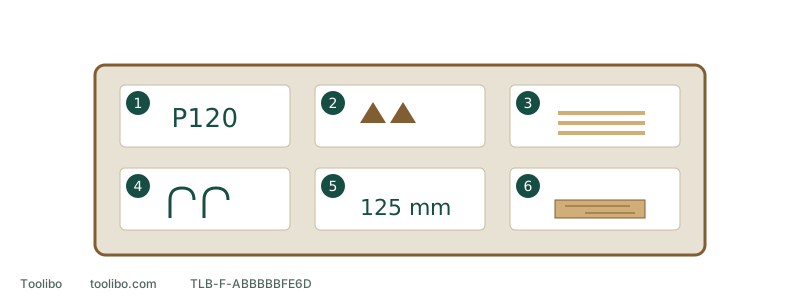
1. Prefix and grade
Keep P120 complete rather than recording only 120.
2. Mineral
Identify the abrasive grain separately from its size.
3. Backing
Paper, cloth or film supports the grains; it is not the workpiece.
4. Attachment
Match hook-and-loop, PSA or clamps to the tool.
5. Geometry
Confirm size and the actual hole arrangement.
6. Intended material
Check allowed work materials and separate dust hazards.
This mock label teaches field locations, not an actual product or compatibility claim; icons stand for text that must be checked on the real package.
Practise with an imaginary packet
Suppose a label reads “P120 / aluminium oxide / paper backing / hook-and-loop / 125 mm / specified hole pattern / wood.” This is a field-reading exercise, not an actual product approved for every tool or proof that all 125 mm discs interchange.
Swipe or scroll horizontally to see all columns.
| Label field | Question answered | Question not answered |
|---|---|---|
| P120 | Grading system and grit grade | A guaranteed finish-ready surface |
| Aluminium oxide | Abrasive mineral | Paper thickness, holes or loading resistance |
| Paper backing | Material supporting the grains | That the workpiece must be paper, or how it attaches |
| Hook-and-loop | Attachment to the pad | Compatible diameter, holes or complete layer arrangement |
| 125 mm and hole pattern | Abrasive geometry and extraction layout | Replacement-pad thread or locating specifications |
| For wood | Intended material direction | Safety of dust from unknown paint or treated wood |
“Backing” means the abrasive’s paper, cloth, film or other supporting layer. “Workpiece material” means the wood, coating or other surface being sanded. Separate them so paper-backed abrasive is not misread as paper-only work, and the actual attachment is not overlooked.
Keep the P; not every 120 is equivalent
FEPA separates P-grit for coated abrasives from F-grit for bonded abrasives. The prefix belongs to the designation: record P120 rather than shortening it to 120 and assuming another grading system’s same number is equivalent.
This is not a conversion chart. If a seller supplies only coarse/medium/fine or an unqualified number, confirm the exact product information. Colour and packet size cannot identify the grade. Recording full product range and grade is more repeatable than remembering “the red fine paper.”
What exactly differs between the tool manuals’ mineral advice?
PCL406 recommends aluminium oxide, silicon carbide and other synthetic abrasives for power sanding, describing natural flint and garnet as too soft for its power-sanding recommendation. A different guide recommending garnet for fine woodwork cannot simply be transferred to PCL406.
Milwaukee 2648-20 categorizes work materials: garnet or aluminium oxide for fine woodwork; aluminium zirconia or ceramic aluminium oxide for rough woodwork; silicon carbide or aluminium oxide for manufactured boards such as particleboard and MDF. These are that model’s material directions, not a sequence requiring every mineral on each board.
Buy a product that satisfies the exact tool, abrasive and workpiece requirements together. Where advice differs, do not average it into a compromise: filter by your own model. Even a matching mineral leaves backing, attachment, dimensions and holes still to check.
Hook-and-loop, adhesive and clamps are separate fields
A fuzzy disc back needs its matching hook-and-loop pad. PSA needs an approved adhesive mounting surface, not glue added to worn hooks. Clamped sheets need exact length and gripping allowance; matching width alone does not establish secure ends.
PCL406 uses five-inch hook-and-loop discs. The supplied hook-and-loop pad and optional PSA pad on 2648-20 are distinct configurations; adhesive discs do not directly replace consumables on the original hook pad. A PSA arrangement requires the complete model-specific pad instructions, not merely a matching grit label.
Inspect the actual back or a clear photograph, then match the complete product number. A round front-view photograph often cannot distinguish adhesive from fleece. If attachment is missing, establish it before buying.
Equal hole counts do not establish a clear path
Compare dimensions, hole positions and shapes with the exact pad requirements before buying. Covering the pad does not prove the disc leaves extraction inlets open. Mesh does not automatically eliminate a required protector or authorize arbitrary added layers.
For fitting, switch off, wait for complete stopping and isolate power before aligning the consumable by the model’s instructions. Do not make an unverified disc fit by trimming, drilling, glue layers or running pressure. Torn backing, lifting edges, covered holes or pad damage must be resolved first, not ignored to finish a packet.
Choose a grade for the next process, not the coarsest or finest label
Identify the defect, remaining material allowance and finishing requirements. Coarser abrasive can create deeper marks requiring further removal; finer abrasive cannot automatically erase an earlier deep scratch. Generic coarse/medium/fine categories are not a specific coating’s preparation instructions.
Assess on identified suitable, securely held scrap under complete safe operating requirements. Keep a consistent product range and grading system where possible, recording condition and result. For powered checks, prepare while isolated, confirm OFF before restoring power and use the tool’s own start/stop method. Stop, wait and isolate again before inspecting. Compare the sensible stages needed for the required surface, not which sheet first makes wood look pale.
Two labels do not give these permissions
“Waterproof” describes the abrasive, not permission to wet-sand with a dry-only tool. The tool, supply and complete method must allow it. “For coatings” cannot make an unidentified coating safe; suspected lead, asbestos or other hazardous material needs assessment before disturbance.
Retain a complete packaging photograph or product-number record that recovers prefix and grit, mineral, backing, attachment, geometry, holes and material scope. That helps avoid buying a different consumable with the same number next time without requiring an elaborate diary of every trial.
Models referenced