
Support the hand-sanding sheet
A flat block spreads contact; fingertip pressure concentrates it on one small area.
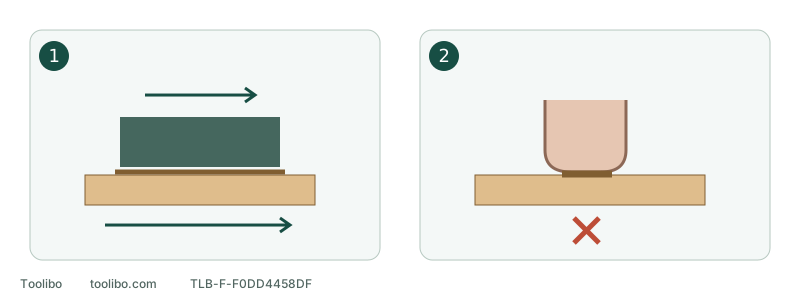
1. Supported sheet
For the pine example, test the chosen sheet on matching scrap before the main board.
2. Concentrated pressure
Do not chase a small defect with unsupported fingertip pressure.
A flat block spreads contact; fingertip pressure concentrates it on one small area.
Define the actual task
“Sand wood” could mean preparing a bare solid-wood panel or working around a curved chair rail by hand. Identify the defect, available material and finish preparation requirements first. Unknown old coatings and uncertain thin veneers are not candidates for exploratory coarse sanding.
Choose grain without inventing a ranking
Swipe or scroll horizontally to see all columns.
| Choice | Useful starting point | Limitation |
|---|---|---|
| Aluminium oxide | Many ordinary bare-wood tasks | Same grain does not mean same construction or fit |
| Garnet | Explicitly suitable bare-wood hand sheets, such as Norton GT | A hand sheet is not a machine disc |
| Ceramic and other grains | A complete product matched to the actual operation | Harder or dearer does not automatically suit fine work |
Tool advice matters: Milwaukee 2648-20 lists garnet or aluminium oxide for fine woodwork, whereas RYOBI PCL406 favours synthetic abrasive and rejects natural garnet for its power-sanding conditions. For PCL406 purchases, follow its synthetic-abrasive requirement rather than another tool’s garnet advice.
Compare paper, cloth and film
Lighter paper conforms more easily; heavier paper is generally more resistant to tearing. Repeated bending around a hand-worked contour places different demands on the backing from flat sanding.
Cloth is useful where flexibility and tear resistance matter. Use a product intended for the hand task, not cloth cut into an improvised powered disc. A tough backing does not itself remove a coarse scratch more finely.
Film products can offer a flat, flexible, tear-resistant construction. Pure Ice, for example, is designed to conform and resist curling. This is not universal machine compatibility: size, holes, attachment and application still matter. A backing’s wet-use capability does not permit wet use of a dry sander.
Consider loading and attachment separately
For a loading-prone suitable material, compare products explicitly offering anti-loading treatment. It cannot compensate for covered extraction holes, an uncured surface or excessive pressure. Paper, cloth and film carry the grain; hook-and-loop and PSA attach the product. Check both, plus actual grade and intended use.
Example: hand preparation of a bare pine board
Assume a stable, uncoated pine board with minor raised fibres and enough allowance for preparation. Read the selected finish’s preparation and final-grade requirements first.
- Choose a sheet explicitly intended for bare softwood hand sanding. Norton GT garnet is a candidate, not a substitute powered disc.
- Select an available grade appropriate to the defect and finish requirement. A fairly fine surface need not begin at the coarsest grade.
- Validate on matching scrap, remove dust appropriately and inspect the original defects under raking light.
- Support the sheet on a suitable flat hand block, secure the board and work regularly with the grain, not with concentrated fingertip pressure.
- Remaining deep scratches require consideration of earlier preparation and thickness. Rapid loading requires material and dust checks, not an automatic mineral change.
The endpoint is the surface required by the part and finish, not completion of every grade in a packet. Keep the product identity, grade, hand application and result for repeat purchases.
Models referenced