
Two different attachment surfaces
Enlarged sections show hooks engaging loops versus an adhesive layer on a designated smooth pad, not adhesive applied over hooks.
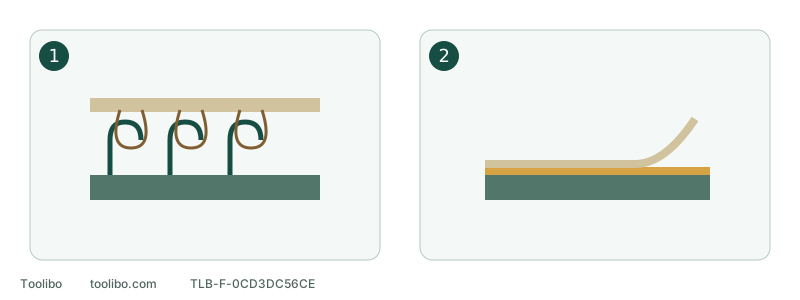
1. Mechanical engagement
Both hook and loop faces must remain sound and free of trapped hard debris.
2. Adhesive attachment
Use the designated PSA pad and protect the adhesive as required.
Enlarged sections show hooks engaging loops versus an adhesive layer on a designated smooth pad, not adhesive applied over hooks.
Understand the attachment
Hook-and-loop uses pad hooks engaging the disc’s loop backing. PSA is pressure-sensitive adhesive applied to its designated pad surface. These describe attachment, not grit, abrasive mineral or sanding motion.
Switch off, wait for full stop and unplug or remove the battery before inspecting the installed pad. Used or previously modified tools may differ from their original configuration. Worn hooks looking smooth do not turn a pad into a PSA pad.
Compare the practical differences
Swipe or scroll horizontally to see all columns.
| Question | Hook-and-loop | PSA |
|---|---|---|
| Required pad | Designated hooks with matching disc loops | Designated PSA surface and suitable adhesive |
| Changing grades | Refit while abrasive and backing remain sound | Follow adhesive handling; do not assume repeated reuse |
| Cleaning focus | Dust, hard debris and wear on hooks/loops | Contamination or failure of surface and adhesive |
| Storage | Separate grades and protect both faces | Protect adhesive with liner/packaging as specified |
| Poor grip | Check wrong backing, wear and debris | Check pad, contamination and adhesive; do not add glue |
Frequent grade changes can favour reusable hook-and-loop, provided discs are sound and uncontaminated. PSA demands the right surface and adhesive care; a lower pack price does not make it suitable for arbitrary pads. There is no universal finish, life or total-cost winner here.
A conversion needs an exact pad identity
The US DCW210B listing identifies DWE64233 as its eight-hole hook-and-loop replacement pad and N373679 as a separately available PSA service pad. Changing attachment can therefore mean replacing the main pad, not sticking adhesive paper over hooks.
These numbers are an accessory path for that tool, not a universal five-inch conversion kit. Match the actual machine/version and follow its replacement procedure. Do not guess screws, torque or brake adjustments; use service help when the procedure is uncertain.
Milwaukee 2648-20 instructions also distinguish the original hook pad from a separately purchased PSA pad, with removal of the original first. They do not permit PSA directly on hooks. PCL406 specifies five-inch hook-and-loop discs; another machine’s PSA option does not approve converting it.
Check size and extraction too
Write machine, actual pad, backing type, nominal diameter and hole arrangement on one shopping line. A disc that sticks can still block extraction holes.
With power isolated, center the correct disc and align openings as required. Inspect flat attachment around the perimeter, without folds, raised edges or unsupported areas. Do not cut, drill, add conversion sheets or extra adhesive to improvise fit.
Store removed discs sensibly
Inspect abrasive and backing before saving a hook-and-loop disc by its actual grade. Mixing fine discs with contaminated coarse ones can return deep scratches to the work. Do not refit torn loop backing or contamination that cannot be removed by an allowed method.
For PSA, follow the tool and abrasive instructions. The 2648-20 manual warns against leaving PSA discs attached after use or during storage because hardened adhesive becomes difficult to remove. That does not justify heat guns, solvents or powered heating. Preserve liners as the abrasive requires; do not assume every removed disc can stick again.
If retention fails
Stop, wait and isolate power. Check the backing system first, then disc damage, hard particles and pad condition. After permitted cleaning, check static attachment with a known correct, undamaged disc.
If it still will not lie flat and secure, keep the tool out of use and address the pad or abrasive. No tape, spray glue, running hand pressure or spinning loose paper flat. Changing attachment systems requires a complete approved arrangement, not a shortcut around damage.
Models referenced