
Two abrasive systems, different preparation
The disc needs matching backing and dust holes. The sheet needs clamping allowance, tension and the supplied hole punch. Dashed lines illustrate clamping ends, not a cutting or folding template; sheet dimensions are not effective pad contact dimensions.
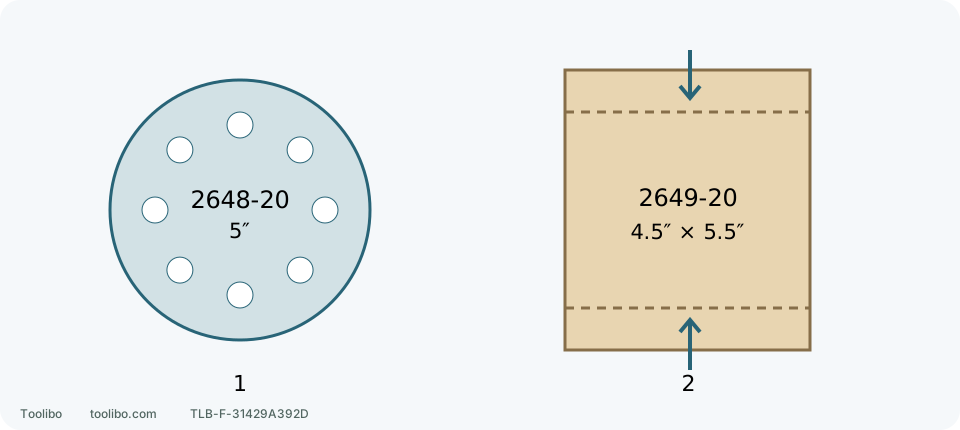
2648-20Random-orbit sander
- 5-inch random-orbit pad; 3/32-inch orbit.
- 7,000–12,000 OPM; six-position dial, without a per-position OPM table.
- Hook-and-loop pad; separate PSA-pad arrangement described in the manual.
2649-20Orbital quarter-sheet sander
- Orbital quarter-sheet tool; 1.6 mm orbit.
- 11,000–13,000 OPM.
- Clamp-on 4.5 × 5.5-inch paper; matching punch required for dust holes.
1 · Disc preparation
Choose the correct hook-and-loop disc; PSA requires its own approved pad.
2 · Sheet preparation
With battery removed, secure front, tension and secure rear, then use the matching punch.
The disc needs matching backing and dust holes. The sheet needs clamping allowance, tension and the supplied hole punch. Dashed lines illustrate clamping ends, not a cutting or folding template; sheet dimensions are not effective pad contact dimensions.
Start with the surface, not the OPM figure
The US 2648-20 is a 5-inch random-orbit sander; the 2649-20 is a quarter-sheet orbital sander. Both use M18 batteries, but their abrasives, support requirements and contact-start sequence differ. Familiarity with one does not replace instructions for the other.
Swipe or scroll horizontally to see all columns.
| Dimension | 2648-20 | 2649-20 |
|---|---|---|
| Contact shape | 5-inch circular pad | Rectangular pad and clamped sheet |
| Motion | Eccentric orbit plus pad rotation | Small orbital movement of the flat pad |
| Published rate | 7,000–12,000 OPM | 11,000–13,000 OPM |
| Published orbit diameter | 3/32 inch, approximately 2.38 mm | 1.6 mm |
| Abrasive preparation | Correct hook-and-loop disc and dust pattern; PSA needs a separate appropriate pad | 4.5 × 5.5-inch paper, clamped and pierced with the supplied punch |
| Included extraction arrangement | Filtered dust box, hose adapter and extension adapter | Dust bag and hose adapter |
The sheet dimensions include clamping material; they are not a promise of full effective contact area. OPM counts orbits, not pad revolutions. A higher number alone establishes neither faster removal nor a finer finish.
Broad tabletops and doors: why consider 2648-20
An open panel without internal corners can support the circular pad completely. The 2648-20 manual permits movement in different directions and notes that random-orbit sanders act more aggressively than simple orbital sanders. That supports considering it first for broad-panel preparation and removing existing marks, not claiming a measured speed win on every material or a swirl-free guarantee.
Heavy pressure, a clogged disc or trapped grit can spoil the surface. Keep the pad flat and moving in broad overlapping passes, checking frequently. Do not dwell on a spot or tilt the round edge to excavate a defect. Thin veneer, narrow rails and exposed edges require conservative removal and adequate support; sometimes a hand block is the better choice.
Straight boundaries: the quarter-sheet trade-off
A rectangular edge is easier to relate to straight frame boundaries or a flat narrow face. The 2649-20 manual calls for slow overlapping strokes parallel to the grain. With suitable abrasive, that fits further refinement of an already reasonably flat surface.
A rectangle does not reach every enclosed inside corner. Housing, clamps, extraction parts and orbital travel need clearance. If only a tiny corner of the pad contacts the work, adequate support and an even finish are lost. Deep grooves, pointed corners or areas too narrow to support the pad need an appropriate detail tool or hand method.
Price the preparation, not just the paper
Changing a 2648-20 hook-and-loop disc is straightforward, but you need the correct diameter, backing and dust openings. Worn hooks add appropriate backing-pad maintenance to the cost. Its standard pad is 51-36-7100; the dedicated disc guide explains the purchasing checks.
Only handle stable equipment safe to approach. With smoking, leaking or persistently abnormally hot batteries, do not approach, touch or remove them to inspect; keep away and seek local emergency guidance.
Before clamping paper, switch off, wait for a complete stop, remove the battery and keep it removed. The 2649-20 can use specified quarter sheets, but a roughly cut rectangle is insufficient. Its manual calls for about 1/4 inch under the front clamp, then drawing the sheet tight around the pad, securing the rear and using the supplied punch to make aligned extraction holes. Loose paper, inadequate clamping or omitted holes can erase a low purchase-price advantage. Compare local prices at matching grits, changeover time and usable stock rather than assuming a universal cost winner.
Check space and the different starting sequences
First establish that the material and coating can be sanded, arrange suitable dust control and secure the work. Unknown coatings or suspected lead/asbestos require qualified assessment; do not trial-sand to choose a machine. Neither included dust arrangement certifies every vacuum for every material.
Normally switch off, wait for full stop and remove the battery before assessing pad support, hand/battery room and hose drag. Keep the battery removed; do not run a tool into a tight gap to explore fit.
Before returning to operation, fit the correct abrasive and extraction under that model’s instructions, confirm the switch is off, then secure the compatible battery. Place 2648-20 on the work before starting; start 2649-20 before contact. Follow each manual for stopping and removal too; this difference is not a universal rule for every round and rectangular sander.
For open broad surfaces with some material removal, examine 2648-20 first. For refinement along grain and a clamped-paper workflow, examine 2649-20. If neither can remain properly supported at your narrow edge or inside corner, neither is the right answer there.
Models referenced