
Identify the machine, not just the round pad
A round disc does not determine the shutdown sequence. Bosch ROS20VS and RYOBI PCL406 are compared here so that changing machines does not carry the wrong final movement across with it. This is not a performance ranking.
The documents are ROS20VS 2610051955, 08/18, and PCL406 998000620, 11-25-24 REV02. Match the body and applicable instructions first. These are normal sanding sequences with correct paper, an allowed material and secured work. Brake checks or special cooling operations are not ordinary sanding starts. Unknown coatings, suspect hazardous materials and obvious faults must be addressed before power is restored.
Same contact start, different place to finish stopping
Bosch ROS20VS: start on the work, lift before switching off.
- Unplugged, finish paper, collection, clamping and cord checks. Confirm the switch is off before connecting power.
- Hold the tool correctly, place the pad flat on the secured work, then switch on. Move steadily rather than dwelling in one spot.
- At the end of the pass, lift the tool away first, then switch off. Keep control and wait for all disc movement to stop before setting it down.
- Unplug before touching the surface for inspection, changing paper, emptying collection or adjusting clamps. Stopped is not isolated.
RYOBI PCL406: start on the work, switch off and stop completely on the work before lifting.
- For a normal, stable tool, complete external preparation with the battery removed. Confirm the switch is off, refit the pack and check both latches are secure.
- Place the pad flat on the work, switch on and move normally.
- Switch off at the end, keeping the sander on the work until the disc stops completely. Only then lift it away. Do not import the ROS20VS lift-first movement.
- Remove the battery before adjustments, inspection or paper changes. A smoking, leaking or increasingly abnormally hot pack is not a routine removal exercise: keep away and use appropriate emergency help.
Waiting on the work with PCL406 does not mean running in one place: the switch is already off. Neither procedure permits stopping a disc by hand or pressing it against another object.
Rehearse the first and last movement without power
After changing tools, rehearse the route with power isolated. Check support under the flat pad, clamp clearance, cord or hose freedom both outward and back, and a safe set-down location. Keep hands on the permitted grips, never below the pad.
For ROS20VS, check that lifting at the end does not make the hose pull the tool sideways. For PCL406, arrange a stopping location that still fully supports the flat pad: do not reach the edge before realizing half the pad is unsupported. Change the clamping or work zones if the route fails, then rehearse again. Tilting one corner is not a substitute.
An unpowered rehearsal is not a material test. Before a real sample, verify abrasive, material, dust control, switch-off, reconnection and the model sequence. Start with a small area of matching scrap. Repositioning clamps requires another shutdown, complete stop and isolation, not one hand on a running sander and the other on a clamp.
Other models: what cannot be borrowed
DWE6423 N412818 APR15 and DCW210 N648180 Sep18 support their switch and power preparation, but do not establish an explicit contact/lift sequence here. Do not copy either sequence above merely because the tool is a random-orbit sander. Obtain complete applicable instructions for the body, Type and market; do not perform powered start/stop trials while the sequence remains unclear.
SR211601 printed page 13 says remove from work before switch-off in one passage, but later describes releasing the switch while gently lifting at the same time. That difference remains unresolved. This guide chooses neither, and a newer catalog does not clarify an operating contradiction. Keep to isolated checks until the applicable sequence is confirmed. Instructions for SR250801 or another model do not replace it.
Correct movements do not excuse abnormal behavior
Impact, loss of control, abnormal vibration, smell or a switch that will not reliably turn off requires safe shutdown and isolation, not repeated starts for practice. Do not set down or touch the moving pad to investigate. Keep away from equipment that cannot be approached safely and obtain appropriate help.
Resume only after an ordinary external cause has been corrected, with no danger signs, damage or unresolved abnormality, and with the model sequence confirmed. Switch failure, suspected brake faults and unexplained shutdown are not grit-selection problems. Learn the machine in your hands rather than a slogan for every sander.
Two normal sanding sequences, not one universal rule
Two rows show ROS20VS lifting while on then switching off, and PCL406 switching off and stopping on the work before lifting.
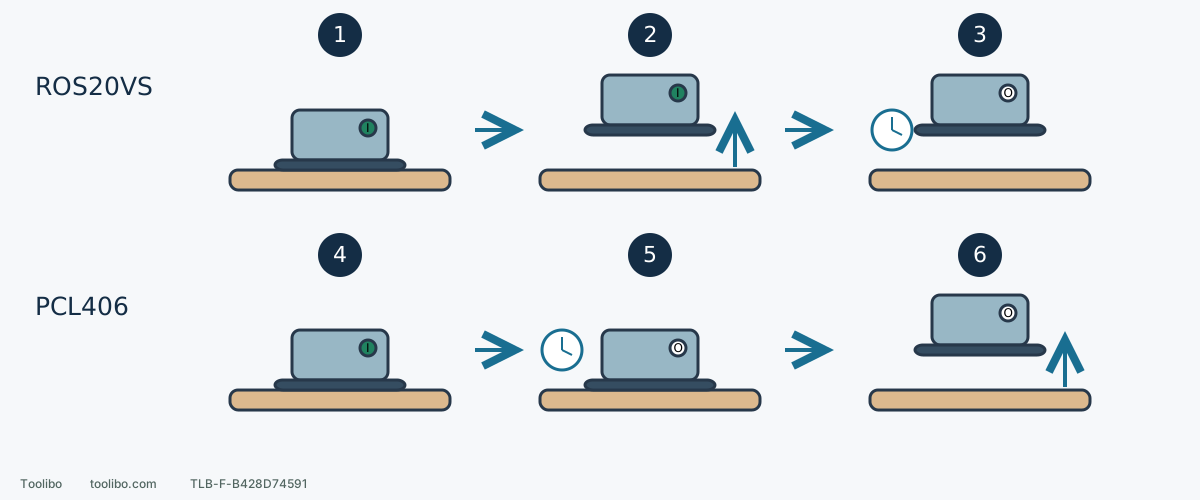
1–3. ROS20VS: contact, lift, then off
Start with the pad flat on secured work. At completion lift first, switch off and hold until all motion stops before setting down; unplug before adjustment.
4–6. PCL406: contact, off and stop, then lift
Start flat on secured work. Switch off and leave the pad on the work until it stops completely; only then lift. Remove the battery before adjustment.
Conceptual side views; I means on, O means off and the clock means wait for complete stop, not a timed interval. No brake-test or other model sequence is shown.
Models referenced