
PCL406 routine brake check is not ordinary sanding
Only a symptom-free, applicable PCL406 routine check uses the bare pad clear of the work. A tool already behaving abnormally stays out of use.
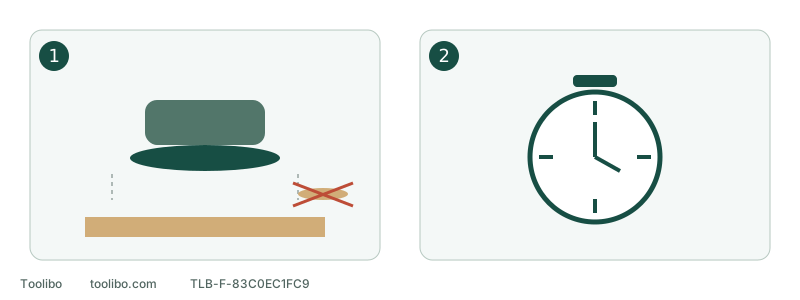
1. Disc removed, no work contact
Prepare while isolated; confirm OFF and both battery latches before the specified check.
2. Observe natural stopping
Switch off; longer than six seconds in this exact check requires authorized service.
Only a symptom-free, applicable PCL406 routine check uses the bare pad clear of the work. A tool already behaving abnormally stays out of use.
Apparent speed does not identify a fault
A random-orbit sander combines small orbital motion with pad rotation. Workpiece contact and pressure change the rotation you see; slow-looking rotation does not directly establish a lack of material removal. Milwaukee 2648-20 instructions explain the influence of pressure, and RYOBI PCL406 instructions do not treat visible rotation as a sanding-performance gauge.
Those characteristics cannot explain every sudden change. New noise, pronounced vibration, loose parts or unusual stopping behaviour must remain an unresolved change, not be dismissed as the wrong abrasive. A departure from its previous behaviour is more useful to report than an estimated video speed with no operating conditions attached.
Already abnormal: stop, without another run to confirm
When safely controllable, switch off, retain control until motion stops completely, then remove a normal battery before external inspection. Never brake the pad with a hand, cloth or loose object. Do not lift a running machine near your face to watch it. For smoke, persistent abnormal heat or imminent danger, move away and seek appropriate help; do not risk touching or removing a dangerous battery.
While keeping it out of use, record existing observations and inspect accessible external items: a misfitted disc, damaged pad edge or an unverified added protector or interface pad. Do not open the housing, tighten unidentified fasteners or add lubricant. Even finding a crooked disc does not establish that abnormal braking is repaired.
What does the PCL406 six-second limit actually describe?
The PCL406 periodic check concerns brake operation after extended use, not a universal stopping limit. Its configuration differs from ordinary sanding: remove the sanding disc, run the machine without load off the workpiece, then switch off and observe whether the backing pad takes longer than six seconds to stop. If it does, return it to the nearest authorized service centre.
Timing with a disc fitted, against wood or while touching the pad is not that test result. Do not apply pressure, change accessories or oil brake parts to achieve six seconds. Other models need their own requirements; ROS20VS, 2648-20 and others cannot borrow the PCL406 limit.
Routine checking and reproducing a fault are separate routes
Swipe or scroll horizontally to see all columns.
| Current condition | Appropriate route |
|---|---|
| No abnormal symptoms, confirmed PCL406, periodic check after extended use planned | Confirm the complete applicable brake-check instructions and safety requirements, then use the restricted sequence below |
| Sudden motion change, abnormal noise or vibration already occurred in normal work | Keep out of use for support or service assessment; do not repeatedly run unloaded to reproduce it |
| Model, accessory arrangement or manual version uncertain | Resolve identity and instructions first; six seconds is not a generic test |
| Applicable check already completed and stopping exceeded six seconds | Stop using it and obtain authorized service, not more sanding or pressure compensation |
For a symptom-free PCL406 to which the routine check applies: switch off, wait for a complete stop, remove the battery and remove the sanding disc. Confirm normal external condition, keep people and objects away from the pad and prepare a secure grip. Confirm OFF before refitting a suitable battery and check that both side latches lock securely. Run unloaded off the work under the complete check instructions, then switch off and observe natural stopping. Isolate power again afterwards. This unloaded procedure belongs only to that model’s brake check; it does not replace its ordinary sanding method of contacting the work before starting.
If you cannot confidently establish applicability, grip or stopping observation, have authorized service perform the check. Do not reach toward the pad to time it, ask someone to catch it or adjust a camera near the running machine. No universal repeat count is prescribed here, and approaching a limit does not mean repeated running will fix it.
Describe the conditions accurately to service
Provide body model, serial information or label photos, pad and abrasive details and any recent accessory changes. Distinguish a change already noticed during work from slow stopping found in the precisely configured periodic check. Do not rewrite a casual working observation as completion of a manufacturer’s test.
If a stopping time already exists, say whether the disc was removed, whether it ran unloaded and which model it was. If not accurately recorded, say the check was not done rather than restarting just to obtain a number. Removing wood does not establish correct braking; a static accessory fit does not establish internal operating condition. Keep power isolated and clearly mark it awaiting repair until appropriately resolved.
Models referenced