
Map the mark before choosing treatment
A paving plan shows a metal chair footprint, vehicle drip point, shaded growth and a small dry comparison patch, linked to separate decision markers.
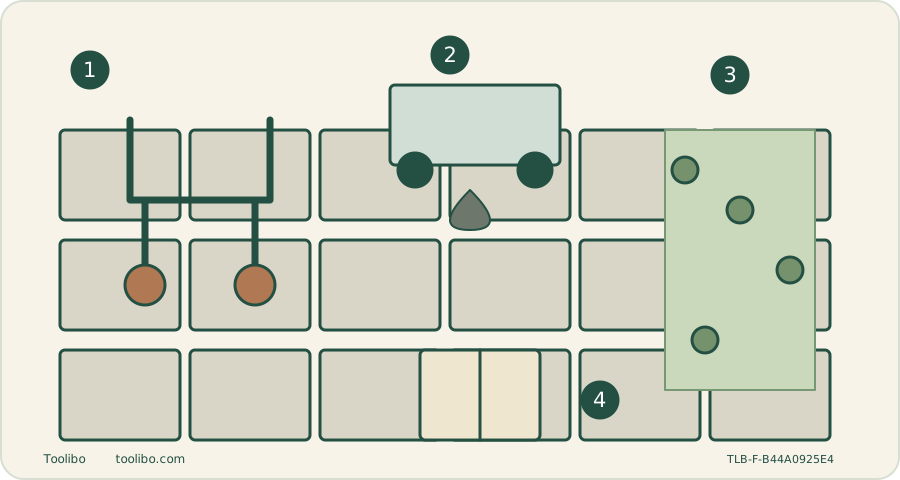
Identify
Confirm the paving material and finish.
Map
Record the mark and likely continuing source.
Trial
Compare a permitted gentle clean after drying.
Decide
Use a stain-specific compatible route or seek help.
Location guides the questions; it does not prove the stain’s chemistry.
Record the material and the pattern
Find the paving’s exact product name and finish. Natural stone, concrete paving and porcelain have different care requirements; “stone patio” is not sufficient identification. Note any sealer, previous treatment or repaired area. If the product is unknown, ask the supplier before applying stain chemicals.
Photograph the dry area and its surroundings. A mark under a metal chair, beside a vehicle or beneath a dripping plant pot provides a useful clue, but not a confirmed chemical diagnosis. Map whether it follows a joint, shade line, drainage route or object footprint.
Do not start with an acid test or a bleach mixture to identify the material. These can change the surface and destroy the evidence you need. Marshalls’ maintenance guidance distinguishes different stain types and calls for trial cleaning; that is a reason to select a compatible route, not to apply every listed treatment in sequence.
Establish what gentle cleaning removes
Sweep loose debris and use the paving maker’s permitted general-cleaning method on a small sound area. Keep a neighbouring untreated comparison. Control rinse water so loosened soil does not dry over the trial and create a new film.
Let the patch dry before judging it. Wet stone often looks darker, so a wet-versus-dry photograph cannot establish improvement. Compare texture as well as colour: a pale streak where the finish has roughened is not a successful stain removal.
Stop if joint material washes out, a coating lifts or the surface visibly changes. Those observations belong to the joint or material-care route, not to a stronger nozzle selection.
Use the remaining pattern as a question
Swipe or scroll horizontally to see all columns.
| Remaining observation | Question and next action |
|---|---|
| Orange-brown mark beneath metal furniture | Is the furniture contributing rust? Remove the continuing source and seek a compatible stain method. |
| Dark mark at a parked vehicle’s drip point | Is there a fresh fluid leak? Address the source and identify the residue before selecting cleaner. |
| Green or dark growth concentrated in shade | What moisture and debris conditions support recurrence? Use the material’s approved growth-removal route. |
| Pale deposit or uneven colour across units | Could it be mineral deposition, treatment residue or normal variation? Obtain product-specific identification. |
| Clean-looking stripe with changed texture | Stop; assess possible abrasion rather than trying to blend the area with more spraying. |
These are investigation prompts, not visual diagnoses. The same colour can have several causes, and two different marks may coexist in one patio.
Select a treatment only after the material match
- Confirm the paving and any sealer with the supplier or installer.
- Describe the mark’s location, duration and possible source. Provide dry photographs and note previous products used.
- Obtain a cleaner explicitly suitable for that material and stain, including its label precautions and wastewater requirements.
- Carry out the specified small-area trial. Do not combine cleaners or apply a second product over an unremoved first one.
- Compare the fully finished, dry trial and decide whether to continue, repeat only if permitted, or seek specialist help.
No acid, bleach or solvent recipe is supplied here. A method that removes one stain can damage a different stone, pigment, coating or nearby metal. Product compatibility and safe handling are part of the choice, not an afterthought.
Deal with recurrence and realistic limits
If the stain returns under the same chair foot, more frequent washing has not addressed its source. If shade and leaf debris keep an area damp, remove the debris and improve ordinary maintenance without assuming the pressure setting was wrong.
Some marks cannot be completely removed without altering the finish. For example, a homeowner may clean general mud successfully but still see an older oil mark. Documenting that separate issue and choosing a compatible specialist route is a better result than repeatedly eroding the surrounding clean paving. The goal is a sound surface and a reasoned next action, not a promise that every stain disappears.