
Four checks before liquid enters the system
Water inlet, onboard tank and gun-mounted bottle shown as different routes.
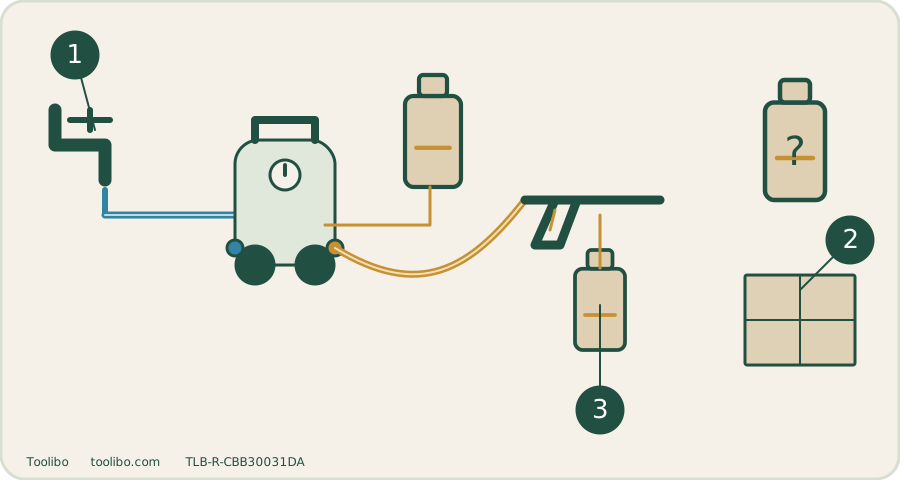
Machine
Verify the permitted chemical and attachment.
Object
Check coating and material restrictions.
Route
Use instructions for the actual application method.
A similar-looking container does not establish the same dosing or chemical exposure.
Identify the route before the product
Trace where the liquid would go. A low-pressure water inlet feeds the pump; a built-in detergent tank follows a model-specific injection route; a bottle attached to a foam lance is another arrangement. Similar-looking containers do not mean identical dosing or chemical exposure.
Do not pour detergent into a supply bucket on the assumption that the pump will dilute it. A self-priming water setup is not automatically a chemical-feeding setup. Likewise, a bottle after the pump does not make a prohibited chemical safe for the gun, seals, surface, operator or runoff.
Complete four approval checks
Swipe or scroll horizontally to see all columns.
| Check | Evidence you need | If it fails |
|---|---|---|
| Machine | Exact manual permits the product type and intended attachment | Do not fill that system |
| Object | Surface/coating maker permits the cleaner and application method | Choose another approved cleaning method |
| Route | Label instructions cover the actual tank, lance, sprayer or hand application | Ask the manufacturer; do not transfer a different route’s dose |
| Use conditions | Legible dilution, protective measures, dwell/rinse and temperature restrictions | Pause until the instructions are available |
A label saying “pressure-washer detergent” does not by itself answer all four questions. Keep the product in its labelled original container while checking it. Never identify an unknown liquid by smelling or mixing it.
A real label shows why route matters
SONAX PROFILINE ActiFoam Energy, article 06183000, lists different directions for a foam lance, a foam sprayer and manual washing. For manual washing it specifies 50–80 ml in 10 L of water; that is not an instruction to put the same mixture into every washer tank. The label also excludes hot surfaces and drying in place.
This example demonstrates how to read a label, not blanket approval of that product for your machine or every vehicle finish. The washer and object checks still have to pass. If the required application route is unavailable, select an approved alternative rather than improvising an injector.
Prepare a small, traceable job
Once all checks pass, measure only the quantity needed using a suitable marked container reserved for that product. Follow the label’s mixing order and dilution notation; do not assume every “1:10” is defined identically. Keep food containers out of the process and label any permitted working solution clearly.
Test the approved method on an allowed inconspicuous area. Arrange the job so the solution can be rinsed within its instructions rather than drying while you fetch equipment. Watch the surface and weather, not just the thickness of foam. More foam does not prove more effective or safer cleaning.
Know the stop conditions
Do not mix bleach, acids, solvents or other household products together. Do not treat dilution as permission to use a chemical the machine or surface prohibits. If an unknown or wrong product has already been added, do not start the machine to “flush it through.” Keep it isolated and ask the machine and chemical suppliers for safe handling and recovery advice.
At completion, use the exact permitted detergent-system rinse procedure and follow the label and local arrangements for remaining solution and runoff. Do not return contaminated working solution to the original bottle. Record the product, route and successful dilution so the next job starts from a known setup rather than a guess.