
Observe from the ground; leave roof and electrical work to professionals
Ground observer, solar array with sunlight, crossed ladder and a service-record sheet.
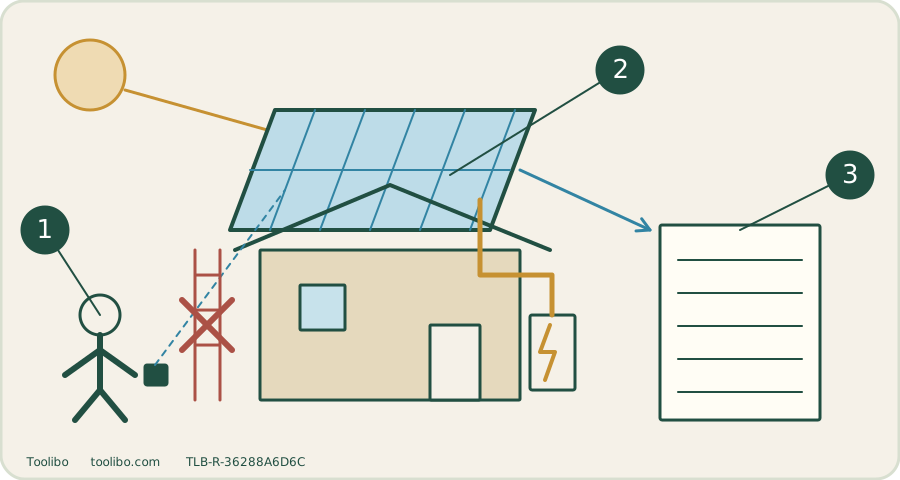
Observe
Use a safe ground position and existing monitoring.
Assess
Professional plan covers access and electrical condition.
Record
Review service findings under comparable conditions.
Sunlight can generate electricity despite a household disconnect; the figure does not show a DIY shutdown.
Start with observations you can make from the ground
Find the system documents and identify the panel manufacturer, model and installer. Use existing monitoring records, if available, to note a change in generation without opening any enclosure. Record the date, weather context and whether nearby shade has changed. A lower reading on a cloudy day is not proof that dirt caused a fault.
From a safe ground position, look for obvious dust bands, bird deposits, leaves, cracked-looking glass or displaced components. A photograph from that position is enough for an initial enquiry. Do not climb onto a roof or reach behind panels to improve the picture.
Separate cleaning from electrical assessment
Swipe or scroll horizontally to see all columns.
| Observation | Appropriate next step |
|---|---|
| Visible dirt, otherwise no known fault | Ask the installer whether cleaning is warranted and which method applies |
| Damage, displaced parts, exposed-looking cable or an electrical concern | Keep clear and request qualified assessment before any cleaning |
| Generation change without visible soiling | Review monitoring context with the installer; do not assume washing will fix it |
| Inaccessible roof array | Arrange suitable professional access; no household ladder-and-hose workaround |
SunPower’s cleaning advice excludes pressure washers, hard brushes, walking on panels and detergents. Australian government guidance recommends qualified panel cleaning. These sources do not establish one cleaning interval or a guaranteed percentage gain for every installation.
Do not create a false isolation step
Photovoltaic modules can generate electricity while exposed to light. Switching a household disconnect or inverter off is not proof that all panel-side conductors are safe. Do not unplug connectors, open an inverter, test wiring or operate switches as a DIY preparation procedure derived from this article.
Roof access, fall protection, electrical condition and the exact module cleaning requirements belong in the professional work plan. Even a ground-mounted array requires an installation-specific assessment; being reachable does not remove its electrical components.
Prepare a useful cleaning brief
Send the provider the panel model, system layout if already documented, safe-distance photographs and a short description of the concern. Ask these questions before accepting the plan:
- Will the method comply with the exact module and installation instructions, without a pressure washer or abrasive treatment?
- Who checks for damage before water is used, and who handles any electrical fault?
- How will roof access, surrounding property and drainage be protected?
- What observations and completion record will be supplied afterward?
Do not ask the cleaner to promise a fixed output increase. Cleaning can remove deposits, but it cannot repair an inverter fault, failed connection or changed shade.
Know what a gentle method should accomplish
Where the exact manufacturer permits it, a qualified cleaner may use clean water and soft non-abrasive tools rather than force. The desired result is removed contamination without scratching, seal damage or disturbed cables. Temperature, water quality and rinsing requirements should come from that installation’s instructions, not a universal recipe copied from a different panel.
After service, review the report for any unresolved damage and compare later monitoring under reasonably comparable conditions. Do not treat a single sunny afternoon as a controlled before-and-after test. Keep the service record and use it to plan the next inspection based on actual conditions rather than an invented monthly washing schedule.