
Run water downward, not behind the overlap
A wall cross-section shows overlapping boards with downward runoff; an upward jet beneath a joint and paths into a window edge are crossed out.
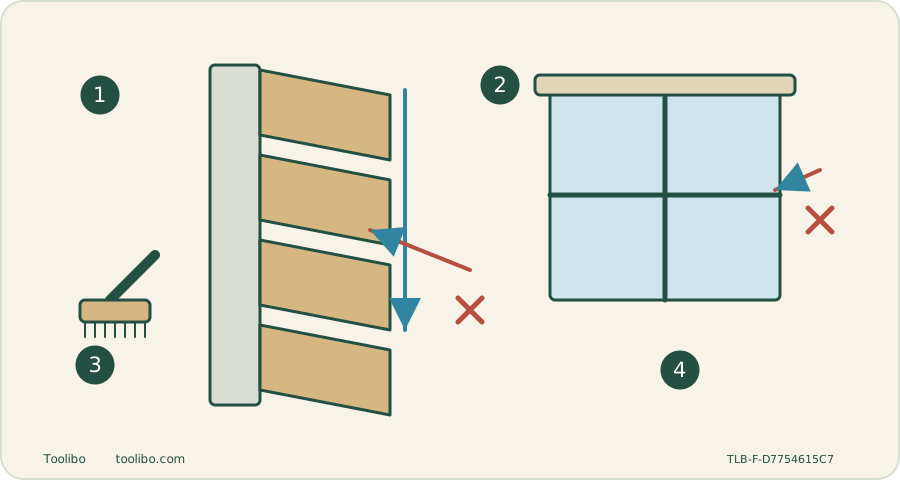
Identify
Match the siding and finish instructions.
Inspect
Find open joints and vulnerable penetrations.
Clean
Use the permitted soft-tool and low-pressure route.
Recheck
Compare dry finish and watch for water entry.
A wall’s overlaps and openings determine the cleaning boundary.
Identify the wall before choosing the tool
Find the siding product, finish and care instructions. Painted fibre cement, vinyl, timber and coated panels are not interchangeable. Even one house can have different materials on a porch, gable and main wall. Do not carry a method from the driveway onto the wall merely because both look hard.
James Hardie’s cleaning guidance uses a garden hose and a soft nonmetal brush rather than a high-pressure washer. Its product-specific finish guidance takes precedence. This example establishes a gentle route for that siding; it is not a universal permission or a pressure setting for all facades.
Check the area from the ground for loose boards, open joints, damaged sealant, peeling finish and previously damp locations. Cleaning cannot repair these conditions. If their significance is unclear, resolve the wall defect before wetting it.
Trace where water could enter
Look at lap joints, window and door edges, vents, electrical fittings and penetrations. Ordinary rain running downward is different from a jet aimed upward into an overlap. A visible gap should not be treated as a convenient place to rinse accumulated dirt.
Plan a reachable section with secure footing and control over the hose. Do not combine a pressure gun with a ladder or lean out to reach a distant patch. If the upper wall cannot be cleaned with appropriate ground-based equipment under the material instructions, use a qualified contractor rather than improvise an extension arrangement.
Move nearby items and account for runoff. Close openings where appropriate, but do not assume closing a window makes its seals resistant to pressure. Do not seal over ventilation or electrical components as an improvised waterproofing project.
Use the gentle route deliberately
- Choose a small sound test area and photograph it dry. Keep an untreated comparison so you can distinguish cleaned colour from wet darkening.
- For ordinary dirt on the specified Hardie example, use water with a soft cloth or nonmetal brush. If a cleaner is needed for a particular soil, match it to the finish and label rather than mixing household chemicals.
- Work manageable sections, using the board’s direction and a controlled downward rinse. Keep water out of joints and openings rather than trying to scour inside them.
- Do not let a permitted cleaner dry on the wall. Remove residue with the allowed rinse method and stop if the finish transfers, peels or changes texture.
- Let the test dry. Inspect the wall and nearby interior locations where water-entry signs could appear before extending the work.
For greasy marks, the relevant finish instructions may call for a mild soap solution. That does not make every degreaser acceptable. Dark growth, paint failure and staining each need their own diagnosis rather than progressively stronger spraying.
Decide from the result
Swipe or scroll horizontally to see all columns.
| Observation | Next action |
|---|---|
| Dirt releases and the dry finish is unchanged | Continue the same approved gentle method. |
| Stain remains after loose dirt is gone | Identify the stain and seek finish-specific guidance. |
| Water appears behind trim or inside the wall | Stop wetting; address the entry route before cleaning again. |
| Chalky coating transfers or paint lifts | Stop and obtain finish advice; do not treat the coating as dirt. |
A clean lower wall does not prove that a higher, weathered section will react identically. Repeat the condition check when the material, orientation or finish changes.
Keep an object-specific record
Record the siding family, finish, cleaner if any, location and dry result. Photograph gaps or damaged coatings separately from dirt. These notes help a contractor understand whether the next task is cleaning, coating maintenance or repair.
For example, a dark stripe under a window may follow a repeated water path. Removing the stripe alone does not correct that path. The successful outcome is an intact, dry wall with removable soil gone—not the strongest possible rinse.