
Shut down and pack away
Numbered schematic explaining Shut down and pack away.
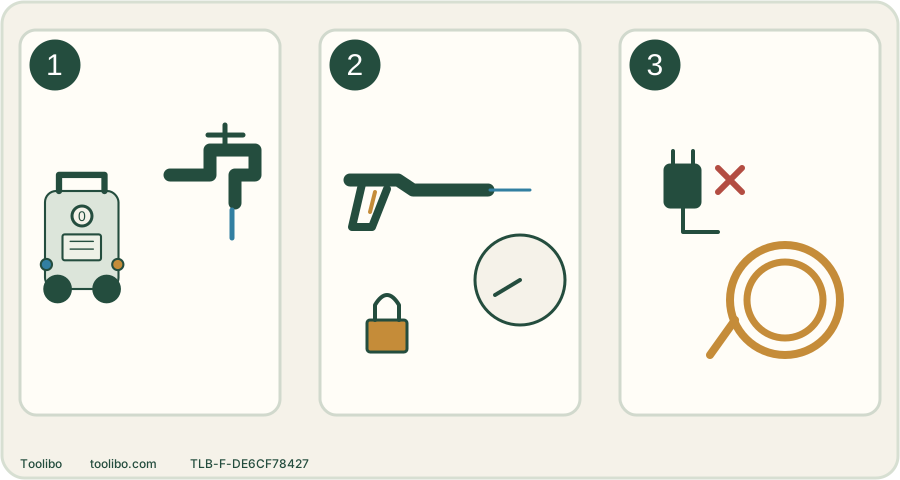
Bosch example: stop supply
The documented sequence starts with machine OFF, then water tap closed.
Release and lock
Point safely, operate the trigger to release pressure, then engage its lock.
Isolate and store
Isolate mains before disconnecting and cleaning; coil without kinks and store frost-free.
Finish detergent flushing first, follow the exact machine’s stopping order, then isolate and disconnect only after pressure has been released. Conceptual schematic, not a product image or scale drawing.
Finish any detergent work before shutting down
If detergent was used, rinse the treated surface and flush the applicator according to its instructions while the system is still set up correctly. Do not leave chemical residue to dry in a bottle, injector or nozzle. Keep the gun directed safely while flushing and keep the supply available for the permitted procedure.
A brief pause to move a pot is not end-of-job shutdown. The Bosch autostop function stops the motor when the trigger is released, but it does not disconnect electricity or prove the hose is safe to remove. Do not leave an energized washer unattended.
Worked example: Bosch UniversalAquatak stopping diagram
The 2025 UniversalAquatak 125/130/135 instructions show the following stopping order in diagram H:
- Turn the machine’s main switch off.
- Close the water tap.
- Direct the gun safely and operate the trigger to release retained pressure.
- Engage the trigger lock.
Isolate the mains supply before disconnecting equipment, cleaning or maintenance. The manual’s maintenance instructions also require disconnection from the water supply. Release pressure before undoing high-pressure fittings; do not use a connector as a pressure-release valve.
This order is deliberately tied to that Bosch manual. Other manufacturers can include a different drain sequence, including a specifically bounded powered step. Do not combine steps from different machines or turn a winterizing instruction into a routine dry-running habit.
Disconnect without forcing fittings
With power isolated and pressure released, remove the hose and accessories using their intended release mechanisms. If a fitting resists, do not pry it apart or loosen a high-pressure joint while it is still loaded. Recheck the correct shutdown and pressure-release method. Never search for a high-pressure leak with a hand.
Let removable hoses and accessories drain as their instructions permit. Keep connectors clean and inspect seals for damage. Do not open the pump housing to drain it after an ordinary wash; seasonal pump draining is a separate model-specific task.
Clean the exterior and coil loosely
For this Bosch example, exterior cleaning uses a soft brush or cloth, not a jet of water, solvent or polish. Clear ventilation openings gently. Coil the high-pressure hose without sharp bends, pinching or trapped twists; store the cable without trapping it under the machine. Do not hang heavy accessories from their coupling or stack loads on the washer.
A cut, blistered or leaking high-pressure hose needs the specified replacement route before next use, not tape. Put damaged equipment aside with a clear note so someone else does not pick it up assuming it is ready.
Choose a frost-free place
Store the machine and accessories in a frost-free area. An emptied hose does not prove that the pump contains no water. If freezing conditions or long-term storage are expected, follow the exact model’s winterizing instructions separately. Do not improvise compressed air, antifreeze or long dry-running cycles.
Before the next job, check that the inlet filter, connectors and seals are present and clean. A short note about the last fault, accessory used or supply problem is more useful than repeatedly discovering it during the next wash.
Before leaving, check three separate states: the electrical supply is isolated, the hose is no longer under retained pressure, and water is no longer being supplied. A quiet motor confirms none of these by itself.