
Engine, sealed pump and serviceable pump are separate systems
A petrol engine silhouette connects mechanically to two alternative pump profiles:90028 with closed casing and 90036 with an external sight glass, each linked to its own record.
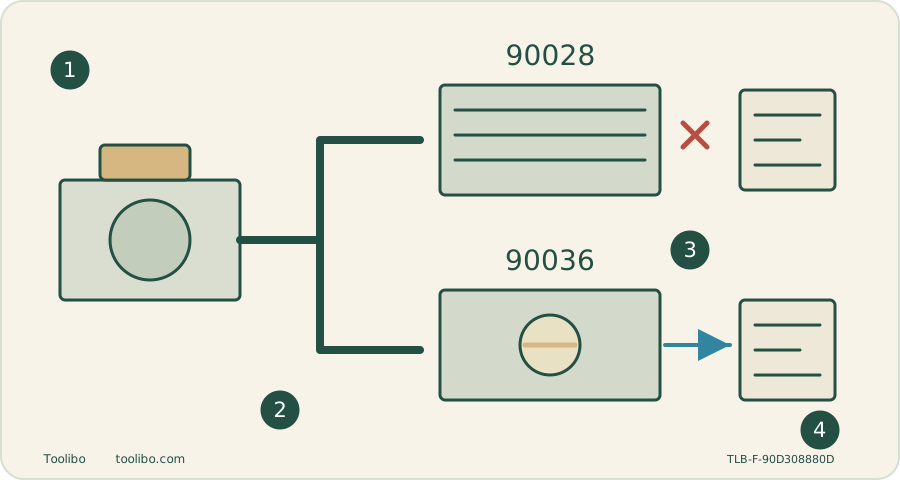
Identify
Read the actual pump record.
Separate
Keep engine tasks apart from pump tasks.
Match
Use only the applicable owner procedure.
Escalate
Send unexplained leaks or mismatches to service.
The sketch identifies maintenance categories; it is not an exploded repair diagram.
Identify the pump, not just the washer badge
Record the washer model and any visible pump identification without removing covers. A machine may have been repaired with a replacement pump, so a generic brand guide is not enough. Use the parts record or service history to resolve a mismatch.
For a petrol pressure washer, identify the engine and pump as separate systems. An engine oil cap, dipstick or service reminder does not establish the pump’s oil requirement. Do not pour engine oil into an unidentified opening.
Compare two documented examples
Swipe or scroll horizontally to see all columns.
| Example | What the manufacturer establishes | Owner decision |
|---|---|---|
| OEM Technologies 90028 axial-cam pump | SIMPSON describes its crankcase as maintenance-free with no oil changes | Do not invent an oil-change procedure for that sealed system. |
| AAA 90036 triplex pump | Its linked pump manual includes a sight-glass check and oil-change schedule | Use that exact pump’s instructions and service competence, not the 90028 rule. |
The 90036 manual specifies an initial oil change after 50 hours, then every 100 hours or 3 months. That is an example showing that service obligations can differ—not a schedule for every triplex pump or every SIMPSON machine. The model association is essential.
What still matters on the sealed example
SIMPSON’s FAQ states that its maintenance-free pumps still need winter protection. Correct inlet supply, clean approved filters, sound hoses and proper shutdown remain relevant; none of these tasks is replaced by sealed lubrication.
A “no oil changes” statement also does not promise a particular lifetime or immunity to freezing, dirty supply water or dry running. If a sealed pump leaks or behaves abnormally after external checks, the answer is not to drill a fill point or remove casing screws to search for oil.
Build a model-specific care card
- Record the installed pump identity and the manual or parts record that matches it. If unknown, leave the service task pending and ask the supplier or service provider.
- Mark whether oil checking/changing is an owner-described task for that pump. Keep engine tasks on a separate line.
- Record only the approved oil specification, quantity and interval from the matching instructions if the task is applicable. Do not fill gaps by assuming automotive oil is equivalent.
- Add external water-system checks and the exact storage/frost routine. An approved protector or draining sequence for one machine is not automatically suitable for another.
- Record dates, operating hours where known and any observations that need service. A guessed hour total should be marked as uncertain rather than treated as a measured maintenance record.
This article explains how to identify the maintenance contract. It does not walk through pump removal, internal seal work or pressure-control adjustment.
Read unusual observations without improvising repair
Swipe or scroll horizontally to see all columns.
| Observation | Next action |
|---|---|
| No owner oil-check instruction for the identified sealed pump | Leave the crankcase closed and follow external care. |
| Visible oil leak or unexpectedly cloudy oil in an authorized sight glass | Stop and obtain pump-specific service advice; a fresh oil fill alone may not resolve the cause. |
| Owner manual and installed pump do not match | Resolve the replacement history before following either schedule. |
| Loss of pressure with no visible oil issue | Use the external supply/nozzle/filter diagnosis; do not assume lubrication is the cause. |
A second-hand purchase example
A used petrol washer arrives with an engine manual but no pump information. The seller says it is “maintenance-free.” That is not enough to determine whether the installed pump is 90028, 90036 or something else. Ask for the exact identification and maintenance history before planning service.
The best outcome is a clear division: owner-permitted external care, any explicitly supported oil task, and work reserved for service. More disassembly is not more maintenance.