
Elapsed time is not trigger-on time
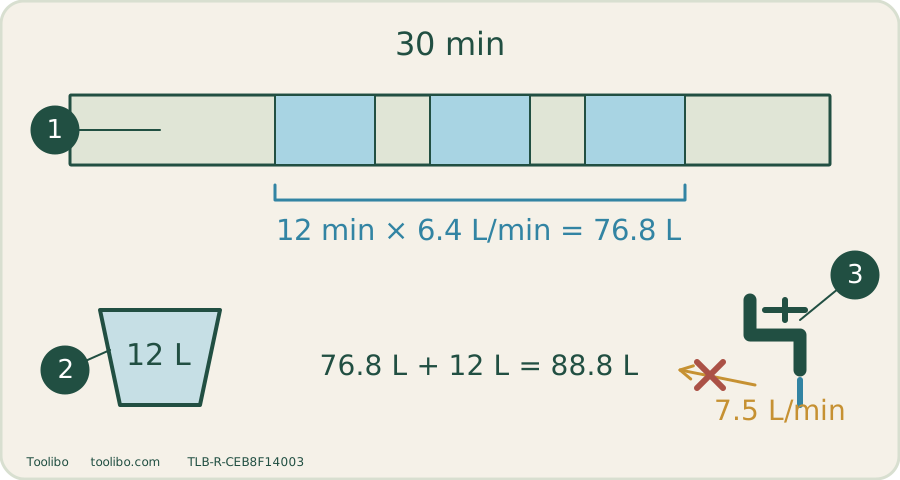
Thirty-minute timeline separates 12 spraying minutes from 18 minutes of preparation and movement;76.8 L nozzle estimate plus 12 L separate rinse totals 88.8 L.
Time
Count trigger-on periods, not the entire job.
Volume
6.4 × 12 = 76.8 L; add the separate 12 L rinse.
Supply
Check minimum feed separately; do not add 7.5 L/min to consumption.
Illustrative timing at the UA135 rated 6.4 L/min. Its 7.5 L/min minimum feed is a separate capacity check, not water to add.
Set up a small worksheet
Record the exact machine and region, the flow label and its unit, the parts of the job that use the trigger, and water used outside the washer. Keep four columns: activity, spraying minutes, planning flow and additional litres. Sweeping loose dirt before washing may change the work sequence, but do not assign an unmeasured percentage saving to it.
Use a flow value whose meaning you know. The 230 V Bosch UniversalAquatak 135 manual gives a rated flow of 6.4 L/min. That is a documented operating figure, not a measurement of your chosen nozzle and setting. For this example it is a planning assumption. If your actual configuration has no documented suitable flow, mark the estimate uncertain rather than substituting the largest marketing number.
Work through a thirty-minute job
The following times and bucket quantities are hypothetical, not a manufacturer performance test.
Swipe or scroll horizontally to see all columns.
| Activity | Elapsed time | Trigger-on time | Water entered in the estimate |
|---|---|---|---|
| Prepare and brush | 8 min | 0 min | None assumed in this stage |
| Wash in three sections | 12 min | 12 min | 6.4 × 12 = 76.8 L |
| Move, inspect and finish | 10 min | 0 min | A separately filled 12 L rinse bucket |
| Total | 30 min | 12 min | 88.8 L |
Do not multiply 6.4 by all 30 minutes: that would produce 192 L and wrongly count pauses as spraying. Equally, do not omit the bucket because it did not pass through the machine. If the garden hose provides a separate final rinse, its volume also belongs in the budget.
Show how uncertain timing changes the answer
Suppose the same job needs 18 rather than 12 trigger-on minutes. With the same planning flow, nozzle volume becomes 115.2 L; adding the same 12 L bucket gives 127.2 L. The extra six minutes contribute 38.4 L. This sensitivity check is more honest than predicting a precise volume before you know the surface condition.
For a model documented in litres per hour, divide that labelled figure by 60 to obtain litres per minute. Preserve the label: maximum flow remains maximum after conversion. Do not combine maximum pressure and maximum flow into a cleaning score or assume they occur together.
Supply capacity is a separate pass/fail check
The same UA135’s minimum supply requirement is 7.5 L/min. It tells you what the feed must be able to provide; it does not replace the 6.4 L/min rated-output figure in this example and must not be added to the estimated usage.
Check the actual supply-hose outlet with the washer disconnected, following the supply-check guide. Adequate stored volume does not prove adequate delivery. A container holding 100 L could exceed this example’s total budget yet still be an unsuitable feed because the machine’s approved supply method, flow, inlet pressure or temperature requirements are unmet. Do not infer bucket self-priming permission from a water budget.
Improve the estimate after the first section
Use a timer to record trigger-on periods without distracting the operator; a helper or notes made after safe shutdown can avoid handling a phone while spraying. Record extra rinsing by known container volume or a suitable existing water meter. If a household meter also records other taps, identify that uncertainty rather than attributing everything to the washer.
After the test section dries, check cleanliness, residue and material condition. If it needs another approved cleaning pass, revise the remaining spraying time. Damage or an unsuitable surface is a reason to stop, not merely to reserve more water. The final record should say estimated from rated flow, or explain how volume was actually measured; do not report calculated savings against an unmeasured hose-cleaning alternative.