
Engine placement and electrical reach are different constraints
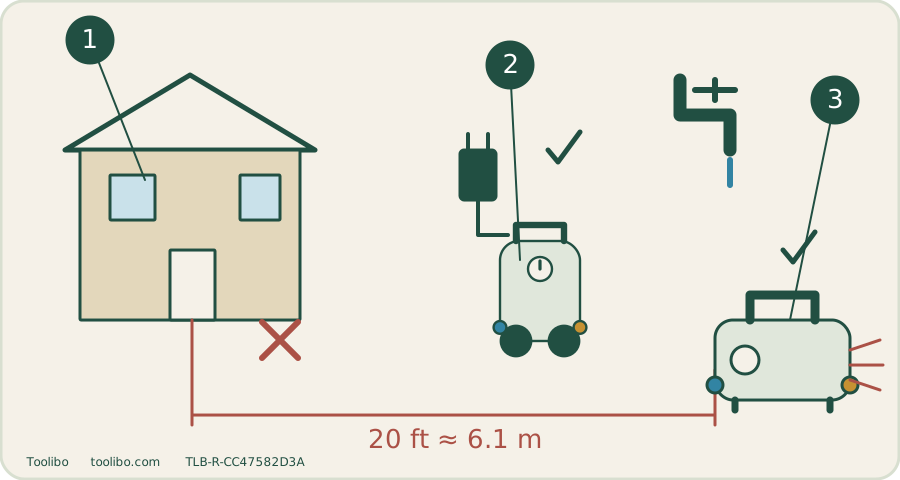
House opening with an exclusion dimension, electric washer near a dry outlet and separate outdoor petrol washer.
Openings
Keep petrol engine exhaust away from doors, windows and vents.
Electric
Confirm exact voltage, protection and permitted cable arrangement.
Decision
Choose only a setup that meets the site and manual requirements.
Petrol engines stay outdoors. CDC guidance excludes positions within 20 ft (about 6.1 m) of any door, window or vent; this distance does not guarantee exhaust safety. The dimension starts at an opening, not the house centre.
Start with where the machine can actually stand
Draw the cleaning area, water source, safe operator route and possible machine positions. Include doors, windows, vents, outdoor sockets and places where runoff collects. The position that gives the shortest hose route may be unsuitable for an engine or an electrical connection. Decide whether either power type can fit this site before comparing advertised pressure.
Both types still need the water supply and approved fittings specified for the exact model. An engine does not make inadequate inlet flow acceptable, and electric power does not make a prohibited surface washable. Separate those requirements from the choice of motor.
Treat petrol exhaust as an exclusion, not a minor inconvenience
A petrol pressure washer belongs outdoors, never in an enclosed space. CDC guidance excludes operation within 20 ft, about 6.1 m, of a door, window or vent. Measure from the opening, not the centre of the house. Reaching that distance does not guarantee exhaust safety; the position must also keep exhaust from entering occupied areas.
An open garage door does not turn the garage into an acceptable engine location. Do not place the machine indoors because the pressure hose reaches outside. If the only practical engine position is near an opening, reject that layout rather than relying on a partly closed window or a brief running time.
Petrol ownership also introduces fuel handling, engine-specific maintenance and storage requirements. Obtain the exact engine and washer manuals before accepting those obligations. This comparison does not supply an oil interval, fuel mixture or starting sequence borrowed from a different engine.
Check the electric route against the exact regional manual
For an electric washer, verify voltage, frequency, supply protection and the actual cable arrangement. Connections need a genuinely dry position away from runoff and overspray. A socket close to the job is not useful if rinse water will collect beneath it.
The US STIHL RE80 provides a concrete example: its instructions forbid extension cords, adapters and power strips. It also has specified GFCI protection and individual branch-circuit requirements. Another washer may allow a particular extension arrangement; that does not authorize one for the RE80. Do not solve a prohibited cable extension by choosing a thinner lead or a travel adapter.
If the existing installation cannot provide a permitted connection, obtain a qualified assessment or choose a different usable arrangement. Do not use the washer as a tester for an uncertain socket, and do not repeatedly reset protection to complete a job.
Compare the recurring work, not only the power source
Swipe or scroll horizontally to see all columns.
| Site or ownership question | What to establish before choosing |
|---|---|
| Engine placement | Outdoors, clear of openings and with safe exhaust management |
| Electrical reach | Exact supply and permitted cable arrangement with dry connections |
| Moving between work areas | Stable route, manageable handling and shutdown before relocation |
| After-use care | Exact draining, storage and power-source maintenance instructions |
For a small patio beside a suitable dry outlet, electric operation may avoid fuel and engine-care tasks. That is a workflow advantage, not proof of superior cleaning performance. A petrol machine may be considered where a compliant electrical arrangement is unavailable, but only if engine placement, water supply and ownership requirements can all be met.
Make a decision that survives the whole job
Walk the proposed route before purchase. Check the far side of the object, bends in the hose and the space needed to keep the machine stable. A nominal hose length does not grant the same straight-line working radius. Before moving either type, follow its safe shutdown and pressure-release procedure rather than pulling it by the hose.
Keep maximum pressure, rated pressure and flow labels distinct when comparing shortlisted models. Power type alone does not establish a measured cleaning speed, duty cycle or reliability advantage. Choose neither until the material permits cleaning, the water supply is adequate and the whole site arrangement is safe. A smaller suitable setup is more useful than a headline specification that cannot be used correctly.