
Remove power sources; separate dry and damp tools
Mower exterior, removed battery and fuse key, separate brush and cloth, crossed underside access.
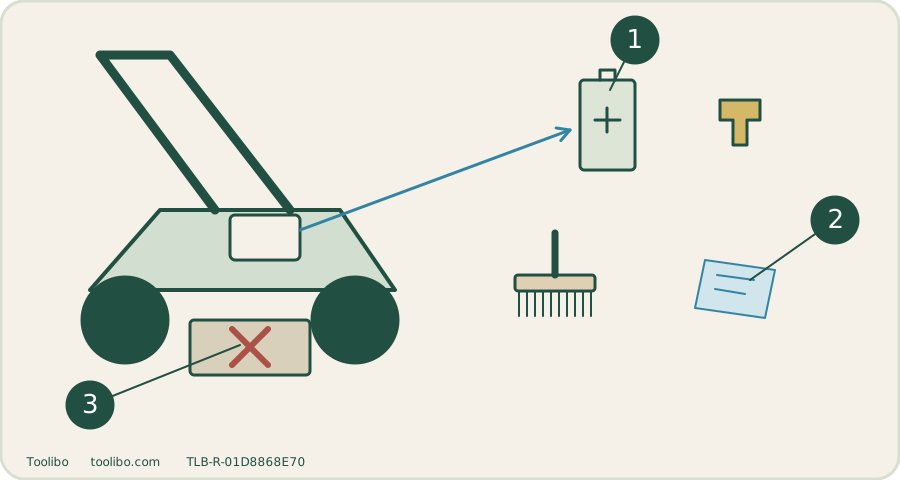
Isolate
Remove fuse key and battery as prescribed.
Zones
Separate dry battery-area tools from slightly damp exterior cloth.
Boundary
Do not reach the blade or improvise tipping.
The underside marker is a scope boundary, not a tipping or blade-service instruction.
Resolve the apparently conflicting advice
A general STIHL UK mower-care article discusses a low-pressure garden hose. The US RMA510 V instruction text is narrower: no pressure washer and no spraying with water or other liquids. For that exact mower, the model-specific restriction controls. Do not borrow permission from a general article or a different petrol mower.
This guide covers accessible exterior care only. It does not explain tipping the mower, reaching the blade, removing guards or working under the deck. Those tasks require the exact model’s positioning and maintenance procedure; a similar-looking mower is not enough evidence.
Prepare the dry-care area
Stop the mower, wait for all movement to cease and follow its isolation instructions. For the named RMA510 V example, remove the fuse key and battery before care. Keep them separately in a safe, dry place so the machine cannot be casually restarted while you work.
Place the mower securely in its normal supported position. Set out a soft brush and separate clean cloths. Keep the pressure washer and garden-hose nozzle out of this stage rather than relying on remembering not to spray certain corners. Wear appropriate protective gloves; isolation does not remove sharp edges.
Clean the accessible exterior by zones
Swipe or scroll horizontally to see all columns.
| Zone | Named RMA510 V care boundary | What to avoid |
|---|---|---|
| Polymer exterior | Slightly damp cloth | Detergents, solvents and liquid spray |
| Accessible loose grass/debris | Gentle external brushing where accessible without entering blade area | Driving debris into openings or removing protective covers |
| Battery housing and guides | Soft brush or soft, dry cloth | Wet cleaning, spraying or opening the battery |
| Underside and blade area | Outside this guide’s verified access scope | Improvised tipping or reaching underneath |
Work from loose debris to remaining surface dirt. Use the brush to lift accessible grass rather than scraping blindly into a seam. Wipe permitted polymer surfaces with a cloth that is only slightly damp, not dripping. Keep the dry cloth for the battery area separate from the damp exterior cloth.
Inspect before considering the job finished
Check that accessible openings are not blocked by displaced grass and that no loose clumps remain where a cover should close. Look for cracked housings, damaged guides, loose parts or evidence of liquid entering an electrical area. Do not force a battery into dirty or damaged guides.
If residue cannot be removed within the permitted exterior method, stop and obtain the model-specific next step or dealer help. A stuck grass clump is not permission to introduce a jet. Do not add a cleaner simply because it is marketed for garden equipment when the exact manual excludes detergents on that part.
Return to use only after the machine is ready
Keep the battery out until cleaning is finished and the relevant parts are dry, intact and correctly assembled according to the manual. If liquid was accidentally sprayed into the mower or battery area, do not reinstall the battery to check whether it still works; seek service guidance.
For another mower, rebuild this same zone list from its own instructions. A documented washout port, if fitted, would need its specific procedure; it does not imply that the entire machine can be pressure-washed. Separating exterior cleaning from blade maintenance is a useful limit, not an incomplete cleaning shortcut.