
The tap and hose end can differ
A cold tap feeds an exposed hose coil under a sun symbol, with a shaded route beside it and a temperature check at the machine-end connection.
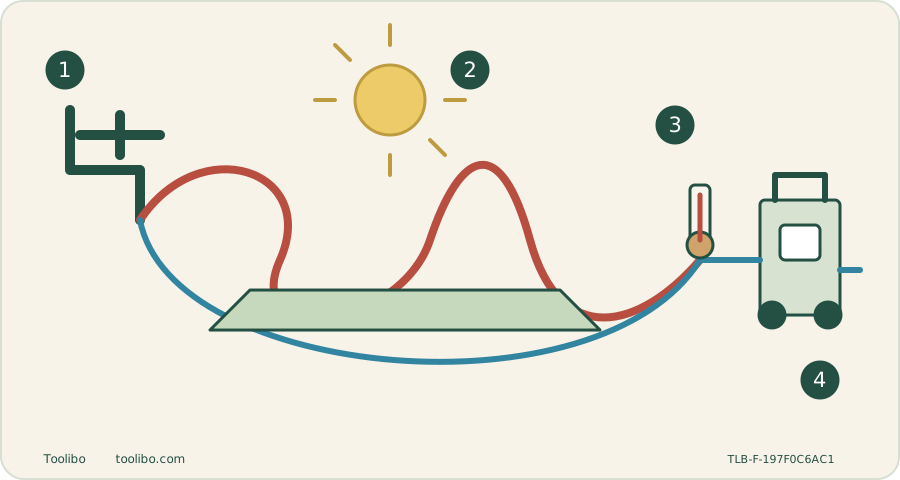
Source
Identify the actual water supply.
Exposure
Check standing water in the hose.
Verify
Establish compliant water at the hose end.
Restart
Use the normal model-specific purge/start.
Verify the water arriving at the washer, not merely the source label.
Distinguish three temperatures
The tap supply, water standing in an outdoor hose and water circulating inside a running pump are different things. A long exposed hose can change the initial inlet condition; a pump left running without spraying can create a separate overheating issue.
SIMPSON’s FAQ identifies sun-heated supply water and excessive bypass time as possible causes of thermal-relief discharge on its machines. That explanation does not mean every electric washer has the same valve or that any water leak is harmless.
Read the limit for the actual washer
The current UK Bosch UniversalAquatak 135 manual gives a 40 °C maximum inlet-water temperature. The checked Kärcher UK K4/K5 Flex manuals also state 40 °C. These are scoped examples, not a universal pressure-washer specification: other machines and professional hot-water equipment can differ.
An accessory may have its own temperature limit, but a higher accessory rating does not raise the machine’s limit. Nor does a cold-water washer become a hot-water machine because the hose and nozzle can tolerate warm water.
Check the supply before connecting or starting
- Inspect the route while the equipment is off. Note hose sections or stored water exposed to strong sun, particularly after the supply has stood unused.
- Verify the exact machine’s inlet limit and the water source. Do not connect a hot tap or water heater as a shortcut to removing grease.
- Where standing hose water may be too warm, keep it out of the washer and clear the supply line safely until suitable water reaches its end. Manage the discharged water without scalding anyone or creating a slippery area.
- If temperature is uncertain, verify it with suitable equipment; do not use your hand as a calibrated thermometer or test with the machine running.
- Once the supply is within the permitted conditions, connect and purge the washer by its normal model-specific method. Temperature suitability does not replace adequate feed flow or a clean inlet filter.
There is no fixed “flush for 30 seconds” rule here. Hose volume, exposure and source conditions vary. The endpoint is suitable water at the actual machine-end connection, not the expiry of an invented timer.
Prevent the condition recurring
Route the supply hose out of direct sun where practical, without creating kinks, trip hazards or a wet electrical connection. If work stops for long enough for the standing supply to warm again, reconsider the inlet condition before restarting.
Do not leave a running machine idle merely because its gun is not spraying. Follow that model’s pause/shutdown instructions. An automatic-stop electric washer and a continuously running petrol unit do not share one generic bypass-time rule.
Interpret an unexpected discharge carefully
Swipe or scroll horizontally to see all columns.
| Observation | Response |
|---|---|
| Hot first water from an exposed supply hose | Keep it out of the washer and establish compliant supply conditions. |
| Water appears at a known thermal-relief valve on a matching model | Stop and follow its instructions; investigate inlet temperature and idle operation without blocking the valve. |
| Leak location is unknown or water emerges from the housing | Stop, isolate and use the leak/service route; do not label it normal cooling. |
| Machine repeatedly stops or behaves abnormally after conditions are corrected | Seek service rather than repeated restart experiments. |
A hot-weather example
A homeowner washes in short sessions while the hose crosses a sunny courtyard. The first session can have a suitable feed, while a later restart has warmer standing water. Checking only at the tap in the morning misses the changed condition at the machine.
The useful improvement is supply planning and a controlled restart, not hotter water, a disabled relief valve or a guessed pressure adjustment. Never obstruct a protective discharge or open a pump to investigate heat.