
Use an approved self-priming supply
Numbered schematic explaining Use an approved self-priming supply.
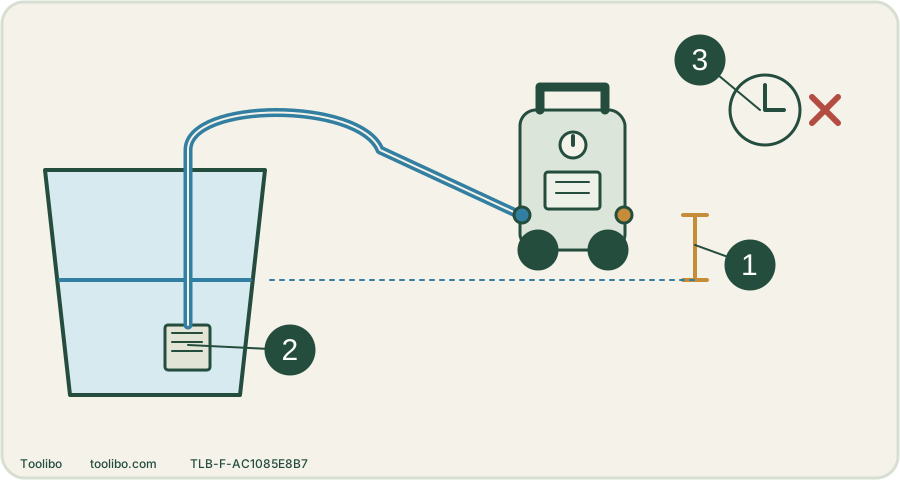
Measure from the water surface
The Bosch example allows up to 0.5 m lift; falling water increases that height difference.
Keep the line filled
Use the specified reinforced hose and submerged strainer with sound airtight seals.
Stop a failed attempt
For this Bosch procedure, stop if steady flow is absent after 25 seconds and correct the cause.
Only use self-priming where the exact model permits it, with its specified kit, lift limit and stop condition. Conceptual schematic, not a product image or scale drawing.
Confirm capability and prepare clean water
Check the exact washer’s manual for alternative-water-source operation. A standard tap hose dropped into a bucket is not automatically a suction kit. For the Bosch UniversalAquatak example, the specified kit has an inlet strainer with non-return valve, a 3 m reinforced hose and the washer coupling. Its function depends on airtight connections and sound, correctly seated seals.
Use a clean container and clean water. Keep grit from the container bottom away from the strainer and leave enough room to maintain submersion. Do not draw chemical mixtures, contaminated floodwater or unknown liquids into the washer. The fitted Bosch inlet filter must also remain clean and in place.
Measure lift from the changing water surface
The UniversalAquatak instructions allow drawing water up to 0.5 m above the source water level. This is a vertical lift limit, not a promise that any 0.5 m-deep bucket works, and not the length of the hose. As the container empties, the water surface drops and the effective lift increases.
Position the washer securely and keep the water level within the permitted arrangement throughout the task. Do not balance a heavy container dangerously to achieve the height. A larger stable water supply may be needed for a long task; stop before the inlet strainer becomes exposed.
Prepare the suction line before starting
With the washer off and isolated for assembly, submerge the specified hose to displace its air. Connect it as instructed while keeping the strainer submerged. Inspect each coupling and seal rather than assuming a lack of visible water leakage proves an airtight suction line.
The matched Bosch manual specifies priming with the lance disconnected, obtaining a steady flow before switching off and fitting the lance and nozzle. After assembly, check that the main switch is OFF, the water source and hose are ready, and the electrical connection is dry and suitable. Reconnect the mains supply, then switch ON to carry out the documented priming attempt with the lance disconnected and the gun/hose arrangement correctly assembled. Start timing at motor start; this is not permission to open a high-pressure joint. Follow the exact gun/hose assembly shown for the machine; do not improvise a powered test with a loose high-pressure connection. Keep the water outlet directed safely and away from people and electrical components.
Use the documented stop condition
For this UniversalAquatak procedure, if steady flow has not been established within 25 seconds, stop and check the connections. This is a model-specific maximum for that priming attempt, not a general allowance to run any pressure washer dry for 25 seconds.
Before another attempt, correct the cause: an unfilled hose, an air leak, an exposed strainer, excessive lift or a restriction. Do not keep resetting the clock without changing anything. If a confirmed correct arrangement still fails, use a supported tap supply or obtain service advice rather than continuing dry attempts.
Watch the water level while cleaning
Once primed, switch off and connect the permitted lance/nozzle safely, then operate using the documented sequence. Watch the container, not just the surface being cleaned. Stop when water approaches the strainer or flow becomes unstable. A tank with a bottom outlet may instead use a gravity-fed procedure: Bosch specifies allowing water to displace air from that supply hose before connecting the washer. Do not mix the two procedures halfway through operation.