
Identify, brush, rinse and compare dry
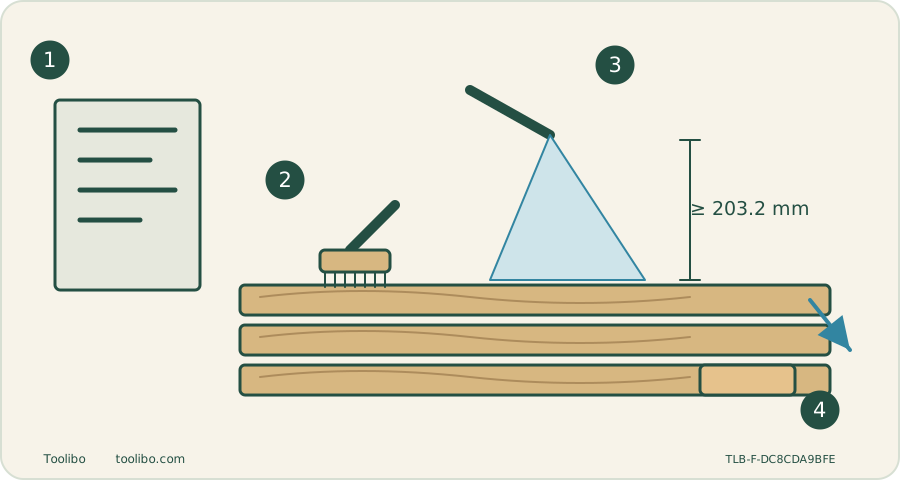
Deck-board geometry shows a soft brush, a downward fan separated from the board by 203.2 mm, runoff and a dry comparison patch.
Identify
Confirm the board family and regional care permission.
Loosen
Use the permitted cleaner and soft brush.
Rinse
Maintain the specified separation and remove dirty water.
Compare
Judge the dry trial before expanding.
The 8-inch minimum belongs to the named Trex example; it is not a generic deck setting.
Identify the installed board
Look for the installation invoice, a spare-board label or the supplier’s product record. Record the brand and family rather than only colour or “composite.” A railing, stair tread and main deck may not share one surface construction. Permission for one does not automatically extend to all three.
The US Trex guidance illustrates why this matters: it provides a pressure-cleaning route for Transcend, Enhance and Select, while its FAQ does not recommend power washing the older Accents, Origins, Brasilia, Profiles and Contours families. These named examples are not a rule for every capped or uncapped board.
If identity is unknown, ask the installer or supplier to establish the product and current regional care instructions. Do not infer the generation from fading or age. Remove loose debris gently while that question is unresolved; postpone unverified chemicals and pressure trials.
Prepare the surface and a comparison area
Move furniture and sweep away loose dirt. Look for lifting edges, loose boards, damaged finish and movement around fixings. Cleaning is not a way to hide or repair those defects. Keep people off the wet work area and plan where rinse water will go before adding cleaner.
Choose a small sound section representing the actual texture and soil. Photograph it dry and retain an adjacent untreated comparison. A whole wet deck can look darker and cleaner even when the method has changed the finish rather than removed dirt. Include an edge or groove only if that part is also covered by the product’s cleaning permission.
Apply the scoped Trex example correctly
For those named US families, the published route uses a washer no greater than 3100 PSI, a fan attachment and soap dispenser, followed by a soft-bristle brush and a thorough fan rinse at least 8 inches (203.2 mm) from the board. This is a ceiling and complete method, not a target pressure for an unidentified deck.
- Confirm that the actual board, cleaner and equipment meet their instructions. Keep the fan clear of damaged areas and unsupported edges.
- Work a manageable section so applied cleaner and dirty water do not dry before rinsing. Use the soft brush to loosen soil instead of increasing force at a stubborn spot.
- Rinse each board completely, moving dirty water away rather than repeatedly pushing it into the next cleaned section. Maintain the specified separation throughout the movement.
- Let the trial dry and compare its texture and colour with the untouched area before extending the method.
No fixed traverse speed is supplied here: soil, texture and the approved equipment differ. The useful endpoint is removal without a changed surface, not a prescribed number of passes.
Read what the dry trial tells you
Swipe or scroll horizontally to see all columns.
| Observation | Next action |
|---|---|
| Loose dirt removed, texture unchanged | Continue the same approved method in small sections. |
| Film appears after water dries | Check incomplete rinsing and dried dirty water; do not immediately increase pressure. |
| A local stain remains but surrounding soil is gone | Identify the stain and use the board maker’s stain-specific route. |
| Roughened texture, exposed layers or changed finish | Stop; document the change and seek product-specific advice. |
Trex specifically warns that dried cleaning water can leave a film. That does not establish that every pale patch is residue: abrasion and pre-existing fading can look similar in a wet comparison. Repeated aggressive passes remove the evidence needed to distinguish them.
Finish with a usable maintenance record
Note the identified family, approved cleaner, attachment, trial location and dry result. Keep photographs showing the same area in similar light. This short record is more useful next season than “the pressure washer worked.”
For example, a homeowner may find one muddy board cleans well while a dark mark under a planter remains. Stop treating that mark as more mud. Check its cause and the board-specific method before doing anything stronger. The goal is a clean, intact deck, not uniform colour at any cost.