
From stopped state to a documented next action
A illustrates OFF and battery removal for the cordless example. B records exact 2526-20 identity and written history. C marks unresolved hazards and questions. D links a documented decision to a conditionally qualified system.
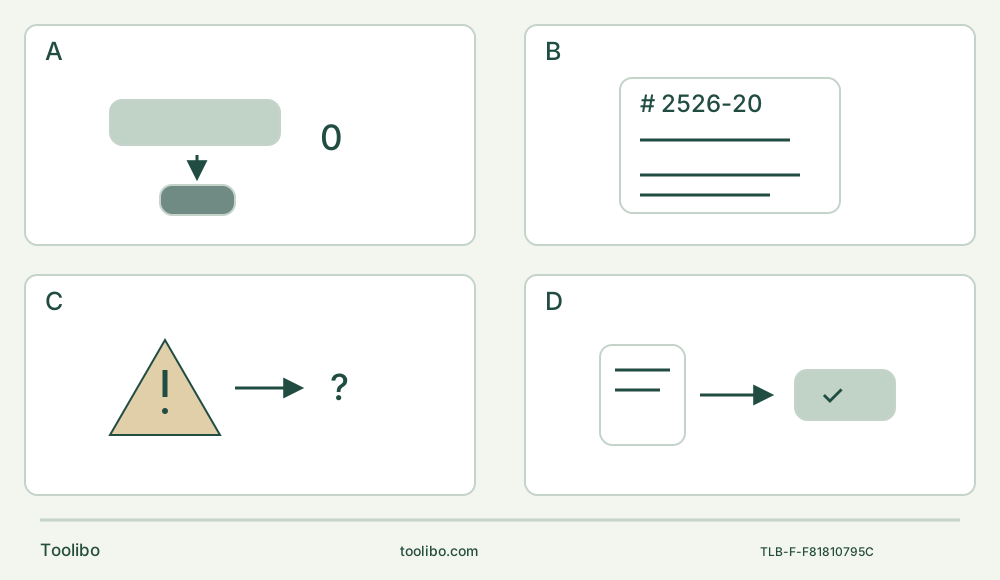
A · Preserve isolation
OFF and complete stop precede battery removal or cord disconnection. Do not reproduce a fault to improve the report.
B · Make the evidence usable
Record actual identity/revision, power items, accessory/material history, observations, prior actions and unresolved questions. Photograph only safely accessible external condition.
C · Ask before intake
Disclose damage, contamination and suspect power items; obtain current qualified intake instructions. Do not improvise hazardous-pack shipping or repair.
D · Record service or complete replacement conditions
A clear service proposal and a separately qualified replacement are different decisions. Retain holds for unresolved parts, power, compatibility or return-to-use requirements.
Original decision schematic, not a repair sequence. A shows the cordless example only; MM35 requires unplugging. C is a warning/hold symbol, not a sanding accessory. D check means requirements have been documented and resolved for the stated next action, not safety certification, warranty approval or permission to ship a damaged pack.
Turn a stopped tool into a useful service case
This guide produces a provider-ready evidence packet and a decision record—not a diagnosis. Its examples are the US Dremel MM35 under its August 2018 instructions and the US Milwaukee 2526-20 under its May 2020 instructions. The MM35 is a corded 120 V system; the 2526-20 uses an already qualified M12 battery and charger. Their different power and service boundaries matter when deciding what information and equipment a provider needs.
Use this route after you have stopped because of damage, abnormal behavior or a problem that has no clearly documented external correction. It is not another no-start experiment. Do not energize a questionable tool, reproduce a jam, probe contacts, open the housing or attempt a battery repair to obtain a more impressive report. If there is active smoke, heat, leakage or other immediate danger, keep people clear and obtain appropriate emergency assistance; ordinary intake preparation must wait until the situation is safe.
A complete outcome is one of three: a clear dossier awaiting qualified assessment, a documented service proposal whose scope you understand, or a separately qualified replacement system. Buying a replacement does not itself make the old equipment safe to handle or dispose of.
Preserve the stopped state
For the MM35, slide backward to OFF, allow complete stop and disconnect from power before handling or inspection. For the 2526-20, slide to OFF, allow complete stop, then press the battery release buttons and pull the pack away. Maintenance also requires its charger unplugged and the battery removed from the charger or tool. Do not handle a hot or damaged pack just to obtain its label; seek the provider’s safe instructions first.
Let ordinary hot accessories cool before touching them and use protective gloves for sharp accessory handling. Put loose sharp parts somewhere protected and inaccessible to children. Do not clean away all evidence before documenting externally visible condition. Equally, do not expose yourself to dust, sharp edges or fluid merely for a photograph.
The MM35 manual says there are no user-serviceable internal parts and directs tool service to a Dremel facility. The 2526-20 manual says not to disassemble the tool, battery or charger and directs repairs to Milwaukee service. A service dossier is not permission to cross those boundaries.
Build a one-page case with supporting photographs
Create a dated record with these fields. Write “unknown” where necessary rather than guessing or powering the tool to fill a blank.
- Identity: exact brand and model, readable nameplate ratings, serial or production information if present, and the region in which the actual product was supplied. Photograph the plate only when safely accessible. Distinguish MM35 from a similar-looking Multi-Max and 2526-20 from another M12 body.
- Instructions: the actual supplied manual identifier or revision and any relevant accessory instructions. For these examples record August 2018 MM35 or May 2020 2526-20 only if they really match the owned body; a downloaded title alone is not proof of the owner’s revision.
- Power items: for MM35, visible cord/plug condition and any extension used, including its marked rating and length if known. Do not electrically test a damaged cord. For M12, record actual pack and charger model identifiers, whether their compatibility was already established, and any externally visible damage. A photograph of a gauge is not a capacity test.
- Accessory and material: exact blade/pad identity and any adapter or original fastener involved, actual material and coating history, known fasteners, and whether the work was loose or installed. Preserve uncertainty about unknown coatings or contamination rather than labeling everything “wood.”
- Chronology: what was happening before the stop, selected setting if remembered, whether the work shifted, and what you observed—sound, vibration, visible damage, light pattern or stopping behavior. State whether an observation happened once or repeatedly during the original event. Do not recreate it now.
- Actions already taken: OFF/isolation, cooling, and any external instruction-based correction previously performed. Include any prior repair or modification you know about. Do not call an improvised fix a manufacturer’s procedure.
- Current condition and question: identify what remains isolated and what you need the provider to establish: safe repairability, correct replacement parts, the scope of examination, or whether the power/accessory system needs separate assessment.
Attach useful external photographs: plate, overall tool, detached accessible accessory and its markings, and the work setup photographed with power removed. A close view should add information, not require opening a guard, housing or pack. Do not send an energized demonstration video. Keep a copy of the packet and your dated proof of purchase if available; neither a receipt nor the packet guarantees warranty coverage.
Ask for intake instructions before sending equipment
Contact the manufacturer’s currently verified service route for the actual region. The old manuals establish service boundaries, but their printed addresses, hours and warranty wording are not a current shipping authorization. Confirm the service case reference and what the provider wants included before transporting or posting anything.
The MM35’s dated warranty section asks for a description of the problem and proof of purchase with the product. It is not a reason to copy an old address into a parcel or include unrelated items. The Milwaukee maintenance instructions discuss the tool, pack and charger as a system for service; do not turn that into permission to mail a damaged lithium battery. Tell the provider which component is suspect and request safe intake instructions, especially for damage, leakage, unusual heat or contamination. This guide supplies no battery packaging, carrier acceptance or disposal procedure.
Ask whether the accessory should remain detached, which power components are needed, what examination is proposed, and how any contaminated or sharp item should be handled. Do not promise the tool is electrically safe because its switch is OFF. If the intake instructions are unclear, keep it isolated and ask for clarification rather than improvise transport.
Separate the service finding from your decision
A useful assessment names the exact unit, the fault or unresolved finding, proposed parts/work, exclusions and what must happen before return to use. Ask for clarification if the proposal says only “repair” while leaving the battery, cord or holder question unanswered. A replaced accessory does not automatically clear a damaged holder; a repaired body does not automatically qualify an unknown charger.
For MM35, the manual’s recommendation for brush service after 50–60 hours is a manufacturer-facility task, not an instruction to open the tool or proof that brushes caused your symptom. For the 2526-20, its periodic service inspection recommendation likewise does not diagnose a specific failure. Record known use history without inventing hours or predicting remaining life.
You may choose a clearly described service proposal after understanding its scope, expected completion and actual quoted cost. This guide sets no repair-versus-purchase percentage, resale value or warranty promise. An incomplete assessment remains a hold even if a headline price looks attractive. Keep the written findings and any return-to-use instructions with the tool.
Before using a serviced system, reconcile the returned model, work performed, accessory/power requirements and provider instructions with the actual manuals. Do not regard a clean exterior, a running motor or a generic “checked” sticker as a substitute for resolving the reported issue. If the fault remains uncertain or the returned system differs from what was assessed, contact the provider before use.
Qualify a replacement as a whole new decision
If repair is unavailable, unsuitable for your needs or declined after a documented proposal, specify the replacement job first. Identify the actual material, required cut or sanding result, workholding, access and dust controls. Then qualify the new exact model’s region, power requirements, permitted accessory and complete operating instructions.
Do not assume an MM35 blade fits a new clamp because both packages say oscillating tool. Do not assume an M12 pack or charger is approved for another body merely because its color or voltage resembles the old one. A new corded tool may need a different electrical rating; a new cordless body may leave you without a qualified battery and charger. Reusing a suspicious accessory or damaged pack transfers the unresolved problem, not value.
Write a short replacement record: exact chosen body and document, actual qualified power system, identified material-approved accessories, required missing items, and which old components are specifically approved for reuse—if any. If an item lacks evidence, mark it pending instead of quietly counting it as reusable. The comparison is between complete qualified systems, not a repair quote and an incomplete bare-tool price.
Keep the old tool clearly out of service until the provider or appropriate local service gives safe disposition instructions. Do not sell it as working, pass on a suspect pack or start dismantling it because a replacement has arrived. The finished dossier should make the next action unambiguous: assessment pending, scoped service accepted, returned system awaiting clarification, or a separately qualified replacement selected. That is a useful decision without pretending to diagnose the machine yourself.
Models referenced