
Interface, power and the non-transferable dial
Three panels show OSL/OSP accepted for both exact bodies and OSM only for GOP55-36, 18 V versus 120 V/60 Hz power prerequisites, and different approximate speeds at dial 2.
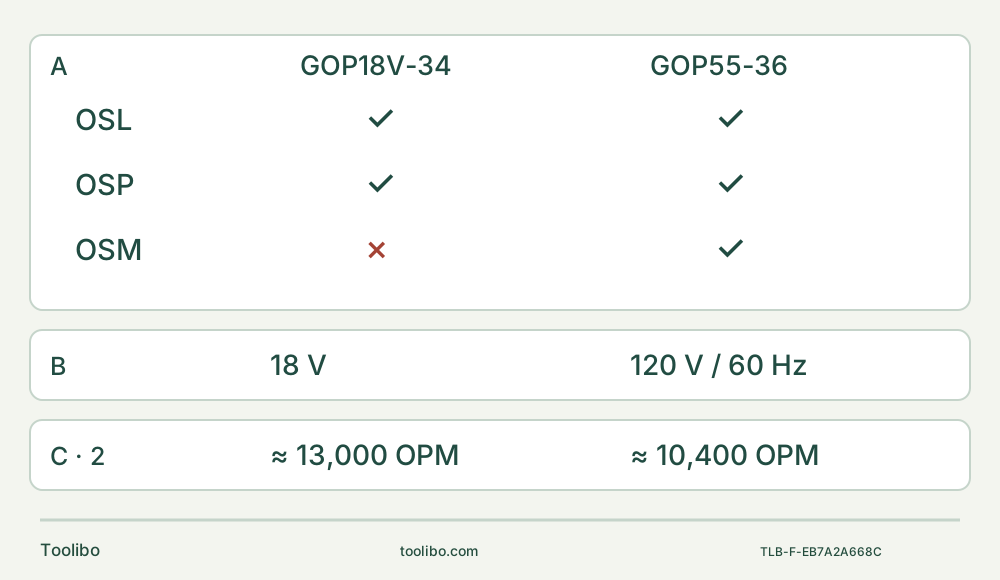
A · Follow the body-specific chart
OSL and OSP are allowed on both; OSM is excluded on GOP18V-34 even when a later general examples table includes an OSM row. Do not adapt around that restriction.
B · Qualify the complete power route
The 34 needs its actual listed approved commissioned cordless system; the US 55 needs the matched 120 V AC/60 Hz supply and safe cord route. A failed power gate leaves the task on hold.
C · Do not transfer dial 2
The 34 table gives approximately 13,000 OPM at 2, the 55 approximately 10,400. Select for the actual accessory and material; both call for controlled medium-speed initial plunge rather than a universal numbered recipe.
Original bounded comparison. Interface checkmarks do not waive the Bosch-only accessory rating of at least 21,000 OPM, exact material approval or workpiece checks. Both dial-2 figures are approximate reference values, not recommended project settings. The power row does not qualify a battery/charger pair or an outlet.
Choose the required accessory before choosing the larger holder
The useful question is not whether StarlockMax sounds more capable. It is whether a particular, identified accessory is necessary for the planned work, and whether the complete tool, power and workpiece setup can support it. This comparison uses two exact US bodies: GOP18V-34 under its March 2023 manual and GOP55-36 under currently hosted manual 2610051957, September 2018. Match actual nameplates and supplied instructions. No present kit, price, cutting-speed test or cross-region equivalence is claimed.
The decision has three possible endings: retain a qualified GOP18V-34 system for an approved OSL/OSP accessory; consider the GOP55-36 when an actually needed OSM accessory and its corded setup are both qualified; or pause because material, accessory, power or access evidence is missing. Owning a larger interface does not close the other gates.
First apply the body-specific interface chart
The GOP18V-34 chart permits Bosch OSL and OSP ranges and excludes OSM. The GOP55-36 column permits all three. Both manuals separately require Bosch accessories rated at least 21,000 oscillations per minute. Their 20,000 maximum running rate does not reduce that accessory requirement, and the common Starlock shape is not blanket permission for any brand or material.
A particularly important trap appears inside the GOP18V-34 document: its later accessory examples include an OSM114 row, although its own body-specific compatibility chart says OSM is not permitted. Do not treat appearance in that general examples table as approval for the 34. The explicit interface restriction remains the selection gate. Do not file, shim or adapt a Max accessory to defeat it.
After the interface gate, read the exact accessory’s material and application row. A metal-capable suffix cannot be silently substituted for a wood blade, and a wood blade’s approved material does not establish its usable reach in your fixture. Sources: GOP18V-34 pages 8, 11–12; GOP55-36 pages 7–8 and 10–11.
Worked choice 1: a small known-softwood sample
Suppose the job is a short, visible straight cut in a clamped, untreated softwood sample with both faces accessible. An identified OSL114 HCS wood plunge blade appears in both matched material tables and falls within both bodies’ permitted interface ranges. Check its actual rating, condition, exposed reach and the full swept clearance around the holder, clamps and waste support.
If that blade can complete the marked path safely, this job has not established a need for OSM or the 55. An existing qualified GOP18V-34 system remains a candidate. A qualified GOP55-36 can also be a candidate, but the Max-compatible holder is not evidence that it will produce a better finish or a faster result on this sample.
If the OSL blade cannot reach safely, stop the selection rather than infer that any Max blade must solve the problem. Identify the alternative accessory and check its actual geometry. Increasing blade reach can also increase the required clearance and make waste support harder. A product’s application description is not a measured capacity guarantee for your fixture.
Worked choice 2: the planned accessory is OSM114
Suppose an existing, correctly identified OSM114 HCS blade is the proposed tool for a known-softwood plunge task. Its matched GOP55 table lists softwood, dowels, tenons and furniture components. This is a material/application basis for considering it, not permission to cut hidden fasteners or installed services.
That accessory rules out the GOP18V-34 branch even though a similar row appears in the 34’s examples. The GOP55-36 passes the interface gate, but remains conditional: the accessory must meet the rating requirement, the complete cut path and backside must be known, the actual working reach must fit, and the stock and waste must remain securely supported. If those checks fail, the outcome is a different documented method or a hold—not forced insertion or a blind deeper cut.
Before acquiring another body solely to use that blade, ask whether an approved OSL/OSP accessory already solves the same complete task. That is an inventory and setup decision, not a claim that different blades perform identically. Avoid purchasing a holder tier to compensate for an unplanned cut.
Power availability can reverse the provisional choice
The GOP18V-34 is an 18 V cordless body. This comparison assumes the owner’s actual battery and charger are already approved under the exact supplied Bosch/AMPShare list and their complete instructions. A bare body or an unverified pack is not a ready system. Keep the switch OFF before insertion, verify secure latching, and physically remove the pack for setup; its two-stage release is not the same as merely sliding the switch back.
The US GOP55-36 requires its matching 120 V AC, 60 Hz supply. A dry workspace with a sound, suitable outlet and a cord route clear of the blade is a prerequisite. If an extension is needed, qualify it separately against the actual nameplate and complete cord table. This comparison supplies no substitute extension recipe and does not use the manual’s low-voltage note to work around a defective supply.
Thus a verified Max blade plus an unsuitable electrical setup still does not produce a usable 55 system. Likewise, no safe mains route does not authorize putting that blade into the cordless 34. Either change the complete accessory/task plan or stop. Power-source convenience cannot override the interface chart.
Similar mounting does not make the controls interchangeable
Both exact bodies use snap-in attachment rather than a separate accessory screw. With the tool OFF and fully stopped, remove the battery from the 34 or unplug the 55. Let hot parts cool and wear protective gloves. Release the old accessory safely, clean the mating surfaces with a clean cloth, face the accessory model marking toward the holder, choose its orientation and press until the jaws snap in. Opening the release lever is not necessary for installation. Check secure engagement while isolated; an uncertain clamp goes to service, not a powered seating test.
The controls then diverge. The GOP18V-34 has an intermediate light-only switch position before the second forward I running position. Fully rearward 0 turns both off. The GOP55-36 uses forward I and rearward 0; the worklight in its shared manual is for GOP40-30 only. Provide separate lighting for the 55 rather than diagnose its absent LED as a fault.
Nor is dial 2 transferable: the 34 table gives approximately 13,000 OPM, while the 55 table gives approximately 10,400. These are reference values, not identical cutting recipes. Select for the actual accessory and material using a secured scrap trial. For initial plunge entry, both matched instructions call for medium speed for control, with an increase possible after the initial cut; neither supplies a universal numbered “medium” for all tasks. Sources: GOP18V-34 pages 9–11 and 16; GOP55-36 pages 8–10 and 15.
Write the decision as a complete system, not a winner
A useful final note names the exact body/document, accessory and approved material, required rating, actual power prerequisites, holding/access plan and stop conditions. For the softwood example, include stable clamping, supported waste, both-hand control, eye/hearing and dust protection, clear vents and the entire blade envelope. Never use the blade to twist around a corner, lever waste or discover hidden services.
After any later qualified trial, stop completely and isolate before inspecting the cut and attachment. Accept only the intended complete cut without shifted stock, uncontrolled damage or unresolved clamp movement; otherwise correct the cause or seek service. Neither holder tier proves sanding readiness: sanding pad identity, extraction and the actual sanding system require their own confirmation, and a sanding-only dust attachment is not saw-blade capture.
Choose the 34 only with an approved OSL/OSP route and qualified cordless system; consider the 55 for a justified OSM route only when the corded setup and whole task also close. When any required evidence is missing, the complete answer is to pause—not to rank the tool by its highest interface tier.
Models referenced