
Two different mounting responsibilities
Two panels contrast Bosch OSL/OSP snap-in with OSM excluded, and Milwaukee 2836-20 M18 battery removal, accessory and threaded bolt with conditional adapter 48-03-2526.
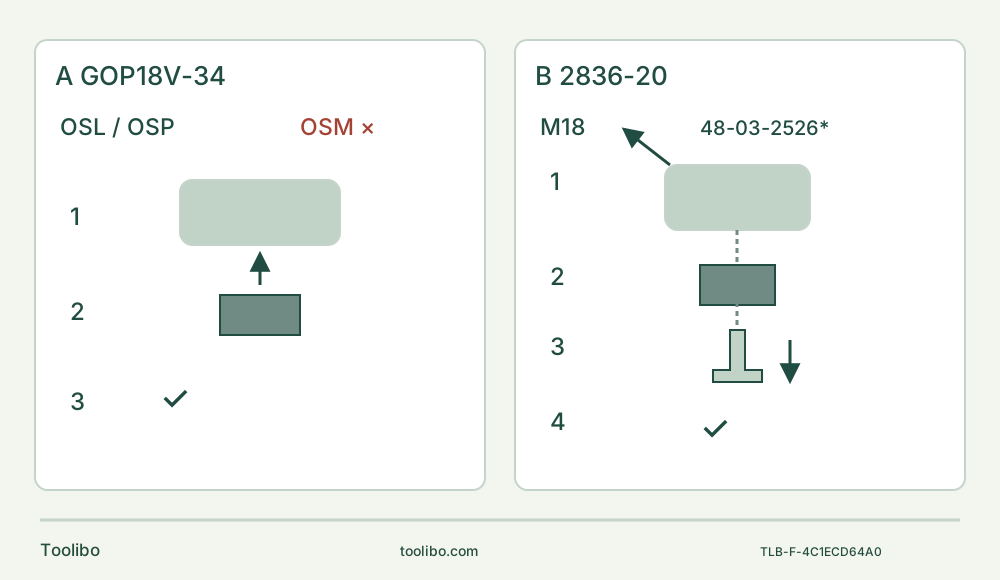
A · Bosch: press in, then verify
Battery out; use Bosch OSL/OSP accessories rated at least 21,000 OPM, not OSM. Orient the model number toward the holder and snap in without opening the release lever; check retention.
B · Milwaukee: the bolt remains essential
Remove M18 power, lift the lever past its detent and unscrew the bolt. Clean, seat the recommended accessory, securely hand-tighten the bolt and return the lever. Resolve any exact adapter requirement before use.
Original schematic. A requires battery removal even though no pack is drawn; the arrow means mating engagement, not permission to touch a powered holder. B shows isolated changeover parts: the downward bolt cue is removal, followed by secure hand-tightening during installation and lever return. The adapter asterisk applies only to the two exact manual profiles, not every blade.
Choose a complete changeover system, not a lever label
The US Bosch GOP18V-34 and Milwaukee 2836-20 both let an owner change accessories without treating every change as a conventional wrench job. Their mechanisms are not interchangeable. Bosch presses onto an approved accessory; Milwaukee still requires a threaded accessory bolt to be securely hand-tightened before the lever returns. Calling both “quick release” hides the step most likely to be missed when moving between them.
This comparison helps select a complete system for alternating between a short clean-softwood cut and a separate small bare-wood sanding sample. It ends with a documented tool/accessory choice, an isolated changeover checklist and acceptance of each sample. It is not a timed changeover test, a buying-price roundup or a claim of universal blade fit.
Use exact US GOP18V-34 instructions 16099221RZ, March 2023, with the matching included battery/charger list, or exact US 2836-20 instructions linked by Milwaukee. These are different power systems: an already commissioned approved Bosch/AMPShare 18 V system on one side and an approved M18 system on the other. Shared nominal voltage is not battery or charger interchangeability. If the actual approved pair and complete power instructions are unavailable, neither route is ready for powered work.
The Bosch route has an explicit but bounded accessory list
The Bosch chart permits OSL and OSP accessory model ranges and excludes OSM. It also requires Bosch accessories rated at least 21,000 OPM. Do not turn “Starlock family” into all StarlockMax blades, all brands or every accessory with a similar-looking centre. Select an identified Bosch wood-cutting accessory appropriate for the sample, then a separately approved sanding pad and sheet for the second task. Material, reach and shape still matter after interface approval.
With the battery completely removed, orient the accessory so its model number faces the holder. Choose the desired working angle and press the oscillating tool into the accessory until the holder jaws snap into it. Do not open the release lever to install. Check secure engagement before restoring power. Removal is different: open the release lever and the accessory is released and ejected. Allow for sharp or hot edges, use protective gloves and keep the release area clear so the blade cannot strike a person or unprotected surface.
This gives a meaningful selection reason for an owner whose documented OSL/OSP cutting and sanding attachments already form a complete system: repeated changes follow a press-in/check and controlled-release sequence without a separate threaded accessory bolt. It does not establish that changes are faster in practice or that retention is better than another system. If the wanted attachment is OSM or lacks the required identity/rating, the Bosch route is rejected for that attachment rather than rescued with a guessed adapter.
The Milwaukee route keeps a threaded-fastener responsibility
For 2836-20, only use accessories specifically recommended for the tool. Remove the battery, lift the quick-release lever and push it firmly forward over its detent. Turn the tool over, unscrew the accessory bolt, remove the old accessory and clean the bolt, flange and mating parts. Place the approved accessory and bolt on the tool, securely hand-tighten, then press the lever back into place. Confirm the accessory is held properly. Closing the lever does not excuse leaving the bolt loose.
The manual notes that an adapter may be necessary when an accessory does not fit snugly and identifies adapter 48-03-2526 for the two illustrated arbor types. That number is not a universal compatibility certificate. Resolve the actual blade, exact illustrated installation profile and manufacturer recommendation before procurement. An unexplained adapter from another kit, a broad “fits oscillating tools” label or a powered wobble check cannot supply missing evidence. Stop and ask Milwaukee if the exact combination is unclear.
This route can be appropriate when the owner already has the correctly identified recommended accessory set and accepts the full bolt-cleaning/hand-tightening sequence at each change. It should be held if the bolt is missing, threads are damaged, the flange does not seat correctly or the lever cannot complete its travel. Do not invent a torque value, substitute a random bolt or modify an accessory to make it appear secure.
Worked choice: a cut followed by sanding
Suppose the job is to shorten a small loose softwood sample and then sand a separate bare-wood face. Make two rows before choosing the body: wood cut and wood sanding. For each, record the exact attachment, mounting evidence, required parts and material-appropriate dust controls. A complete cutting row does not close the sanding row, and a pad’s triangular shape does not prove it shares the other tool’s holder.
If the Bosch OSL/OSP blade and Bosch sanding assembly are positively identified, rated and complete, GOP18V-34 offers a documented two-task path. If a specifically recommended Milwaukee blade/pad combination is complete—including an exact adapter only when required—2836 offers its own path. If the only available blade is OSM, reject it for Bosch; do not automatically approve it for Milwaukee. The Milwaukee recommendation and installation evidence must stand on their own. If either sanding system lacks dust suitability, finish the selection only for the qualified cut and hold sanding.
Count completion items rather than bare bodies: approved battery/charger documentation, sound holder components, both attachments, suitable paper, any required adapter, clamps and dust control. No current kit contents or prices are inferred here. A manufacturer-supported complete existing system may be the sensible choice even when the other mechanism looks simpler. If neither system closes all requirements, the correct outcome is to obtain evidence or missing parts before purchase or use.
Power-state differences change the handoff checklist
Bosch’s slide switch has three meaningful positions: fully back at 0 switches off the tool and worklight; the first forward position lights the worklight only; the second forward position at I runs the tool and light. A lit lamp without oscillation is not battery isolation. For any accessory change, switch fully off and remove the pack completely. Bosch’s secondary battery latch requires the release/slide action again to take the pack all the way out; a partly released pack is not the work state for mounting.
Milwaukee’s switch slides forward to I to run and back to 0 to stop. Its speed dial has positions 1–10 plus A. A selects Auto-Load: the tool begins at 15,000 OPM and rises to 20,000 OPM when load is applied. It is already moving at the lower speed. A is not standby, a trigger, a touch-safe mode or proof the blade will stop when lifted from the work. Always switch off, wait for complete stop and remove the M18 pack for a changeover.
Bosch uses six numbered settings, approximately 10,000, 13,000, 14,000, 16,000, 18,000 and 20,000 OPM. Its feedback aims to maintain the selected speed; its temperature/load protection can reduce speed or shut down. These are not the Milwaukee Auto-Load response. After Bosch automatic shutdown, the manual requires switching off and allowing the battery to cool before restarting. Do not keep cycling the switch or transfer another brand’s protection-reset story. No comparison of sustained cutting power follows from these control descriptions.
Run the samples without turning them into a fit test
Only proceed after the selected combination is already documented and securely assembled with the battery removed. Inspect both faces of clean uncoated stock; exclude concealed fasteners, unknown coatings and hidden services. Clamp it to a stable bench, support waste, keep the whole blade envelope clear and use the exact model’s full safety instructions. Wear appropriate eye/hearing and dust protection; Milwaukee specifies ANSI Z87.1 eye protection. Maintain controlled grip and clear vents, and do not hold the stock in the spare hand.
For the short cut, select an appropriate setting on scrap first. Milwaukee’s cutting instructions call for high speed, full speed before work and moderate pressure; do not treat A as the only approved cutting setting or force a low-load blade into the material to make it accelerate. Bosch emphasizes light contact and progressive passes with the correct accessory. Do not twist or force either blade. Stop if the stock moves, the blade binds or the mount shifts, then isolate before correcting the cause. No deliberately loose accessory or overload experiment is part of selection.
After the cut, switch off and wait for all movement to stop before laying down or inspecting; remove the battery. Accept the sample only if the intended line/size and breakthrough are achieved without uncontrolled tear-out, scorching or support movement. Otherwise reject that result and correct the isolated setup rather than declare one brand inferior.
For sanding, perform the selected body’s full isolated change sequence with its correct backing pad and abrasive. The Bosch manual has a specific brief powered seating step after hand-aligning the sanding sheet against a flat surface to improve adhesion; that is not permission to power-test an uncertain saw-blade clamp. Follow the full matched sanding procedure, suitable extraction and respiratory controls, and keep sanding and cutting instructions separate. Milwaukee describes light pressure and sweeping strokes on clamped work. Inspect the finished sample only after OFF, complete stop and battery removal: seek the intended uniform surface without unwanted rounding, gouging, scorching or shifted stock. Missing dust controls or incomplete pad attachment mean stop, not an improvised trial.
Record the selection and the non-transferable actions
The final choice should name one exact body, approved power system, cutting attachment and sanding setup, plus any unresolved hold. Beside it, record the action that does not transfer: Bosch installs without opening the release lever; Milwaukee requires secure hand-tightening of the accessory bolt before closing its lever. Also record that Bosch light-only and Milwaukee A are not isolation.
Retain the complete owner instructions and keep each system’s parts together. Damaged mounting components, persistent faults, suspect batteries or uncertain accessory identity require manufacturer-qualified help. The successful outcome is a complete supported system and acceptable samples, not a claim that a lever, an adapter number or a shared voltage makes these two tools interchangeable.
Models referenced