
A change record, not a calendar certificate
Four conceptual panels show a prior-use record, physically disconnected supply, separate guard condition and a documented ready-or-hold decision.
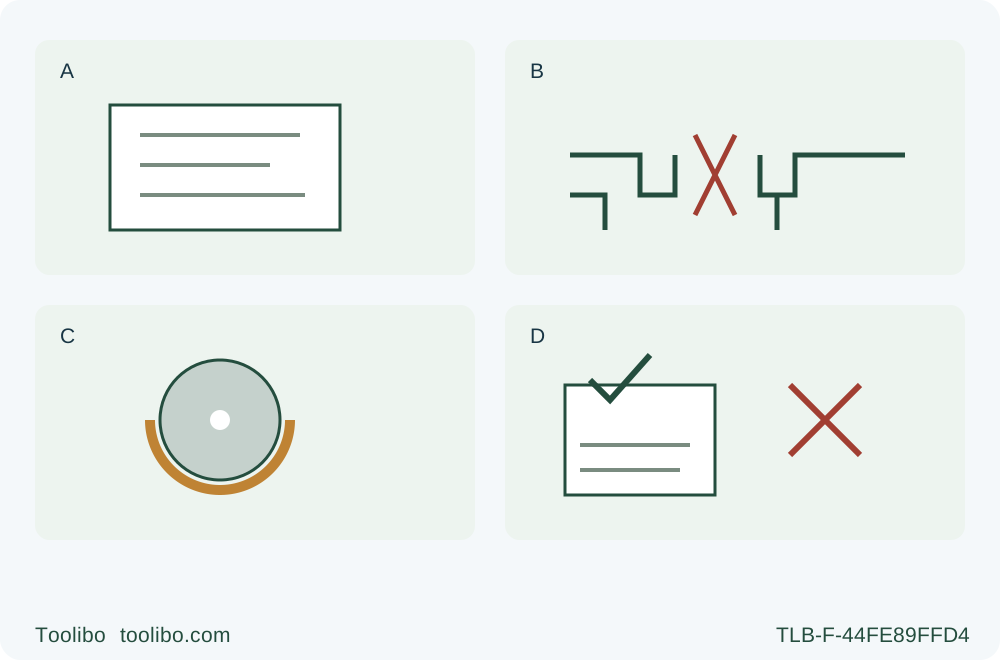
A · Establish the baseline
Compare the known last qualified setup with storage events, other users and unresolved faults; missing evidence remains open.
B · Isolate and inspect supply
Keep the plug disconnected and check the actual cord, plug, outlet and proposed extension route. Damage is not cleared by a powered trial.
C · Check separate conditions
Use the complete unplugged guard check and original-assembly conditions; a passing guard does not clear other damage or unknown parts.
D · Record ready or hold
Only a fully established condition/supply/workspace record admits the saw to its complete owner setup. Record unresolved issues and their next action instead of marking the calendar complete.
The diagram is a decision aid, not a timed maintenance schedule or a mechanical procedure. B uses a neutral disconnected-cord symbol; this corded model has no battery checklist. C is one condition among several, not overall certification. D admits only entry to the complete owner workflow after all prerequisites pass; it does not authorize a live fault test.
A known saw returning from storage needs a different decision from a used-saw purchase or a post-drop investigation: what has changed since its last qualified use, and which parts of the old setup still have evidence behind them? This guide produces a return-to-use record for an existing US Makita 5007MG under manual 884671-946. Its result is either ready to enter the complete supported owner workflow, or held for a named missing prerequisite or qualified service.
“Seasonal” describes the interruption, not a manufacturer-specified service interval. The manual requires checks before use and maintenance of the tool’s condition; it does not prescribe a number of idle months after which a saw is automatically safe or unsafe. This guide organizes those requirements around storage changes. It does not certify a saw, prescribe lubricant or corrosion treatment, or use an energized test to discover whether damaged equipment is safe.
Begin with a known owner baseline
Keep the plug disconnected and under your control. Identify the actual 5007MG, its supplied instructions, original approved wood blade and matched mounting assembly. This is not the 5007MGA: the shared manual’s MGA-only brake and post-brush run-in instructions are not a seasonal procedure for the MG. Do not turn a long idle period into a reason to run it unloaded for ten minutes.
Retrieve whatever reliable record exists from the last use: material cut, blade identity, accepted guide relationship, supply and extension lead, any unusual behavior, and any maintenance referral. An undocumented memory that “it worked last year” is not evidence that a reported fault was corrected. If another person used, repaired or changed the saw, establish what happened before relying on the old record.
Separate three questions. Was the tool known to be serviceable when stored? Was it protected from damaging events while stored? Is the proposed work still within its qualified assembly and current workspace? A yes to one cannot answer the others. A missing blade identity, unresolved prior burning or switch fault, suspected drop, water exposure or unknown modification moves the corresponding issue to hold. Do not disguise a post-impact or unknown-history assessment as routine seasonal preparation.
Record storage changes without inventing a repair
Check the unplugged tool in a dry, well-lit area, using suitable eye protection and keeping fingers away from teeth. Look for damage, missing parts, loose or broken components, binding or misalignment, and contamination that could affect operation. Check accessible cord and plug condition along their length, not only the portion visible beside the handle. The manual requires damaged cords to be replaced and defective tools serviced; this is not permission for a taped repair or plug conversion.
Record what changed in plain observations: a crushed cable section, cracked housing, a base that no longer lies flat, debris around the guard, an unreadable blade marking, or evidence that the tool was wet. Do not label an observed stain as harmless or diagnose electrical insulation by appearance. Drying a suspect tool or wiping it clean is not a documented return-to-service test. Keep it disconnected and seek qualified assessment where damage or ingress cannot be excluded.
The maintenance section includes brush and alignment work, but those are not automatic storage rituals. This existing-assembly guide does not open brush caps, remove the blade, adjust base screws or clean blade deposits with chemicals. If inspection reveals a need outside ordinary documented owner care, refer the exact condition and model to the appropriate Makita service route. A conservative referral is this guide’s boundary; it does not claim every task in the complete manual is forbidden to a qualified owner.
Re-establish moving-part and control conditions
The manual requires the lower guard to move freely and close immediately before each use. With the saw unplugged, use the documented retracting-lever check, opening and releasing the guard while keeping clear of the teeth. Check that the lever does not touch the housing and that the guard does not touch the blade or other parts through all angles and depths of cut. Do not tie the guard open or force a sticky mechanism past resistance.
Sluggish return can arise from damage, deposits or debris, but the observation does not identify the cause. Guard or spring malfunction requires service before use. A clean exterior does not excuse delayed closure. Conversely, an immediately closing guard does not clear a bent base, damaged cord or unknown blade. Mark each condition separately on the return record.
Check that the switch trigger moves properly and returns to OFF while unplugged. A switch that cannot control the tool must be repaired. Do not connect power merely to see whether a suspect switch, guard or cord fails. Check the original blade remains sharp, clean, undamaged and appropriate for the intended wood; damaged teeth, cracks or uncertain installation stop this original-assembly workflow. No sharpening or fitting recipe is supplied.
Return depth and bevel to the settings needed for the new task rather than trusting their stored positions. Do so unplugged under the complete model-specific instructions, then require secure locks and guard clearance. Old zero marks and an old measured straightedge offset do not validate a changed blade, angle, contact edge or damaged base. Any required requalification belongs to the normal complete owner setup, not to an improvised calibration here.
Recheck the supply and workspace as changed systems
A familiar saw may now be connected in a different room, through a longer lead or beside a changed bench. Confirm the actual nameplate supply and an intact matching outlet/plug arrangement. Do not modify the polarized plug. An unsuitable outlet requires the appropriate electrician route, not an adapter or altered blade. The extension table depends on actual amperage, voltage and total length; an old cable is not qualified just because it was used before.
For the manual’s 120 V row above 12 through 16 A, the table specifies 14 AWG at 25 ft and 12 AWG at 50 ft, with 100 and 150 ft not recommended. Apply that example only when the actual electrical conditions match. Outside that row, use the correct complete instructions; do not extrapolate a universal lead length. Check the proposed route for heat, sharp edges, oil, pinch points and interference with the cut.
Confirm the bench or supports have not become loose, damaged or obstructed. A storage box occupying the former outfeed area can invalidate the entire travel plan. Before admission to cutting, there must be stable retained-work clamping, support for both portions outside the blade path, waste free to separate, clear approach and exit, and room for two-hand control without overreach. Do not infer support capacity from appearance or invent a universal overhang allowance.
Review the new material, not only the saw. Use known loose wood suitable for the approved blade, with nails and foreign objects excluded. Unknown coatings, treatment or embedded material require a different assessment. Provide appropriate eye, hearing and respiratory protection, ventilation and the actual documented dust arrangements. Storage in a home workspace does not authorize cutting there when bystanders, ignition sources, dust exposure or inadequate clearance remain unresolved.
Make a complete ready-or-hold record
Use one row per prerequisite: tool and original assembly identity; prior faults and repairs; storage events; cord and switch condition; guard and moving parts; supply and extension; current material; support, guide and dust plan. For each, write the evidence, the result and the next action. “Not checked” is not the same as “acceptable,” and a service referral remains open until the relevant work and instructions are available.
A ready result means every applicable condition is established and the tool may enter its complete normal owner workflow for a suitable task. It is not permission to skip that workflow or a prediction of flawless performance. If changed guide contact, material or layout needs qualification, first use an appropriate supported scrap sample under the complete owner instructions, after—not instead of—all condition checks. Do not use a sample to clear suspected damage.
The first normal cut has its own acceptance: correct geometry and finish, stable guide and supports, controlled cord and base, and no unusual behavior. On binding or interruption release the trigger and hold the saw motionless until complete standstill; never pull a moving blade backward. Normal completion requires trigger release, complete standstill and guard coverage before safe setdown, then unplugging before inspection. An unexpected condition reopens the hold; repeated attempts do not constitute diagnosis.
If any prerequisite remains unresolved, write a specific hold: “cord damage—qualified replacement required,” “unknown blade assembly—identity and installation must be established,” or “new bench lacks exit support—layout must change.” Do not reconnect merely to complete the checklist. Store the unplugged tool safely out of reach of children and untrained users, preserving the record for whoever next handles it. The useful seasonal outcome is a defensible transition from a known past setup to a qualified present one, not an arbitrary calendar tick.
Models referenced