
Inspect the cause after protection intervenes
An unexpected nail and pinched bit show sudden-load causes; the lower scene shows isolation and a stop before any restart.
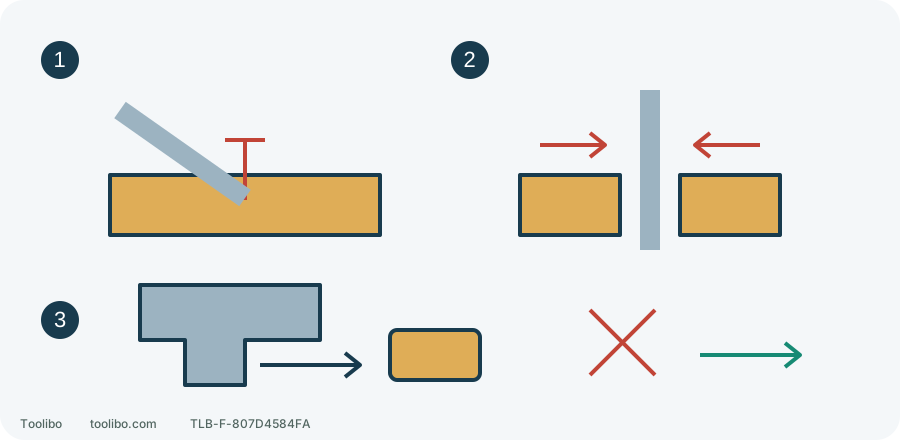
1. Unexpected hard object
Identify it; RFC is not a hidden-object detector.
2. Pinched accessory
Review restraint and axis rather than increasing force.
3. Stop and isolate safely
Keep clear of active battery hazards; only stable equipment gets ordinary removal.
Observed hazards, not tests to perform. The crossed restart path stays closed until the cause is corrected and all normal-use conditions are restored.
What RFC does and does not do
DS18DEX reactive force control is called RFC. When its control detects the relevant reaction, motor output stops to help reduce arm twisting from a sudden tool movement. This is not a promise that every bind will be caught before injury. Some operating conditions may prevent activation; no observed intervention does not establish safe work.
This guide uses the DS18DEX and shared DEX manual C99268561G, not the DS18DDX temperature-flash timing. “Activation” means protection intervening, not an instruction to restart. The purpose is deciding what to inspect and when to stop using the tool, not diagnosing an opened electronic controller.
Prepare without relying on protection
Clamp the work instead of using the other hand to restrain material that can rotate with the bit. Choose an appropriate type, diameter and projection, and check for bending or chipped edges. Use the specified gripping surfaces and any applicable auxiliary-handle arrangement, not the chuck as a reaction grip.
With power isolated, check the intended axis: secure hand positions, balance and an unobstructed withdrawal path. Unknown walls, potentially nailed old timber and unidentified hard objects are not explored by trial drilling with RFC as a detector. Prying, excessive feed and sudden biting can increase load abruptly; reduce those conditions through the setup.
Read the tool light, not the charger
DEX Table 9 groups overload and RFC under the same fast-flash display. That display cannot by itself distinguish them. The following concerns the tool LED, not charger lights or every Metabo HPT model.
Swipe or scroll horizontally to see all columns.
| Table 9 display group | What it establishes | Action |
|---|---|---|
| On 0.1 second, off 0.5 second; flashes about 3 seconds after trigger release | Overload/RFC protection group, not a unique diagnosis | Release; inspect load, binding, moving work or misalignment; no repeated pulses |
| On 0.5 second, off 0.5 second while protection is active | Temperature protection indication | Stop and allow tool and battery to cool thoroughly; also review the heating cause |
| Unclear, unremembered or different indication | Insufficient information | Do not recreate the failure to watch the light; record existing observations and consult service |
About 3 seconds describes the display, not a countdown granting safe restart. An extinguished lamp or a cooler housing does not release a trapped bit or establish that an internal fault is gone.
Follow this order after shutdown
- Release the trigger immediately, stop feeding, maintain safe control and wait for all movement to stop. Do not lever a stalled drill by its housing.
- Smoke, leakage or rapidly worsening abnormal battery heat means keep people clear, not approach for removal. Only with stable equipment safe to approach, remove the battery and keep power isolated for inspection.
- Check the work first: slipped clamp, stock closing onto the hole or an unexpected hard object. Identify the cause before deciding whether the accessory can be freed by an appropriate safe normal method. If safe release is not possible, stop and obtain assistance.
- Check accessory and axis: sideways load, poor chip clearance, damaged edge or unsuitable choice. Overload while in gear 2 may call for gear 1, but only after stopping, isolating and correcting the cause. Low gear is not a cure for every shutdown.
- Look for abnormalities in handles, switch and battery connection. Repeated looseness, damage or inability to stop normally ends use; battery reinsertion must not hide it.
Do not create another sudden bind to distinguish RFC from overload. Existing observations can describe gradually increasing load versus an abrupt bite and twist, but do not replace a service examination.
When restarting can be considered
All conditions must hold: the cause is identified and corrected; tool, accessory and battery show no damage or dangerous symptoms; work is securely held; material, mode and gear are appropriate; tool and battery meet normal temperature requirements; and grip and withdrawal space are restored. Otherwise remain at inspection, not powered trials.
If all are met, complete normal assembly checks. Keep your finger off the trigger while reinstalling and securing the compatible battery, select the correct direction and start from the normal contact position. Do not pull the trigger into a still-trapped accessory to “reset” it. A further shutdown or sudden twist ends the attempt and calls for inspection.
Give service the full model, material, hole and accessory, selected gear, observed lamp behaviour, any sudden bite and external corrections already made. Do not turn a guess into “RFC is definitely broken,” or stage a dangerous demonstration to obtain a video.
Models referenced