
Sensor branding does not clear electrical work
An indication symbol, a crossed outlet exclusion and a separately clamped wood joint distinguish sensor branding from permitted fastening.
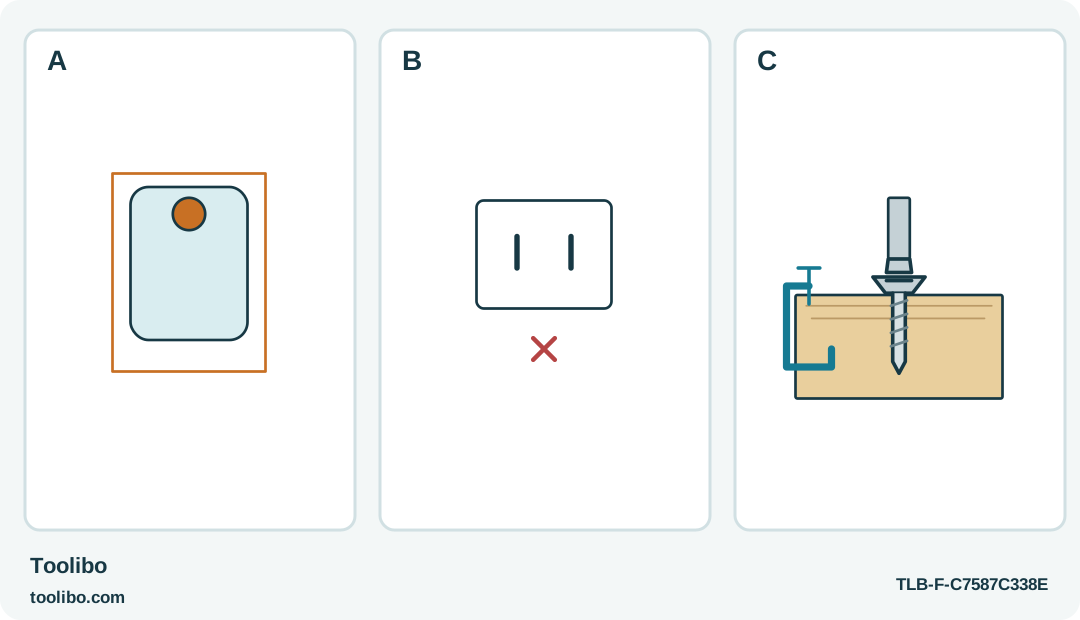
A
A sensor-related indication is not an absence-of-voltage guarantee or authorization to probe a circuit.
B
Do not insert a bit into outlets or electrical contacts. This crossed symbol is an exclusion, not a test procedure.
C
Keep powered SD561201 fastening within its documented softwood and no-larger-than-ST3.5 scope; support the non-electrical work.
The crossed outlet is an exclusion, while the supported wood joint represents a separate permitted task; a sensor indication does not connect the two.
Separate the two functions in your mind
The US SKIL SD561201 is a small powered screwdriver with a Circuit Sensor feature. The presence of that feature can make an electrical fitting look like an obvious place to use the tool. That is precisely where a clear boundary is needed: this household guide does not authorize opening outlets, switches, appliance housings or other electrical equipment.
A screwdriver bit is for engaging a suitable fastener. It is not a probe to insert into an outlet, nor should any part of the tool touch potentially energized circuitry. The sensor’s location on the body does not turn the bit into an approved electrical contact accessory.
For ordinary home use, keep the fastening task independent of electricity. Work on a supported, non-electrical object whose screw and material are known. If the job involves a circuit, concealed wiring or an uncertain electrical condition, stop and use an appropriately qualified person and the proper isolation and testing process.
Do not turn a quiet indication into a guarantee
A feature that responds under specified conditions is not a universal statement about everything nearby. Do not reason that a lack of a signal proves that an object is safe to touch, drill, dismantle or fasten through. The sensor’s operating conditions and limitations remain relevant even when the housing is small and familiar.
Do not experiment by inserting a bit into an outlet or touching a conductor to see whether a warning appears. Such an experiment creates the very contact hazard that needs to be avoided. Likewise, do not use the tool to investigate a damaged cable or a suspected fault inside an appliance.
If a household repair depends on knowing whether electrical energy is absent, that question must be resolved through the appropriate professional procedure. This article deliberately does not provide a step-by-step circuit test, and the screwdriver’s convenience does not reduce the importance of that separate task.
Check whether the fastening itself is within scope
Even on a non-electrical object, choose the screw and material carefully. The SD561201’s powered screwdriving table includes self-tapping screws up to ST3.5 in softwood. Do not stretch that entry into general permission for every particleboard fitting, cam connector or large furniture fastener.
For screws outside the applicable listed powered combinations, the instructions distinguish manual, nonpowered use. That distinction matters when choosing how to assemble a piece of furniture. A motor that can turn a screw does not establish that the combination is included in the tool’s intended powered use.
Follow the furniture’s own fastener requirements as well. Do not replace a specified screw with a smaller one just to fit a tool table, or use a different material solely because it is easier to drive. Change the tool or method when necessary rather than altering the assembly without a sound basis.
Keep the operating controls deliberate
On this model, the forward/reverse collar also starts the motor. Treat it as a start control when positioning the tool or handling the bit, rather than assuming that it is only a direction selector. Keep it untouched while making adjustments and release it to stop.
Use the cinch-lock sleeve to fit the correct compatible bit, then check that the bit is retained. Inspect the screw recess and keep the work supported before choosing a direction. A small driver still needs a straight approach and a clear stopping point.
If the bit slips, the screw binds or the work moves, stop and correct the non-electrical fastening problem. Do not let the presence of an electronic feature distract from the ordinary mechanical checks that determine whether the screw is being driven properly.
Store and explain the tool without misleading others
Keep the exact instructions with the screwdriver, especially in a shared household tool box. Explain that the sensor feature is not a general invitation to repair electrical fittings. A short label identifying the model and its proper accessories is more useful than describing it as a tool that makes electrical work safe.
Have internal tool faults handled through the appropriate authorized service route. Do not open the housing to inspect the sensor or battery, and do not modify the bit to act as a probe. Damaged equipment should be taken out of use rather than tested informally on a live installation.
The practical advantage of this boundary is clarity. Ordinary supported fastening stays an ordinary mechanical task. Electrical safety remains a separate responsibility, handled with the right competence and equipment rather than inferred from one feature on a screwdriver.
Models referenced