
Cool, isolate, wipe dry and separate the battery
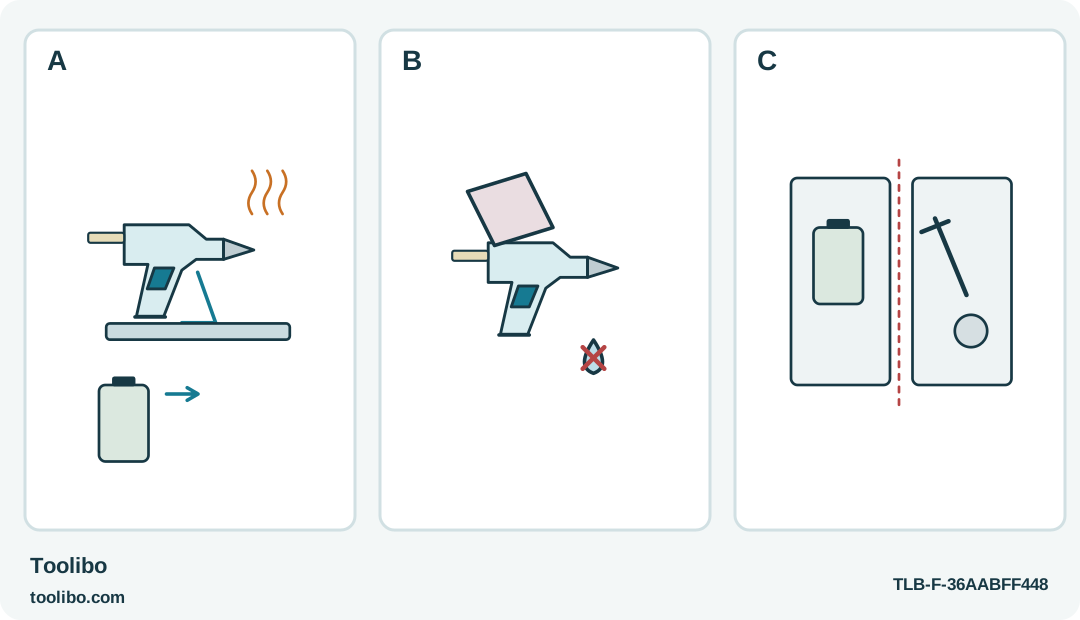
A cooling supported tool with separate battery, dry-cloth exterior care with water excluded, and divided battery/hardware compartments show the storage sequence.
A
Switch off and cool in the proper stable position. Remove the compatible battery before maintenance when handling is safe.
B
WX045L exterior care uses a dry cloth, not water or chemicals; no internal cleaning or forced control movement.
C
Store the pack separately with contacts protected from loose metal. Leave the installed stick in place and keep its packaging identified.
Dry exterior care and separate protected battery storage address different hazards after the tool cools.
Make shutdown a separate step from cleaning
The end of a gluing session is often the untidiest moment: a warm tool, a trailing glue strand, a battery and several small metal parts share the bench. Do not start wiping everything together while the nozzle is still hot. First switch off the North American WORX WX045L and place it upright in its proper stable resting position on a suitable heat-resistant surface.
Keep the nozzle pointed safely away from people and do not lay the gun on its side. Some adhesive may continue to drip while the tool remains hot after use. Protect the surface beneath the nozzle without wrapping or covering the tool, and keep the area clear until it has cooled fully.
This guide is limited to external owner care. The WX045L has no user-serviceable internal parts. A cracked housing, damaged battery connection, smoke or abnormal operation is a reason to stop and obtain service, not an opportunity to remove screws while cleaning. Do not treat unexpected sparking as a harmless feature of a glue gun.
Remove the battery before maintenance
Once safe handling is possible, remove the designated compatible battery using the normal release procedure. The tool must be isolated from its battery before adjustment, servicing or maintenance. Keep your hands away from the nozzle even if the handle feels cool; do not use your fingertip to test the metal tip’s temperature.
Place the removed battery on a clean, dry surface away from the glue residue. Inspect it externally for obvious damage without opening the pack or inserting anything into its contacts. A swollen, cracked, leaking or unusually hot pack should not be charged or reused. Follow the manufacturer’s service and disposal guidance for a damaged battery.
The system’s 20 V Max label corresponds to 18 V nominal voltage; that label alone is not a compatibility test for another pack. Use only a designated compatible battery and its specified charger. Do not connect loose wires, improvised adapters or a different battery simply to see whether the tool will restart after cleaning.
Apply the exact dry-cloth rule
For the WX045L, wipe the external tool with a dry cloth. Do not use water or chemical cleaners. Advice for a different glue gun that permits a damp cloth does not carry over to this model. Keep the grip, accessible control surfaces and exterior openings free of loose dust without pushing debris into the housing.
Work gently around the switch and trigger. Cleaning should not require levering a control, forcing it through hardened glue or introducing a probe into the feed mechanism. If a control remains obstructed after permitted external care, leave the battery out and seek service rather than making the mechanism move by force.
Do not spray cleaner into the nozzle or apply solvent to dissolve adhesive. Do not immerse the housing, rinse the battery interface or use a wet wipe as a convenient substitute for a dry cloth. If a spill has entered the tool, surface dryness does not establish that the inside is safe to energize; stop and obtain proper assessment.
Deal only with accessible hardened residue
Allow adhesive residue to harden before considering removal. The instructions permit a blunt object for excess hardened glue, but that is not permission to dig into the nozzle, feed path, battery connector or housing seams. Keep any external removal gentle and stop if the residue cannot be separated without stressing a tool part.
Do not scrape toward your hand or substitute a sharp blade to make the job quicker. A small harmless external mark is preferable to cutting the housing or damaging a control. Leave the installed stick in its normal position rather than pulling it backward to make the tool look empty.
After the accessible exterior is clean, inspect the resting base, grip and controls again. The gun should sit securely and be comfortable to hold during the next session. Cleaning cannot repair cracks, distorted plastic or an unreliable switch. Note such damage and keep the tool out of use until an appropriate repair decision has been made.
Store the tool and pack as separate items
Store the cooled gun and accessories in a dry place where the nozzle cannot touch vulnerable materials and the rear stick will not be bent by pressure from other tools. Keep the tool protected from accidental knocks without sealing it away while still warm. Store identified adhesive with its packaging so the next session does not begin with an unknown formulation.
Protect the battery terminals from paper clips, coins, keys, screws and other loose metal objects. Do not toss the pack into a mixed hardware drawer. A short circuit between terminals can cause burns or fire, even though the battery is no longer attached to the gun.
Before the next use, check that the tool remains dry and undamaged and that the correct battery seats normally. Repeatedly cleaning an unreliable tool is not maintenance success. A good storage routine ends with a cool, externally clean gun, an isolated protected battery and a clear decision not to reuse anything damaged or abnormal.
Models referenced