
Match surface, formula and complete tool system
A material identity record, a visibly mismatched stick and inlet, and a separate supported material trial show the required compatibility checks.
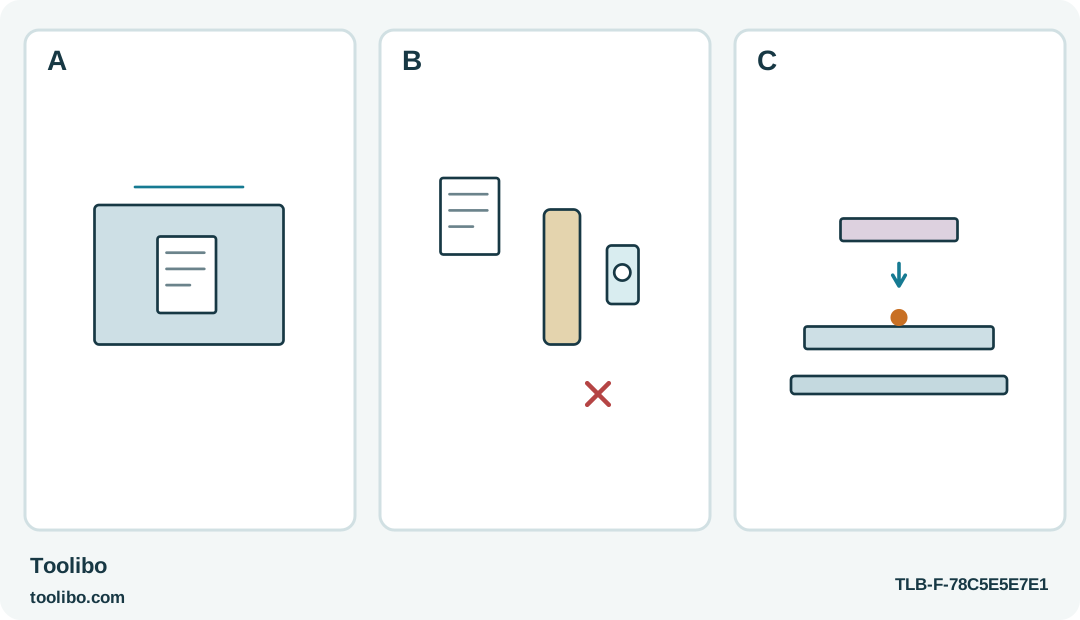
A
Identify the actual polymer and finish from accessible markings and documentation; never burn, heat or solvent-test an unknown plastic.
B
An unrelated formula claim cannot override a tool exclusion. A larger stick beside a smaller inlet is a mismatch, not an adaptation opportunity.
C
Trial only a permitted complete combination on matching supported scrap, then reject heat damage or clean release after cooling.
Material identification and adhesive claims must agree with the complete tool system before a scrap trial is relevant.
Identify the surface you will actually bond
“Plastic” is not a useful compatibility decision by itself. A clear lid, a flexible strip and a rigid decorative panel can be different polymers, with different coatings and different responses to heat. Before selecting a hot-glue stick, identify the actual surface of both pieces. A recycling mark or a material declaration can help, but a label on the main body does not necessarily identify an attached trim or painted layer.
Look for a molded material code in an accessible area without dismantling the object. Compare it with the product’s own material information if available. Write down the identification rather than relying on how the piece feels. If you cannot establish the material, do not use burning, heating or solvent tests to identify it. For a valued object, an unknown surface is enough reason to choose a removable mechanical or nonthermal alternative.
The intended use matters as much as the polymer. This guide concerns small decorative pieces for dry indoor display. It does not cover food containers, pressure vessels, electrical parts, protective equipment or a broken load-bearing plastic component. A compatible adhesive would not, by itself, authorize those repairs.
Keep the tool restriction and formula claim together
The identified Bosch GluePen instructions exclude PE, PP, PTFE, Styrofoam and plasticised PVC. Do not override those exclusions because an unrelated hot-melt product lists one of those materials. A manufacturer can formulate a particular adhesive for a particular application without making that adhesive suitable for every gun or every surface carrying the same polymer name.
For example, STEINEL Universal 050092 is an 11 mm, 190 °C adhesive whose material list includes PE and PP. It is not a 7 mm consumable for the GluePen or the GlueMatic 1007. Its formula claim does not remove the GluePen’s exclusions, and its diameter and processing requirements do not fit the 7 mm GlueMatic 1007 system. Treat it as an example of why the complete combination matters, not as a workaround to load into either tool.
The standard GlueMatic 1007 and the 1007-LT also must not be merged. The standard model is a 170 °C system; the LT requires its dedicated 85 °C sticks. A package saying “low melt” or “universal” is not enough. Match the exact gun, the recommended stick, its processing temperature and the identified substrate before a trial begins.
Trial a permitted combination on matching scrap
- Confirm that neither the tool instructions nor the adhesive information excludes the identified material or intended environment.
- Prepare an offcut with the same surface finish, not just a different piece of the same nominal polymer.
- Remove loose dirt and allow the surface to be dry. Do not introduce flammable solvent residue or sand an unidentified coating.
- Support the scrap on a heatproof silicone mat and establish normal glue flow according to the selected gun’s manual.
- Apply a small amount without resting the nozzle on the plastic, join the pieces promptly and leave them supported until cold.
Inspect both appearance and contact. Look for a shiny melted depression, warping, discoloration or a bead that lifts cleanly away from the surface. A damaged surface is a failed test even if the glue seems to remain attached. An adhesive shell around a part is not proof of bonding to that part.
Do not compensate for a failed test by increasing temperature beyond the tool’s setting, adding more adhesive or scratching aggressively into the plastic. Those changes can damage the object while leaving the underlying compatibility question unanswered. A different adhesive method requires its own instructions and suitability decision.
Decide whether the trial applies to the real object
A scrap test reduces uncertainty; it does not establish a universal bond rating. Check that the real object has the same finish, cleanliness and shape, and that the joint can be assembled as promptly as the trial. A curved piece under bending stress may fail even when two flat scraps stayed together. Dry-fit first and reject a joint that must be forced into position.
Keep the finished decoration away from heat, moisture and repeated flexing unless the exact complete system has appropriate evidence for those conditions. This small household workflow makes no such promise. Inspect the cold joint gently before display, and stop using the attachment if an edge lifts or the surface changes.
Preserve the adhesive packaging alongside the tool so the successful combination can be identified later. Record the material and finish in your project notes rather than labeling all plastics suitable. The useful result is a narrow decision about one permitted tool, formula and surface—not the discovery of a supposedly universal glue.
Models referenced