
Detached use spends stored heat
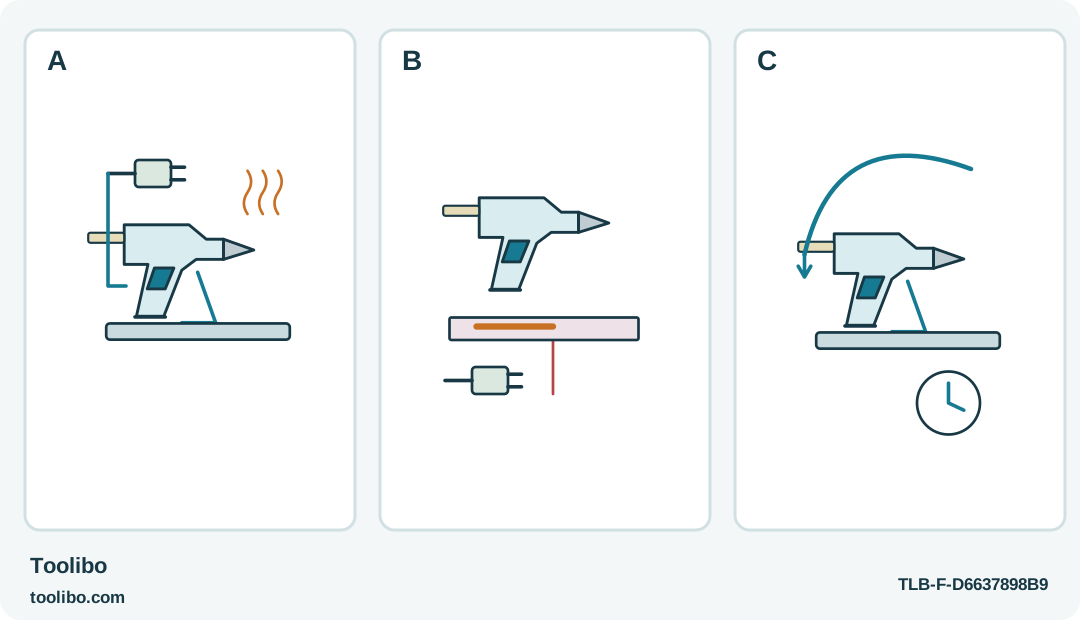
A powered supported gun, a detached-cord application and a short return arc illustrate residual-heat use.
A
Heat the exact 940 normally on its stand with the intact designed cord connection; establish flow on scrap.
B
After designed cord removal, make only a prepared short application. There is no battery maintaining heat away from the supply.
C
Declining flow calls for return to instructed reheating, not stronger trigger pressure. Keep the return and stand clear.
The short trip to the joint uses stored heat, so the return to the powered position remains part of the task.
Choose a job that fits a short working window
A trailing lead can get in the way of a small decorative repair even when the work is close to the bench. The Dremel 940’s detachable cord can help with that final approach, but only for a limited period using stored heat. It is not a battery tool that continues maintaining temperature away from its supply.
Choose a dry, accessible, nonstructural piece that can be prepared and positioned before the cord is removed. The job should be indoors, within easy reach of the protected workstation and free of overhead gluing. Do not take the hot gun around the house looking for something else to fix while its temperature falls.
Inspect the gun, lead, connector and stand before heating. A loose or damaged connection needs attention rather than a careful grip to hold it together. Use the exact 940 arrangement and suitable adhesive; do not transfer detachable-cord instructions to a 930 or another gun whose lead is not designed for removal.
Rehearse the complete repair while cold
Dry-fit the pieces and establish how they will stay aligned as the glue cools. Place any support or positioning guide before heating. A repair that requires one hand to hold a small piece behind the nozzle while the other handles the gun needs a better fixture or a different method.
Keep the mating faces clean, dry and free of loose material. Test the actual surface and adhesive on an appropriate spare sample when possible. A decorative coating can release even if the underlying wood would bond; do not assume a clean-looking finish is a sound bonding layer.
Plan two safe resting locations only if both are necessary and suitable. The simplest arrangement is a short move from the heating position to the nearby joint and back. Ensure there is enough space to set the gun on its kickstand without the hot nozzle approaching paper, a cable or the edge of the table.
Heat the 940 with the proper connection
Connect the rated cord to the gun as intended, then use the correctly matched supply. Switch the 940 on with its own switch and allow it to reach operating temperature. Its indicator identifies the switched-on heating condition; do not treat the first moment of illumination as proof that adhesive is ready to dispense.
Make a modest scrap application to establish normal flow before attempting the repair. Use the approved adhesive size and formulation for the 940, not the smaller sticks associated with the 930. Keep the tool on its stand between preparations rather than resting the heated body on its side.
When everything is ready, disconnect the detachable cord at the designed connection, keeping hands and the lead away from the hot end. Handle the connector, not a pull on the cable. If the connection does not release normally, stop instead of forcing it or carrying the gun with a partly engaged plug.
Apply only while the flow remains normal
The manual describes a limited residual-heat period before reheating is needed. Treat it as a short opportunity, not a guarantee that every joint can be completed until a precise final second. The adhesive, pace of use and actual condition of the tool affect what you observe.
Apply the amount proven by the scrap test, park the gun safely and join the pieces promptly. Keep them supported while the adhesive cools. Do not stretch the session by pressing harder when the output becomes thick or reluctant; declining flow is a reason to stop and return to normal heating.
If the joint is not ready, do not leave a long cooling bead on one face while rearranging the work. Stop, let the unsuccessful sample cool and reconsider the sequence. More pressure on the feed trigger does not replace lost heat or reopen an adhesive surface that has already cooled.
End with normal isolation and cooling
Return the gun safely to its heating position if another short application is genuinely needed, reconnecting only through the intended intact arrangement. Otherwise switch off, disconnect the supply and allow full cooling on the stand. A detached lead alone does not make the nozzle safe to touch.
Inspect the repaired decoration after cooling and during the light handling it will receive. Reject loose, distorted or poorly fitted joints. Do not turn a successful decorative trial into a claim of structural or water-resistant repair. The useful outcome is a controlled short application with less cable interference, not a longer unsupported working radius for a hot tool.
Models referenced