
A wood formula still needs the right mode and fit
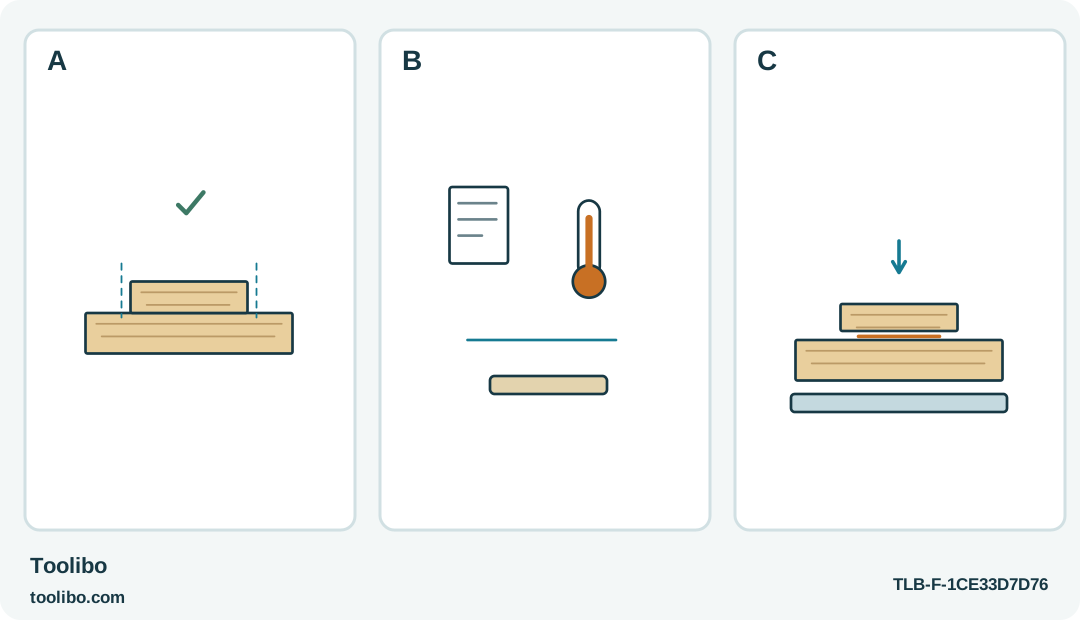
A registered flat wood fit, identified adhesive beside the high-setting symbol and a supported thin-contact assembly show the GG03 workflow.
A
Keep the attachment decorative on an already sound object and establish a flat, unforced fit with matching finish scraps.
B
Identified GG03 belongs with the 930 high 165°C mode, not low mode. Its broader adhesive range does not add another setting to the gun.
C
Apply modestly to one face, park the gun and join promptly; inspect cold without assigning a structural furniture-repair rating.
The GG03 wood formula and 930 high mode support a small decorative attachment only after the actual faces fit.
Keep the wood project decorative
A small wood embellishment on an already sound desk organizer is a different job from repairing a drawer corner or chair joint. This workflow uses an existing Dremel 930 for a light, dry indoor wood craft attachment only. The organizer must remain functional without the added piece, and failure of the decoration must not create a safety problem.
The 930 is a retired model in the identified range. This is guidance for an owner with a correctly identified tool and suitable labeled consumables, not a claim that a new unit or every accessory is currently available. Inspect the cold tool and cord before use; damage belongs with qualified service, not an improvised repair to complete the craft session.
Choose a small piece that lies flat against the receiving wood without spring pressure. Avoid a valuable finish or an unknown coating that cannot be tested on a representative scrap. A glue stick described for wood does not establish compatibility with every varnish, paint or surface treatment applied to wood.
Match GG03 to the 930 high setting
Dremel GG03 is the original 7 mm wood adhesive identified for wooden materials and listed for the 930. The 930 has two settings: low 105 °C and high 165 °C. Use GG03 with the high 165 °C setting, not the low-temperature setting used for compatible decorative sticks. The adhesive product’s broader 165–195 °C operating range does not mean the 930 can be adjusted to 195 °C.
Keep the GG03 packaging with the sticks and confirm that the consumable identity is known. Do not substitute an anonymous 7 mm stick because it resembles the wood adhesive. The shared Dremel accessory table distinguishes formulas and compatible tools; a nominal diameter alone does not establish the temperature choice.
On the 930, plugging into the appropriate supply starts heating. The selector is a temperature control, not an off switch. Prepare the bench and tool stand before connecting power, and remember that switching to low does not turn the gun off at the end. No nozzle replacement or internal adjustment is needed for this project.
Rehearse and trial the actual wood surfaces
- Place the intact organizer on a protected stable bench and dry-fit the embellishment.
- Mark the intended alignment on a hidden edge or with an external reference that remains visible during placement.
- Prepare matching scraps of the wood and its finish. Remove loose dust without using a flammable solvent shortcut.
- Set the 930 on its stand, use the correct high mode and allow the manual’s approximately five-minute heating period.
- Establish normal flow on supported scrap, then make a small trial attachment and leave it undisturbed until cold.
Inspect the trial for a raised gap, a visible stain or a bond that releases from the finish. A successful scrap bond supports only this cosmetic application under comparable conditions. It does not provide a furniture-repair strength rating or prove resistance to water or heat.
If the pieces rock during the dry fit, solve that problem before dispensing. Do not fill a wedge-shaped gap with a large blob and call it a joint. If ordinary trigger pressure does not produce usable flow after the correct heating sequence, stop and check the normal setup without forcing the feed.
Attach once, then leave the joint alone
Apply a modest amount to one contact surface and keep it away from the visible edge. Park the hot 930 on its stand before bringing the embellishment into place. Align promptly at the prepared references and hold through cool accessible areas, with fingers clear of any path for squeeze-out. Do not rest the hot nozzle on the wood to keep a bead liquid while you search for the second piece.
Leave the work supported while it cools. Repeatedly nudging the decoration to check whether it has set can shift the joint and spoil contact. If the glue has cooled before assembly or the piece is visibly crooked, let the attempt cool fully before deciding whether gentle cold rework can preserve the surface. Do not try to rescue it with a flame or by dragging the nozzle over the joint.
After cooling, inspect alignment and gently check normal decorative handling. A lifted edge or moving piece means the attachment is not ready for display. Do not add a surrounding shell of glue to hide that failure. Keep a successful result in a cool, dry indoor location and away from food-contact or child-use purposes.
Unplug the 930 to end the session and let it cool completely on its stand before storage. Preserve the GG03 identity with the tool so the next project does not accidentally use low mode. A useful wood craft bond depends on a sound fit, the correct formula and a controlled small application—not on treating hot glue as a replacement for a structural wood joint.
Models referenced