
Keep adhesive families and residual contents identified
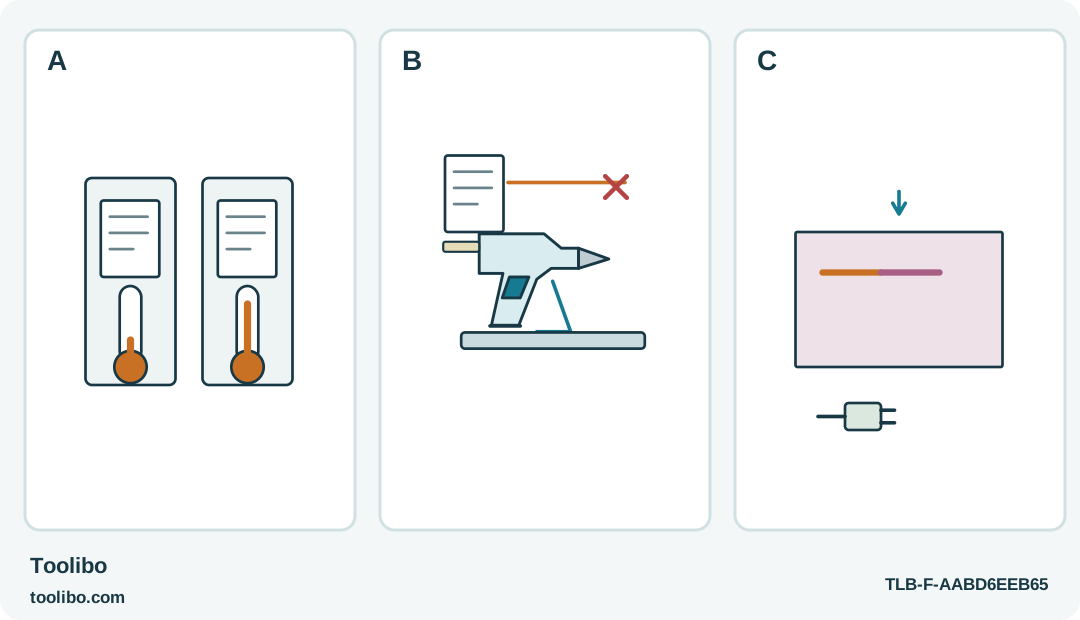
Separate adhesive bins with low/high symbols, a gun beside an uncertain contents record and forward transition output distinguish temperature choice from formula change.
A
930 low mode belongs with its specified low-temperature formulas; high mode belongs with its identified high-temperature formulas.
B
The adhesive already in the tool matters. A selector change cannot identify unknown residue or instantly change its formulation.
C
Use only the documented forward changeover onto protected scrap; never pull backward. Unplug to stop heating—the selector is not off.
Changing a temperature setting does not change the identity of adhesive already left in the gun.
Make the adhesive list before the project list
The Dremel 930 offers a low position marked I and a high position marked II. That does not mean a partially loaded tool can safely be moved between every craft task by flicking the selector. The adhesive already inside matters. Before a mixed session, put the labelled sticks beside the intended materials and decide which combinations belong together.
This is an existing-owner workflow for a sound 930. Keep its 7 mm system separate from the larger 940 system. For the 930, the low setting is 105°C and the high setting is 165°C. Those figures describe the tool settings; they do not certify that every piece of paper, coating or plastic will tolerate contact.
Separate the appropriate low-temperature multipurpose and decorative stock from the high-temperature multipurpose or wood adhesive. In the listed Dremel families, GG02, GG04 and GG05 belong to the low-temperature group, while GG01 and GG03 use the high setting. Do not infer the group from clear appearance or glitter alone when the packaging is missing.
Check the material and the current load
Write down what was last loaded into the gun. If you cannot identify it, do not use an important project as the test. A known stick added behind an unknown remainder does not immediately make the output known. The new material first pushes out what was already in the feed and melting chamber.
Inspect the intended project for heat-sensitive surfaces and for any demand beyond decorative indoor attachment. Food-contact items, safety-critical joints and repairs exposed to water are outside this session. Prepare matching scraps, not just any waste card, so that heat marks and adhesion can be judged before the finished piece is touched.
Make the simplest safe plan: group tasks using the same compatible adhesive together. If a temperature or formula change cannot be completed clearly under the tool and adhesive instructions, use a separately prepared suitable tool or postpone that part. Avoid creating a difficult changeover merely to save a few minutes of setup.
Prepare the selected setting and test
Keep the 930 on its stand, on a protected heat-resistant work area, with the lead routed behind the activity. Check the actual rated supply. The 930 heats when plugged in; its temperature selector is not an off switch. Set the position appropriate to the identified adhesive before beginning that session.
Allow the tool to reach its operating condition before feeding. Use a small application on the matching scrap and inspect it after cooling. For delicate paper, look at the face opposite the adhesive for strike-through or distortion. For an appropriate wooden decorative piece, check that the mating surfaces actually fit rather than expecting glue to fill a large gap.
A clean test includes appearance, positioning and the light handling expected of the finished item. It is not a strength certification. If the sample fails, change the construction or choose another suitable bonding method rather than increasing temperature without checking the adhesive requirements.
Handle a changeover without pulling the stick
The 930 instructions describe forward feeding to empty the melting chamber when changing glue. They do not permit pulling the unused portion backwards. Keep any normal forward discharge on protected scrap, with people clear of the hot output. Do not insert a rod to push the remainder or remove the nozzle to speed the process.
Do not raise the setting while low-temperature colour or glitter adhesive remains simply to make it run faster. Likewise, lowering the selector does not instantly cool the gun or turn high-temperature residue into a low-temperature formula. A change of setting and a change of material are two separate conditions to resolve.
If you cannot establish that the previous material has been cleared through the permitted procedure and that the next adhesive is appropriate, stop the changeover. A second clearly labelled session is better than experimenting on mixed residue. Never treat the first coloured streak or clear drop as proof that the whole internal feed is now a different formulation.
Finish with a record that prevents the next mistake
Unplug the 930 when the work is finished and let it cool completely on its stand. Leave the remaining stick in place. Keep its packaging with the tool or record the exact adhesive family in the storage box, without attaching anything to a hot surface.
Next time, start from that record and a fresh scrap trial. The benefit of the two-temperature gun is a choice between supported adhesive systems, not permission to mix their requirements. A successful session ends with a tidy, suitable joint and a known consumable history, rather than a gun whose contents have become impossible to identify.
Models referenced