
A portable job has three separate limits
Original diagram showing a battery-only vacuum, a short hose work zone and an emptying point, with no mains connection.
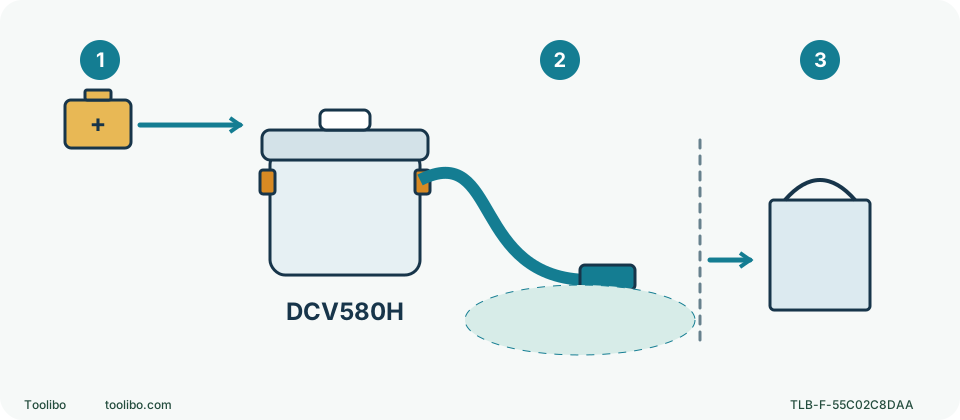
Power
Use the exact approved battery setup.
Reach
Move the stopped body before the hose becomes taut.
Empty
Stop and isolate before handling the tank.
Plan power, reach and emptying separately; this is a workflow schematic, not a dimensional drawing.
Match the label before arranging the job
The US DCV580H is the battery-only member of this compact family. The current product listing points to Type 11 documentation NA130652 and a 20V MAX* lithium-ion supply. A closely named DCV581H has a mains option; this one does not. Do not buy an improvised cord adapter to turn the battery port into that missing feature. Battery and charger are separate purchase decisions, not items to assume are in the bare-tool box.
For a used machine, write down the complete model and type from its own label before ordering anything. A web photograph of the same yellow body is insufficient evidence that an older pack or filter belongs on it. This guide matches the manufacturer’s current product-linked manual; it does not claim that every older revision or second-hand configuration has been inspected.
Make the cleanup smaller than the machine’s limits
A useful first task is a known, permitted patch of ordinary household debris in one accessible area. Remove valuables and anything that should not enter the nozzle. Establish the material before starting: a compact wet/dry vacuum is not a means of identifying unknown renovation powder. Keep fuel, solvents, hot particles and hazardous material out of the task entirely.
Sketch the order of work: park the machine, clean the nearest accessible area, stop, move it, then continue. This is different from stretching a hose across the whole room. The listed hose is 5 ft long and 1-1/4 in in diameter. Its reach is a planning limit, not a lifting strap. Leave slack for the nozzle movement and move the switched-off machine before the hose pulls the body toward an edge.
Prepare the body, filter and power separately
With the switch off and battery removed, inspect the accessible hose, collection tank, latches and filter seating. The matched manual keeps the wet/dry filter installed for both collection modes. Do not import a different brand’s instruction to remove its dry cartridge before water pickup. An absent or damaged filter is a reason to correct the setup, not to try a brief test without it.
Choose the supplied crevice tool or wide nozzle to match access, rather than forcing the wider mouth into a narrow gap. Close the head securely before fitting the approved battery. Check that the battery is seated without forcing a latch. If the pack or tool is damaged, wet or unusually hot, stop and follow its instructions instead of repeatedly reseating it.
Swipe or scroll horizontally to see all columns.
| Before starting | Practical check | If it is not right |
|---|---|---|
| Identity | DCV580H and actual type match the instructions | Resolve the revision first |
| Collection path | Tank, filter, hose and nozzle are sound | Replace the correct damaged part |
| Movement | Hose remains slack through the planned reach | Reposition the machine |
| Power | Suitable charged battery is securely fitted | Use the matched battery/charger instructions |
Change tasks without making a muddy mixture
The 2-gallon description is a nominal tank specification, not a measured amount this guide promises you can recover before stopping. For a small, clean-water task already within the manual’s limits, empty dry contents first. Keep the machine upright and electrical parts dry. Decide where the collected water can be disposed of before beginning; never carry a running vacuum to the emptying point.
If pickup suddenly falls and the motor sound changes, stop rather than squeezing more liquid into the tank. A suction cutoff does not tell you that the motor or battery is electrically isolated. Switch off, remove the battery and inspect the cause. After a tip, restore the upright position only once stopped; persistent abnormal behavior belongs with service, not repeated tilt-and-restart experiments.
Close the session with a useful record
Empty and clean the permitted collection materials, inspect the filter and leave cleaned components suitably dry before storage. Do not put a wet tool into a sealed storage box and assume the battery compartment makes it weatherproof. Store accessories where they cannot crush or kink the hose.
Record what stopped the session: full collection space, loaded filter, inaccessible reach or depleted battery. These call for different changes next time. More batteries do not cure a blocked nozzle; a larger tank does not justify unsafe lifting. This model suits small dispersed tasks when its documented configuration is adequate. Repeated long sessions or bulk recovery may need a different machine and work plan, not a forced conversion of this one.
Models referenced