
Garage-door cleaning boundaries
Amarr and Clopay guidance excludes pressure washing; separate panel, glazing, seals and adjacent driveway work.
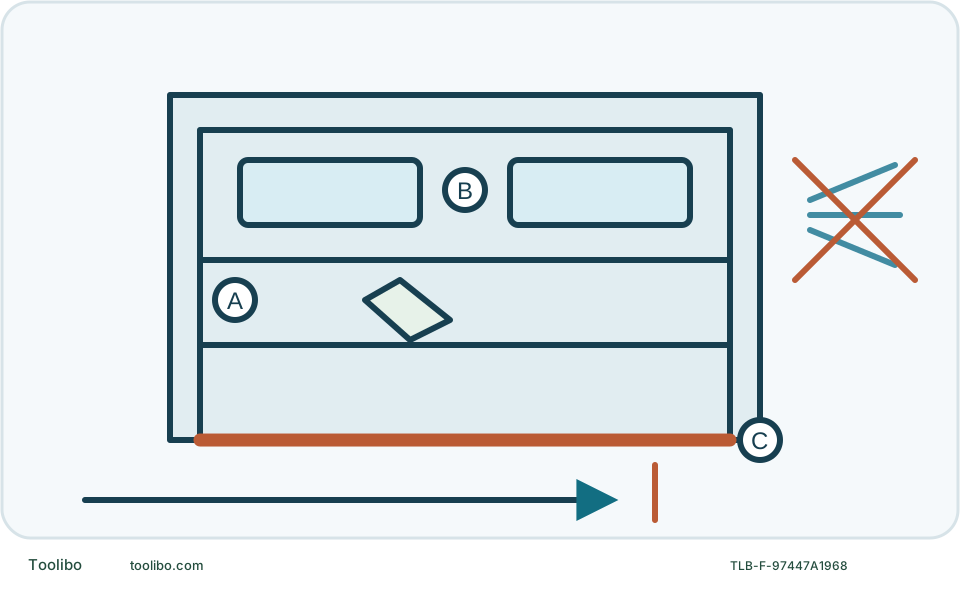
Door
Follow its care instructions; no pressure-washer experiment.
Window
Identify the glazing and use its separate approved method.
Driveway
Keep adjacent spray and runoff away from the door and electrics.
A low setting cannot override a door maker’s no-pressure-washing instruction.
The useful tool decision is often not to use the washer
A garage door is not simply another flat painted wall. It combines a finish, panel joints, perimeter seals, windows and moving hardware, often near an electric opener and safety sensors. Before selecting a nozzle, identify the door maker, material and finish. Amarr’s care guidance says not to pressure wash its garage doors; Clopay’s washing guidance also excludes a power washer. A pressure-washer product page that mentions general outdoor cleaning does not override those instructions.
That boundary remains in place even if the washer has a lower setting. For example, Core 125’s Gentle PR adjustment or Core 140’s PowerControl levels do not provide a manufacturer-approved garage-door method. A wide fan is still a pressure-washer jet. Where the door instructions say no, do not try to find a supposedly safe bar value or distance by experimenting on the door.
Identify which cleaning instructions belong to which component
Swipe or scroll horizontally to see all columns.
| Component | What to establish before cleaning | Do not assume |
|---|---|---|
| Painted steel or aluminium panel | Exact finish and maker’s wash method | All detergents or waxes are suitable |
| Wood or overlay | Finish condition and approved care | A hard-looking overlay tolerates a rotary nozzle |
| Window | Glass, acrylic, polycarbonate or special finish | Panel cleaner and brush are safe on glazing |
| Seals and joints | Intact condition and permitted hand-cleaning access | Pressure is needed to clean behind a seal |
| Hardware and opener area | Owner-care boundary in the door instructions | Cleaning authorizes adjustment or repair |
Clopay’s component-specific guidance is particularly useful: its polycarbonate-window instructions call for a soft sponge or cloth and do not allow brushing or scrubbing. That differs from the soft-bristle option described for some door finishes. The lesson is not to memorize one universal recipe, but to keep the window and panel instructions separate.
A low-energy cleaning plan
- Locate the actual door care instructions and inspect the finish while dry. Photograph existing chips, rust, cracks or lifted edges so that cleaning does not get mistaken for a repair assessment.
- Keep the door stationary and prevent unexpected operation according to its own instructions. Arrange access from stable ground. Do not improvise work around a moving door, touch springs or disconnect tensioned cables.
- Remove loose surface dirt with the maker-approved soft implement. Use only the cleaning solution and dilution permitted for the specific finish. Do not copy a detergent recipe from a different door series or mix cleaners with bleach.
- Work on a small inconspicuous panel area first, using gentle contact rather than concentrated spray. Watch for colour transfer, gloss change or softening. Stop if the test changes the finish.
- Follow the maker’s permitted rinse method with clean water. For the Clopay general washing method, this is a light garden-hose rinse, not a pressure washer with a different nozzle. Keep water away from electrical components and avoid forcing it into openings.
- Use the separate glazing method on windows. Finish with the approved drying procedure and check for water entering the garage before declaring the job complete.
This sequence is a planning checklist, not a replacement for model-specific care instructions. It intentionally does not give a universal wax, solvent, bleach concentration or stain-removal treatment. Special finishes and glazing can have exceptions that make a generic recipe inappropriate.
Keep adjacent driveway cleaning a separate job
The fact that you decide not to pressure wash the door does not require abandoning an otherwise suitable driveway task. It does require a separate layout. Move the washer, hose and test area so that the jet and splash do not target the door, threshold, sensors or nearby sockets. Do not sweep the spray upward at the end of a paving pass.
If the only way to clean the strip next to the door is to spray directly into the bottom seal, stop the pressure-washer work short of that strip and hand-clean it using an approved method. A cleaner-looking threshold is not worth forcing contaminated water indoors. Keep a safe escape route; do not stand inside the garage spraying outward through a closing-door path.
Recognize when cleaning is no longer the task
Persistent chalking, rust, peeling, cracked glazing, a displaced seal or water entering behind a panel calls for assessment of the door or finish. Extra pressure can remove more material without fixing the cause. Ask the door maker or a qualified door professional which repair or refinishing process applies.
If the door binds, moves unexpectedly, has damaged cables or shows a spring problem, stop and use professional service. Do not adjust tracks, springs, brackets or safety devices as part of a washing article. Cleaning dirt off a surface does not establish that a moving door is mechanically safe.
Before putting away the washer used on the driveway, switch it off, unplug safely, shut off water and release pressure according to its own manual. Store the door-care supplies separately from pressure-washer chemicals so the next session starts with the right method rather than the nearest bottle.
Models referenced